For a commercial driver, a failed drug or alcohol test is a career-halting event. Suddenly, you are pulled from safety-sensitive duties, your income is at risk, and you are facing a mandatory Return-to-Duty (RTD) process. In the rush to get back behind the wheel, many drivers turn to the internet for solutions. This leads to one of the most critical questions in the industry right now: Is an online DOT SAP program accepted in all 50 states?
The answer is not a simple “yes” or “no.” It involves navigating federal regulations, understanding the difference between “online programs” and “remote assessments,” and knowing exactly what the Federal Motor Carrier Safety Administration (FMCSA) demands. Misunderstanding these rules can result in wasted money, rejected assessments, and a prolonged suspension from driving.
This guide breaks down exactly how the Department of Transportation (DOT) views virtual SAP services and what you need to do to ensure your return-to-duty process is valid, legal, and accepted nationwide.
What is a DOT SAP Program?
Before diving into the format (online vs. in-person), it is crucial to understand the function of the Substance Abuse Professional (SAP).
Under DOT regulations (49 CFR Part 40), any employee performing safety-sensitive duties who violates drug and alcohol rules must be removed from duty immediately. They cannot return until they complete the Return-to-Duty process (The Steps of the Return-to-Duty Process Explained). The SAP is the gatekeeper of this process.
The SAP’s role includes:
- Conducting an initial face-to-face assessment of the driver.
- Recommending education and/or treatment.
- Monitoring the driver’s progress.
- Conducting a follow-up face-to-face evaluation to determine if the driver has successfully complied with the recommendations.
Only when the SAP signs off can the driver take a return-to-duty drug test and potentially resume working.
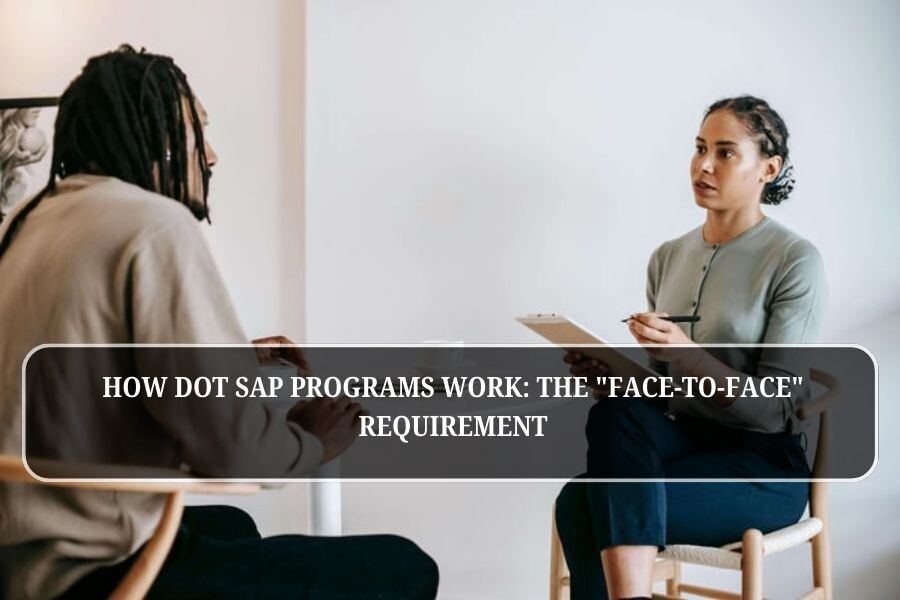
How DOT SAP Programs Work: The “Face-to-Face” Requirement
Historically, the DOT has strictly required that SAP assessments be conducted face-to-face. This means the driver and the SAP must be in the same physical room.
The reasoning is simple: SAPs need to observe physical cues, body language, and other indicators that might be missed over a phone call or a text-based chat. For years, “online” programs that promised instant certification via a questionnaire were scams, and the DOT rejected them outright.
The Shift to Remote Assessments
However, the landscape shifted significantly during the COVID-19 pandemic. The DOT issued guidance allowing for remote assessments under specific conditions, primarily using video conferencing technology (like Zoom or Skype) where the SAP and driver can see each other in real-time.
Crucial Distinction: There is a massive difference between a remote video assessment conducted by a certified SAP and a purely “online course” that you click through at your own pace without human interaction.
Current FMCSA Rules on Virtual SAP Formats
As of 2026, the FMCSA and DOT regulations still prioritize face-to-face interaction, but they acknowledge the validity of technology-assisted assessments if they meet specific criteria.
Accepted:
- In-Person Assessments: The gold standard.
- Video Conferencing: Real-time, two-way video and audio where the SAP can clearly see the driver. This is often accepted as “face-to-face” equivalent provided the technology is reliable.
NOT Accepted:
- Phone-only interviews: Audio alone is insufficient.
- Self-paced online courses: You cannot simply watch videos and take a quiz to satisfy the SAP requirement.
- Email or chat-based evaluations.
Is an Online DOT SAP Program Accepted in All 50 States?
If by “online program” you mean a video-based assessment conducted by a qualified SAP, then yes, this is generally accepted across all 50 states, provided the SAP holds the proper licensure for the jurisdiction where the assessment takes place (or where the driver is located, depending on state licensing board rules).
Federal law (DOT regulations) supersedes state law regarding transportation safety. Since the DOT program is federal, a compliant return-to-duty process is valid nationwide.
However, there are nuances:
1. State Licensing Board Restrictions
While the DOT allows flexibility, the SAP must be a licensed professional (e.g., Licensed Clinical Social Worker, Licensed Psychologist, etc.). Some state licensing boards have strict rules about “telehealth.” A SAP licensed only in Florida may not legally be allowed to conduct a telehealth session with a driver sitting in California.
- The Risk: If the SAP operates outside their licensing jurisdiction, the assessment could be challenged not just by the DOT, but by state medical boards.
2. Employer Policies
An employer is federally required to accept a valid return-to-duty plan, but they may have internal company policies that are stricter than the DOT minimums. Some major carriers may prefer or require in-person assessments to limit their liability.
3. The “Online Course” Trap
If you find a website offering a “$99 Instant SAP Certificate” that involves clicking through slides, that is not accepted in any of the 50 states. Using such a service will result in your Clearinghouse status remaining “Prohibited.”
Legal and Compliance Implications
For CDL Holders, choosing the wrong program has severe consequences:
- Loss of Time and Money: You will pay for a service that the DOT rejects, and you will have to pay again for a real SAP.
- Career Stagnation: Your violation remains in the FMCSA Drug and Alcohol Clearinghouse until you complete a valid program.
- Audit Risks: If you return to work based on an invalid assessment, and a subsequent audit catches it, you will be pulled from duty immediately, and your miles driven during that period could be considered illegal.
For Employers:
- Accepting an invalid SAP evaluation exposes your company to massive liability in the event of an accident.
- Learn more about Who Pays for the SAP Program? Employer vs. Driver and ensure your policies are clear and compliant.
- You must verify that the SAP is qualified and that the assessment met the “face-to-face” (or valid video equivalent) requirement.
Actionable Steps for Compliance
If you need a SAP, follow these steps to ensure your online/remote assessment is valid:
- Verify Credentials: Ensure the SAP is listed on a reputable provider network and holds a valid license (LCSW, LMFT, MD, etc.).
- Confirm Video Capabilities: Ask explicitly: “Will we be doing this via secure video conference?” If they say “phone only” or “just fill out this form,” hang up.
- Check Cross-State Licensing: If you are in a different state than the SAP, ask them if they are licensed to provide telehealth services in your specific state.
- Check the Clearinghouse: Ensure the SAP is registered in the FMCSA Clearinghouse. For a detailed guide, see How to Register for the FMCSA Clearinghouse. They must be able to report your progress directly to the federal database.
FAQs: Common Questions About Online SAP Acceptance
Q: Can I do my SAP education classes online?
A: Yes. The education or treatment recommended by the SAP can often be completed via online courses or virtual counseling, depending on what the SAP prescribes. However, the initial assessment and follow-up evaluation must be face-to-face or valid video conference.
Q: Does the DOT Clearinghouse know if I did my assessment online?
A: The Clearinghouse records that an assessment occurred. It does not flag “video vs. in-person.” However, if an audit reveals the SAP did not follow 49 CFR Part 40 procedures (e.g., used phone only), the process is void.
Q: Why do some SAPs refuse to do video assessments?
A: Some SAPs believe they cannot adequately assess a driver’s honesty or physical symptoms of addiction through a screen. It is their professional prerogative to require in-person visits.
Conclusion
So, is an Online DOT SAP program accepted in all 50 states?
The answer is Yes—but only if “online” means a synchronous, face-to-face video assessment with a licensed professional.
Automated courses, phone calls, and email assessments are never accepted. While the federal DOT guidelines allow for video assessments nationwide, you must ensure the SAP you choose is licensed to practice in your state to avoid technicalities that could stall your return to the road.
Don’t gamble with your CDL. Ensure your SAP utilizes compliant video technology and holds valid credentials.
Call to Action:
Are you a driver needing to get back on the road, or an employer navigating complex compliance rules? Contact a certified DOT SAP provider today to schedule a compliant, convenient assessment that protects your career and your company.
Key Takeaways: Online SAP Acceptance by State
Feature | Acceptance Status | Notes |
|---|---|---|
Federal Acceptance | Accepted (Conditional) | DOT allows video assessments that simulate face-to-face interaction. |
All 50 States | Accepted | Valid nationwide if the SAP follows federal rules. |
Cross-State Service | Varies by License | A SAP must be licensed to treat patients in the state where the driver is located. |
Self-Paced Courses | REJECTED | “Click-through” courses are scams and not accepted in any state. |
Phone-Only | REJECTED | Audio-only does not meet the “face-to-face” requirement. |