October 2025 - Page 2 of 5 - AACS Counseling

Domestic Violence Assessment in Georgia: What You Need to Know

Introduction

If you are involved in a legal matter related to domestic violence in Georgia, a domestic violence assessment may be a critical part of the process. Whether you’re facing a criminal charge, involved in a family law dispute, or complying with a court order, understanding what to expect from this evaluation can help you navigate the legal and emotional challenges ahead.

In Georgia, courts may order domestic violence assessments for a variety of reasons, including to determine the level of risk, assess treatment needs, or guide sentencing or custody decisions. This article will explain everything you need to know about domestic violence assessments in Georgia, the evaluation process, and how AACS Counseling can support you with professional, court-accepted reports.

What Is a Domestic Violence Assessment?

A domestic violence assessment is a professional evaluation used to evaluate an individual’s behavior, mental health, and risk factors related to domestic violence. It is typically ordered by a judge or legal authority as part of a legal proceeding and is conducted by licensed mental health professionals who are qualified to assess individuals accused of domestic violence.

Clinical vs Legal Purpose

The assessment serves two main purposes:

  1. Clinical Purpose: To assess the individual’s mental health, emotional state, and patterns of behavior that may contribute to domestic violence.
  2. Legal Purpose: To help the court determine the severity of the situation, identify treatment needs, and assess the potential risk of reoffending. It may also influence legal decisions, such as sentencing, probation, or custody arrangements.

When Is a Domestic Violence Assessment Court-Ordered in Georgia?

In Georgia, domestic violence assessments are often ordered in the following situations:

1. Criminal Cases

If someone is charged with domestic violence, a court may order an assessment as part of the criminal justice process. This assessment can help determine the individual’s risk of reoffending and their suitability for anger management or batterer intervention programs.

2. Family Court & Custody Cases

Domestic violence assessments may be required in family court, particularly when custody or visitation rights are at stake. The assessment helps the court determine whether it is safe for children to remain in the care of one parent and whether supervision or restrictions are necessary.

3. Protective Orders

If someone is seeking a protective order (restraining order) due to domestic violence, the court may require the respondent (alleged abuser) to undergo an evaluation. This helps the court assess the need for further legal action or intervention.

4. Probation or Sentencing

In cases where a defendant is sentenced for domestic violence, the court may mandate a domestic violence evaluation to determine whether rehabilitation programs, such as batterer intervention, are necessary. The evaluation helps guide the length of probation, treatment options, and other sentencing decisions.

Who Conducts Domestic Violence Assessments in Georgia?

In Georgia, domestic violence assessments must be conducted by licensed professionals who are court-approved and trained in forensic evaluations. These professionals typically include:

1. Licensed Mental Health Professionals

  • Psychologists, social workers, and marriage/family therapists are commonly responsible for conducting these assessments. They evaluate the individual’s mental health, risk factors, and behavioral history.

2. Court-Accepted Evaluators

The Georgia court system requires that the evaluator be recognized and approved by the court. This ensures the evaluation process adheres to legal standards and results in a valid, reliable report that can be used in legal proceedings.

3. Importance of Georgia Compliance

Georgia courts have specific standards and guidelines for domestic violence evaluations, which must be followed by evaluators. It is important to work with professionals who are familiar with Georgia’s legal framework and who provide court-compliant assessments.

What Happens During a Domestic Violence Assessment?

A domestic violence assessment typically involves several key components:

1. Intake & Interview

The process begins with an intake session where the evaluator collects basic information about the individual’s background, the nature of the allegations, and any history of violence or abuse. This often includes:

  • Personal history
  • Family dynamics
  • Past incidents of violence or aggression

2. Behavioral History

The evaluator will examine past behavior patterns, including any previous charges or incidents of domestic violence, alcohol or substance abuse, mental health concerns, or issues with anger management.

3. Risk Assessment

A critical part of the evaluation is assessing the individual’s potential for future violence. This is done by analyzing factors such as:

  • Previous violence
  • Triggers or stressors
  • Emotional regulation and impulse control

4. Psychological Testing (if applicable)

If necessary, the evaluator may administer psychological tests to assess mental health conditions that could contribute to violent behavior, such as depression, anxiety, or personality disorders.

Georgia-Specific Court Expectations

In Georgia, courts have very specific reporting standards and confidentiality rules when it comes to domestic violence assessments:

1. Reporting Standards

The evaluator’s report must be:

  • Objective and neutral
  • Based on the assessment process and documented findings
  • Written in a format that is acceptable to the court, detailing the individual’s risk, treatment recommendations, and suitability for any intervention programs

2. Confidentiality Rules

Georgia law requires that the information collected during the assessment process remain confidential, except when it is necessary for legal proceedings or when there is a risk of harm to others. Only the court, legal representatives, and authorized individuals will have access to the evaluation report.

3. Compliance with Georgia Courts

Evaluators must adhere to Georgia court rules to ensure the assessment is legally valid and accepted. This is why it is crucial to choose a provider like AACS Counseling that is familiar with Georgia’s court requirements and can produce court-accepted reports.

How to Prepare for a Domestic Violence Assessment

Preparation for a domestic violence assessment is key to ensuring the process goes smoothly and the results are accurate. Here’s what you should expect and how to prepare:

1. Required Documents

You may need to bring certain documents, including:

  • Proof of identification
  • Any court orders, legal documents, or police reports related to the case
  • Prior medical or mental health records (if relevant)

2. What to Expect

During the assessment, expect to discuss your background, any history of domestic violence, your mental health, and how you manage stress and emotions. The evaluator will ask questions related to your relationships, behavior, and any incidents that led to the current legal situation.

3. Common Mistakes to Avoid

  • Do not minimize the situation. Be honest about past behaviors, as withholding information can lead to inaccurate recommendations.
  • Avoid rushing the process. Take your time during the interview and assessment to provide thoughtful and accurate responses.

How Long Does a Domestic Violence Assessment Take in Georgia?

The length of a domestic violence assessment can vary depending on the complexity of the case. On average, the evaluation process takes between 1-3 hours for the interview and testing, but it may take longer if additional assessments or collateral interviews are required.

Report Submission Timeline

Once the evaluation is complete, the evaluator typically submits the report to the court within 2-4 weeks, depending on court deadlines and the complexity of the case.

What Happens After the Assessment?

After the domestic violence assessment is complete, the evaluator will submit a report to the court with their findings and recommendations. This report may include:

1. Court Report Explanation

The report will explain the individual’s risk level, treatment recommendations, and any behavioral concerns. It may also recommend participation in anger management or batterer intervention programs.

2. Possible Recommendations

  • Court-mandated treatment programs
  • Probation
  • Supervised visitation (in family court cases)
  • Other legal consequences or outcomes

3. Next Legal Steps

Depending on the evaluation findings, the next steps may involve court hearings, treatment mandates, probation requirements, or other legal actions.

Why Choose AACS Counseling for Domestic Violence Assessments?

At AACS Counseling, we provide licensed, professional domestic violence assessments that are designed to meet the legal requirements of Georgia courts. Our services include:

  • Experienced evaluators who are familiar with Georgia’s court systems
  • Confidential and court-ready reports that help inform legal decisions
  • Neutral, professional approach to ensure fair evaluations
  • Timely scheduling to meet court deadlines

Domestic Violence Assessment FAQs

1. Is a domestic violence assessment mandatory in Georgia?

Yes, if it is court-ordered, participation in a domestic violence assessment is typically mandatory in Georgia.

2. Will the results be sent to the judge?

Yes, the results of the assessment will be sent to the judge or legal authority who ordered the evaluation.

3. Can I choose my evaluator?

In some cases, you may have the option to choose your evaluator, but they must be licensed and court-approved.

4. Does this assessment affect custody or sentencing?

Yes, the results of the assessment may impact custody decisions, sentencing, or probation requirements depending on the legal case.

Call to Action

If you’ve been ordered to undergo a domestic violence assessment in Georgia, it’s important to choose a trusted provider who understands the legal requirements and can deliver court-accepted, professional evaluations. At AACS Counseling, we specialize in providing confidential, professional, and timely assessments that meet the needs of Georgia courts.

Book your assessment today to ensure compliance with court deadlines and protect your rights.

How Employers Must Handle SAP Return-to-Duty Cases Under Part 40 in 2026

The DOT Return-to-Duty (RTD) process is changing again in 2026, and employers must be ready. These updates directly affect hiring, safety-sensitive operations, Clearinghouse reporting, and compliance audits. When an employee fails or refuses a DOT drug or alcohol test, the employer becomes legally responsible for following the Substance Abuse Professional (SAP) process under 49 CFR Part 40.

This guide explains your 2026 responsibilities, reporting rules, timelines, and compliance risks—using simple language so every employer team member can understand the process.

What Happens Immediately After a DOT Violation in 2026?

When an employee fails a test, employers must take specific actions right away:

1. Remove the Employee From Safety-Sensitive Duty

You must remove the driver or employee immediately. They cannot operate a CMV, perform dispatching, handle maintenance, or conduct any safety-sensitive work.

2. Provide the Employee With a List of DOT-Qualified SAPs

Part 40 requires employers to give a neutral list of qualified SAP professionals.
You cannot recommend, influence, or pressure them to choose a specific SAP.

3. Report the Violation to the FMCSA Clearinghouse

Beginning in 2026, reporting deadlines are shorter.
Employers must report:

  • A positive test
  • A refusal to test
  • Actual knowledge of drug/alcohol use

This must be done within 3 business days.

Employer Obligations During the SAP Process (Part 40 Requirements)

After the SAP evaluation begins, employers still have several responsibilities. Because many companies mistakenly believe “the SAP handles everything,” violations often occur. To avoid penalties, make sure your compliance team understands the following steps.

1. Monitor the Employee’s Progress

You must stay updated on:

  • SAP initial assessment
  • Treatment or education plan
  • Completion of the plan
  • SAP’s final evaluation

Although employers do not manage treatment, they must verify every step before moving forward.

2. Approve the Employee Only After SAP Issues a “Return-to-Duty Determination”

In 2026, SAPs must submit the employee’s compliance status directly into the Clearinghouse.
Employers must check the Clearinghouse and confirm:

✔ The employee completed treatment/education
✔ The SAP completed the follow-up evaluation
✔ The SAP authorized the RTD test

Without this confirmation, reinstating the employee is illegal.

3. Schedule and Pay for the RTD Drug Test

The RTD drug test is observed and must be negative.
If the employee fails, the whole process starts again.

New 2026 Clearinghouse Requirements Employers Must Follow

FMCSA added new rules for 2026 to close safety gaps. These changes increase employer obligations and reduce the risk of illegal rehiring.

1. Mandatory Monthly Queries

Employers must run monthly queries on all currently employed CDL drivers in 2026 (previously annual).
This ensures no new violations are missed.

2. Real-Time SAP Reporting

SAPs must now update treatment completion and follow-up schedules in the Clearinghouse. Employers must review these updates before re-hiring or reinstating the employee.

3. Tightened Reporting Deadlines

Employers must report:

  • Negative RTD tests
  • Completed follow-up tests
  • Actual knowledge incidents

These must also be submitted within 3 business days.

How to Set Up the Follow-Up Testing Schedule (Your 2026 Obligations)

The SAP defines the schedule, but the employer must enforce it.
In most cases, the employee must complete:

  • A minimum of 6 unannounced tests in the first 12 months

  • Additional tests for up to 60 months, depending on SAP direction

Employers must:

✔ Use only DOT-certified labs
✔ Maintain secure records
✔ Never give advance notice to the employee
✔ Report completions to the Clearinghouse

Missing even one test puts the employer at risk for federal penalties.

Employer Liability & Penalties in 2026

Because compliance oversight is increasing in 2026, employers face higher risks.
Penalties now include:

  • FMCSA civil fines (often $5,000–$30,000 per violation)
  • OOS (Out-of-Service) orders for safety violations
  • Increased DOT audit scrutiny
  • Higher insurance premiums
  • Criminal charges in cases of negligence leading to crashes

Many violations occur simply because employers do not understand the SAP/RTD process. That’s why following Part 40 closely is more important than ever.

How Employers Can Stay Compliant in 2026 (Best Practices)

To protect your company, use these safety and compliance strategies:

✔ Train HR & safety teams yearly

Many RTD mistakes happen during onboarding.

✔ Use only DOT-qualified SAP evaluators

Always verify their credentials in the Clearinghouse.

✔ Keep strict audit-ready documentation

FMCSA has increased random audits in 2026.

✔ Establish a written RTD policy

This protects you during legal disputes.

✔ Run monthly queries

This helps you catch new violations before they affect your fleet.

Final Thoughts: Compliance Is Mandatory, Not Optional

Handling SAP Return-to-Duty cases correctly in 2026 is critical. Employers must follow every step of Part 40—from the initial violation to the final follow-up test. When done right, you protect your business, reduce legal risk, and maintain a safe, trustworthy fleet.

What Happens When You Get an Out-of-State DUI?

Getting charged with a DUI is a serious and stressful event. The situation becomes even more complex when it happens outside of your home state. You suddenly find yourself navigating an unfamiliar legal system from afar, which can feel overwhelming. This guide explains what happens when you get an out-of-state DUI, what consequences you can expect, and how professional counseling and legal support can help you manage the process.

Facing an out-of-state DUI means dealing with two separate jurisdictions: the state where the offense occurred and your home state. Understanding the potential impact on your license, finances, and personal life is the first step toward resolving the issue effectively.

Understanding the Immediate Aftermath

When you are charged with a DUI in another state, the consequences begin immediately. The arresting state has jurisdiction over the offense, meaning you will have to answer to their courts and legal system.

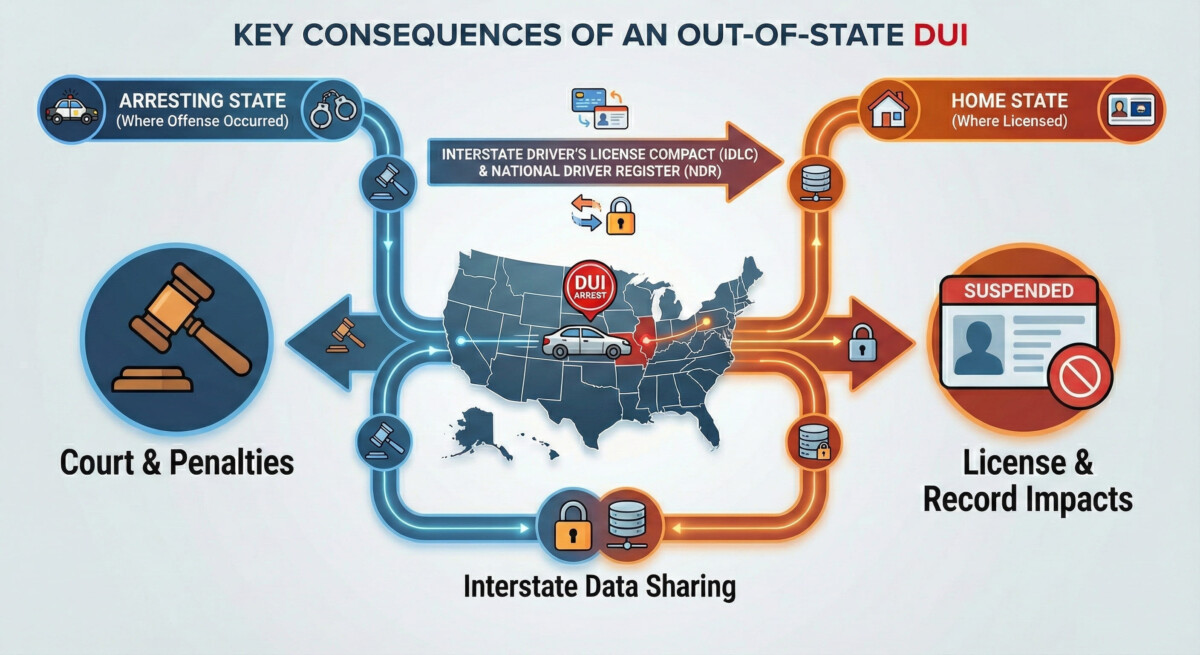
One of the most significant factors in how states handle these charges is the Driver License Compact (DLC). This is an interstate agreement used by 45 states (all except Georgia, Massachusetts, Michigan, Tennessee, and Wisconsin) to share driver information. If you get a DUI in a member state, your home state will be notified and will typically take reciprocal action, such as suspending your license.

Even states not in the DLC have other ways to share information, such as the National Driver Register (NDR), a database that tracks problem drivers. It’s nearly impossible to hide a DUI charge from your home state.

Key Consequences of an Out-of-State DUI

Key Consequences of an Out-of-State DUI

Navigating an out-of-state DUI involves several challenges. You will likely face penalties from both the state where the incident occurred and your home state.

1. Your Home State Will Be Notified

Through the DLC or other information-sharing agreements, your home state’s Department of Motor Vehicles (DMV) or equivalent agency will learn about your DUI charge. This triggers a secondary set of consequences at home, even if the initial charge is hundreds of miles away.

2. You May Face License Suspension in Two States

An out-of-state DUI can lead to two separate license suspensions. The state where you were arrested may suspend your driving privileges within its borders immediately. Once your home state is notified, it will likely suspend your license under its own laws. This “reciprocal suspension” means you could lose your right to drive everywhere, not just in the state where the offense occurred.

3. You Might Have to Appear in Court

You will be required to appear in court in the state where the DUI occurred. This can be a significant logistical and financial burden, requiring travel, time off work, and accommodation expenses. Ignoring a court date is not an option, as it can lead to a bench warrant for your arrest and further legal complications. A local attorney can sometimes appear on your behalf for certain hearings, but your presence may be mandatory for others.

4. You Could Face Fines, Jail Time, and Other Penalties

The penalties for a DUI vary significantly by state but often include steep fines, court costs, and even jail time. You will be subject to the sentencing guidelines of the state where you were charged. Additionally, many states require the completion of substance abuse education programs or counseling as a condition of sentence or license reinstatement.

Steps to Take After an Out-of-State DUI Arrest

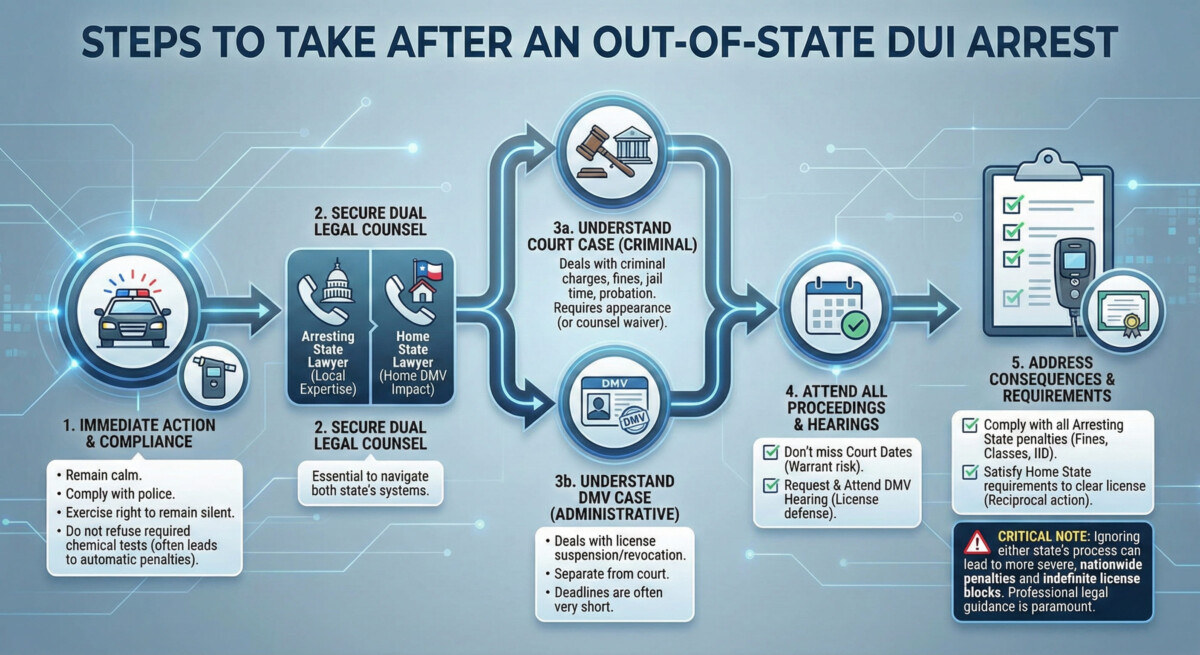
Steps to Take After an Out-of-State DUI Arrest

Receiving an out-of-state DUI charge is jarring, but how you respond is critical. Taking thoughtful, deliberate steps can make a significant difference in the outcome.

1. Stay Calm and Cooperate

During the arrest, remain calm and cooperative with law enforcement. Being argumentative or uncooperative can escalate the situation and lead to additional charges.

2. Hire a Local DUI Attorney

This is one of the most important steps you can take. A qualified DUI attorney in the state where you were charged will understand the local laws, court procedures, and key legal figures. They can guide you through the process, represent you in court, and work to negotiate a more favorable outcome.

3. Do Not Ignore Court Dates or Deadlines

Failing to appear in court or missing essential deadlines will only make matters worse. Keep track of all requirements and stay in close communication with your attorney to ensure you meet every obligation.

4. Complete All Required Programs

If the court orders you to complete a DUI education program or substance abuse counseling, it is essential to do so promptly. AACS Counseling offers court-approved programs that can help you fulfill these requirements. Completing these programs is often a necessary step for license reinstatement and shows the court you are taking the situation seriously.

How Professional Counseling Can Help

An out-of-state DUI is more than just a legal problem; it’s a deeply personal one. The stress, shame, and anxiety can take a significant toll on your mental health and well-being. This is where professional counseling becomes invaluable.

A counselor can provide a safe and confidential space to process the emotional impact of the DUI. At AACS Counseling, our experienced professionals can help you:

  • Manage Stress and Anxiety:Develop coping mechanisms to handle the stress of navigating the legal system from afar.
  • Fulfill Court Requirements:We offer DUI evaluations and counseling services that meet court mandates, helping you move your legal case forward.
  • Address Underlying Issues: Explore the root causes of the DUI and develop strategies to prevent future incidents.
  • Prepare for Reinstatement: Our services support your journey to regain your driving privileges and restore normalcy to your life.

Dealing with the consequences of an out-of-state DUI can feel isolating, but you don’t have to go through it alone.

Take the Next Step

If you or a loved one is facing the repercussions of an out-of-state DUI, getting the proper support is crucial. Navigating the legal requirements while managing the personal impact requires professional guidance.

The team at AACS Counseling is here to provide the expert support and confidential counseling you need to satisfy court requirements and get your life back on track. Contact us today to learn more about our DUI counseling services and schedule a consultation.

2026 Return-to-Duty Process: Legal Timelines, SAP Requirements & How to Get Back to Work Faster

When a CDL driver fails or refuses a DOT drug or alcohol test, they immediately become prohibited from operating safety-sensitive duties. The only way back to work is through the DOT Return-to-Duty Process, guided by a DOT-qualified SAP and regulated under 49 CFR Part 40.

In 2026, FMCSA has tightened monitoring of this process through the Clearinghouse, which means drivers and employers must strictly follow every step — and any mistake can delay your return to duty.

This guide breaks down the exact 2026 RTD timeline, legal SAP requirements, treatment expectations, and proven ways to get back behind the wheel faster and legally.

Why the Return-to-Duty Process Matters in 2026

✔ Strongest search volume among all SAP-related queries
✔ Drivers urgently want to know exact timelines & costs
✔ Employers need clarity on legal obligations
✔ FMCSA updates add new compliance layers in 2026

Step 1: SAP Evaluation Timeline (2026 Guide)

The first step drivers must complete is the SAP Initial Evaluation.
This is a clinical assessment done via in-person or telehealth by a DOT-qualified Substance Abuse Professional.

2026 SAP Evaluation Timeline

  • Schedule SAP appointment: 0–48 hours
  • Initial SAP evaluation: 30–60 minutes
  • SAP issues treatment/education plan: Within 24–48 hours
  • Driver begins program: ASAP after evaluation

Important:
A SAP cannot give “same-day clearance” under any circumstances — this is illegal.
In 2026, the Clearinghouse flags suspiciously fast SAP updates.

Step 2: Treatment & Education Requirements in 2026

Based on the SAP’s clinical assessment, drivers must complete:

✔ Education
✔ Treatment
✔ Or a combination of both

Every plan is customized.
There is no standard number of sessions, and no legal shortcut.

Typical 2026 SAP Recommendations:

  • 8–12 hours education (minimum for low-risk cases)
  • 3–6 weeks outpatient treatment (moderate cases)
  • Support meetings & relapse prevention programs
  • Random testing before SAP follow-up evaluation

Drivers must complete exactly what the SAP prescribes — not more, not less.
Skipping steps means you cannot progress to the next stage.

Step 3: Follow-Up SAP Evaluation (Clearance Step)

Once treatment or education is completed:

✔ The driver returns to the SAP
✔ SAP verifies successful completion
✔ SAP authorizes the RTD drug test

This clearance is logged directly into the FMCSA Clearinghouse.
Without this update, employers cannot legally send a driver for the RTD test.

Step 4: RTD Drug Test Rules for 2026 (Mandatory)

In 2026, the RTD test is:

  • Directly observed
  • Required before the driver can return to safety-sensitive work
  • Not optional, not negotiable
  • A one-time test, but must be negative

What Drivers Can Expect

✔ Observed urine test (DOT rule)
✔ Employer receives negative result
✔ Driver becomes “Eligible for Safety-Sensitive Functions”

After this moment, the driver can legally return to duty.

Step 5: Follow-Up Testing Schedule (2026–2028 Requirements)

After returning to duty, the SAP sets a Follow-Up Testing Plan lasting 1 to 5 years, depending on clinical risk level.

2026 Mandatory Requirements:

  • Minimum 6 follow-up tests in the first 12 months
  • Tests must be:
    ✔ Unannounced
    ✔ Observed
    ✔ Spread throughout the year
  • Longer plans (2–5 years) are based on SAP’s clinical judgment

Employers must follow this plan exactly.
Drivers cannot negotiate out of tests, and employers cannot skip them.

How Long Does the 2026 Return-to-Duty Process Take?

This depends on the SAP recommendation, but typical timelines:

Fastest RTD Timeframe (Low-Risk Case):
  • SAP Evaluation = 1–2 days
  • Education program = 1–2 weeks
  • Follow-up SAP review = 24–48 hours
  • RTD test scheduling = 1–3 days
    Total: 2–3 weeks
Moderate Case:

4–6 weeks

High-Risk Treatment Case:

8–12+ weeks

❗ In 2026, FMCSA is watching for unusually fast or fake SAP clearances.
Cheap or fraudulent SAP providers often lead to restarting the entire process.

How to Get Back to Work Faster in 2026 (Legally)

Here are proven ways to speed the Return-to-Duty process without breaking rules:

✔ 1. Schedule SAP evaluation immediately

Top SAPs offer appointments within 24–48 hours.

✔ 2. Choose a DOT-qualified SAP (not cheap scams)

Fake SAPs delay drivers the longest.

✔ 3. Start treatment or education the same week

Do not wait — downtime increases costs.

✔ 4. Complete every recommendation without skipping

Every skipped session adds more days.

✔ 5. Communicate with the SAP frequently

Faster paperwork → faster clearance.

✔ 6. Choose employers who process RTD tests quickly

Some carriers can schedule tests same day.

What Employers Must Know in 2026 (Legal Obligations)

Employers are legally required to:

  • Immediately remove the driver from safety-sensitive duties
  • Provide list of available SAP providers
  • Ensure driver is not working while prohibited
  • Conduct required RTD test only after SAP approval
  • Follow SAP’s Follow-Up Testing Plan exactly
  • Report violations to the Clearinghouse
  • Keep records for audits

Failure to follow these rules can result in FMCSA penalties.

The Truth About Cheap SAP Providers: 2026 Legal Risks, Fraud Warning Signs & Safe Alternatives

Every day, drivers search for “cheap SAP providers”, “low-cost SAP evaluation,” or “fast SAP clearance.”
But in 2026, the DOT has intensified enforcement, and using a fake or unqualified SAP can destroy your career, lead to Clearinghouse violations, or even trigger federal penalties.

This guide exposes the truth behind cheap SAP scams—and shows you how to find safe, affordable, DOT SAP-qualified options that keep you compliant and protect your CDL.

Why Drivers Seek Cheap SAP Providers

When a driver fails or refuses a DOT drug or alcohol test, they face:

  • Lost income
  • Suspension from safety-sensitive duties
  • Mandatory SAP program costs
  • RTD delays

Naturally, many look for the cheapest SAP evaluation they can find.
And scammers know this.

In 2026, fraudulent SAP websites have increased significantly, especially those offering:

  • “Complete SAP process in one day”
  • “Guaranteed RTD clearance”
  • “No treatment required”
  • “SAP evaluation for $50–$70”

These are illegal, and falling for them can put you in serious federal trouble.

2026 Federal Penalties for Fake or Unqualified SAP Providers

Under 49 CFR Part 40, only DOT-qualified SAPs can:

  • Conduct SAP Evaluations
  • Recommend treatment or education
  • Approve completion
  • Authorize the Return-to-Duty (RTD) Test
  • Update your status in the FMCSA Clearinghouse

If a provider is not DOT-qualified, the consequences are severe:

❌ Your entire SAP process becomes invalid

You must start over from the beginning, regardless of money paid.

❌ Employer cannot accept your RTD clearance

You remain legally disqualified from driving.

❌ FMCSA may investigate employer or driver misconduct

Using fake SAPs can trigger audits or enforcement action.

❌ Possible civil penalties

Submitting false SAP records can lead to fines for employers and SAPs.

❌ Longer time off the road

Scam SAPs regularly delay drivers by weeks or even months.

This is why the DOT repeatedly warns drivers about “too cheap to be real” SAP services.

Real vs. Fake SAP Providers: 2026 Legitimacy Checklist

Use this DOT-compliant checklist to verify whether a SAP provider is real.

✔ REAL DOT-Qualified SAP Provider

A legitimate SAP must:

  • Hold a DOT-specific SAP credential
  • Appear in professional registries (NAADAC, EAPA, IC&RC)
  • Provide their full name, license number, and state
  • Conduct a clinical face-to-face or telehealth SAP evaluation
  • Follow all steps of Part 40 Subpart O
  • Never promise “quick clearance”
  • Update the FMCSA Clearinghouse directly
  • Give written treatment recommendations
  • Require a follow-up evaluation
  • Determine follow-up testing plan (minimum 1 year)

If these requirements are followed, the SAP process is federally compliant.

❌ FAKE or UNQUALIFIED SAP Provider Warning Signs

Avoid any SAP provider that:

  • Offers SAP evaluation for suspiciously low rates ($50–$120)
  • Claims “Guaranteed same-day clearance
  • Says “No treatment required
  • Cannot provide licensure or SAP certificate
  • Avoids clinical questions
  • Does not list a physical office or verifiable location
  • Avoids video sessions and wants only phone calls
  • Cannot update the Clearinghouse
  • Demands cash-only payments
  • Pushes pressure tactics like “limited-time discount”

These services violate federal law and put your CDL at risk.

How Cheap SAP Scams Delay Your Return-to-Duty in 2026

A “cheap SAP provider” often leads to expensive consequences:

❌ Clearinghouse does not update your status

Only real SAPs can change your profile from “Prohibited” to “RTD Eligible.”

❌ Employer rejects your SAP report

No fleet can legally let you drive based on fake paperwork.

❌ You get stuck in violation status longer

Many drivers lose 3–6 months after using a scam provider.

❌ You may need to repeat evaluation + treatment

By law, the whole process must be redone with a qualified SAP.

❌ Job offers disappear

New employers cannot hire you until they verify a legitimate SAP clearance.

In short: Cheap SAP = Expensive Delays.

How to Verify DOT-Qualification in 2026 (Simple 3-Step Check)

1. Ask for Their SAP Certification

  • Must include:
  • Provider name
  • Credentialing body (EAPA, NAADAC, IC&RC)
  • Expiration date
  • SAP course requirement documentation

2. Request State License Information

Any real SAP will immediately provide:

  • License number
  • State board
  • Professional title
  • Verification link

3. Check Their Clearinghouse Registration

Only a legitimate SAP can log into the FMCSA Clearinghouse and update your file.

If they cannot update the Clearinghouse → They are not a real SAP.

Safe & Affordable Alternatives to Cheap SAP Providers (2026)

Drivers don’t need the cheapest provider—they need a verified, compliant, affordable SAP.

A safe alternative should offer:

✔ Transparent pricing

No hidden fees.

✔ DOT-qualified SAP providers only

No uncertified “counselors.”

✔ Fast appointments (24–48 hours)

Without skipping federal steps.

✔ Clear treatment plans

Based on clinical evaluation.

✔ Direct Clearinghouse updates

So employers can legally hire you.

✔ Nationwide telehealth availability

Fast access across all 50 states.

Child Custody Evaluations: A Complete Guide for Parents

For many parents, the phrase “child custody evaluation” triggers a wave of anxiety. It feels like your entire life, your parenting style, and your relationship with your children are being put under a microscope. If you are currently navigating a custody dispute, you likely have dozens of questions keeping you up at night. Will the evaluator understand my bond with my child? What if I say the wrong thing?

Take a deep breath. While the process is rigorous, it is designed with a single, crucial goal: to determine your child’s psychological best interests, helping you stay focused on what truly matters during preparation.

At AACS Counseling, we are here to support you at every stage of your child custody evaluation. This guide breaks down the evaluation process step-by-step, covers what evaluators look for, the specific questions you might face, and practical strategies to help you navigate this challenging time with confidence and grace.

Understanding Child Custody Evaluations

A child custody evaluation is a comprehensive investigation conducted by a mental health professional typically a psychologist or psychiatrist. It usually occurs when parents cannot agree on a parenting plan or when a judge needs more information to rule on custody and visitation.

Unlike a standard court hearing, where lawyers argue on your behalf, an evaluation is a forensic assessment. This means the evaluator acts as a neutral investigator. Their job is not to take sides but to gather objective data about your family dynamics. They assess the children’s needs and each parent’s ability to meet them.

Knowing that support from counselors and attorneys is available can reassure you, helping you feel less isolated and more confident during this process.

Ultimately, the evaluator provides a detailed report and recommendation to the court. While the judge has the final say, these recommendations carry significant weight because they come from an expert who has observed the family firsthand.

The Child Custody Evaluations Process

The process begins when the court appoints a specific evaluator, or when both parties agree on a private professional. Once the appointment is official, the clock starts ticking. However, patience is essential; a thorough investigation generally takes at least two months, and complex cases can take longer.

Steps in the Investigation

You should expect a multi-faceted approach to data gathering. The evaluator will not rely on a single interview to form an opinion. Instead, they will use several methods:

  • Interviews: You will participate in individual interviews to discuss your background, parenting philosophy, and concerns. The evaluator will also interview the children (depending on their age) and potentially other adults involved in the children’s lives, such as teachers, doctors, or therapists.
  • Home Visits and Observations: The evaluator typically visits each parent’s home. This allows them to see the environment where the child lives and observe interactions between you and your child in a natural setting.
  • Record Reviews: Expect to sign releases for school records, medical files, and police reports. The evaluator reviews these to identify patterns in stability, attendance, and health care management.
  • Psychological Testing: In many complete evaluations, parents undergo psychological testing to screen for personality disorders or mental health issues that could impact parenting capacity.

AACS Counseling can help you prepare for each of these phases, offering expert guidance on what evaluators are looking for and how you can present your parenting strengths authentically.

Special Circumstances

If your case involves allegations of domestic violence, substance abuse, or child neglect, the process adapts to address these safety concerns.

If there is a history of domestic violence, safety is the priority. You can request separate interviews to avoid being in the same room as the other parent. It is also vital to provide the evaluator with copies of any existing restraining orders or police reports immediately. The evaluator’s role in these scenarios shifts to include a risk assessment to determine whether unsupervised visitation is safe for the child.

AACS Counseling offers specialized support in high-conflict and trauma situations, helping you gather the proper documentation and communicate your concerns in a way that prioritizes your child’s well-being.

Key Questions in a Child Custody Evaluation

Evaluators ask targeted questions to assess specific areas of your life. Being prepared for these topics can help you answer honestly and clearly without getting confidence.

Parenting Capacity

These questions assess your daily involvement and ability to care for the child.

  • “Describe your child’s daily routine from the moment they wake up until they go to sleep.”
  • “How do you handle medical decisions? Who takes the child to the doctor?”
  • “What discipline methods do you use when your child breaks a rule?”
  • “How do you support your child’s educational needs?”

Co-Parenting Dynamics

The court favors parents who can facilitate a relationship with the other parent.

  • “How do you communicate with the other parent about childcare or schedule changes?”
  • “Describe your willingness to support the child’s relationship with the other parent.”
  • “What positive attributes does the other parent bring to the child’s life?”

Home Environment

This assesses stability and logistical support.

  • “Who lives in your household, and what is their relationship to the child?”
  • “What childcare support do you have (e.g., grandparents, babysitters)?”
  • “How does your work schedule impact your parenting time?”

Child-Focused Questions

These demonstrate how well you know your child as an individual.

  • “What activities does your child enjoy most?”
  • “How does your child react after returning from visits with the other parent?”
  • “What are your child’s greatest strengths and biggest challenges?”

AACS Counseling can work with you to practice responding to common questions and highlight your dedication to your child’s needs.

Preparing for a Child Custody Evaluation

Preparation involves organizing your caregiving responsibilities by documenting who manages daily tasks like school drop-offs, medical visits, and activities, which can serve as objective proof of your involvement.

Start by documenting your caregiving responsibilities. Create a log or calendar that shows who takes the children to school, who attends medical appointments, and who manages extracurricular activities. If you are the primary parent handling these tasks, documentation serves as objective proof.

Next, focus on child-focused home preparation. Ensure your home is clean, safe, and appropriate for children. This doesn’t mean it needs to look like a model home, but it should be functional. The child should have a dedicated sleeping space and a study area. Verify that safety measures, like smoke detectors and secure storage for medications or firearms, are in place.

Finally, practice neutral communication. During the evaluation, you might feel tempted to vent about your ex-partner’s flaws. Resist this urge. Unless there is a safety issue (like abuse), disparaging the other parent often reflects poorly on you. Focus on your relationship with your child, not your conflict with your ex.

If you need help getting organized or shaping how you communicate, AACS Counseling offers dedicated preparation sessions to help you manage stress, plan documentation, and approach the evaluation with confidence.

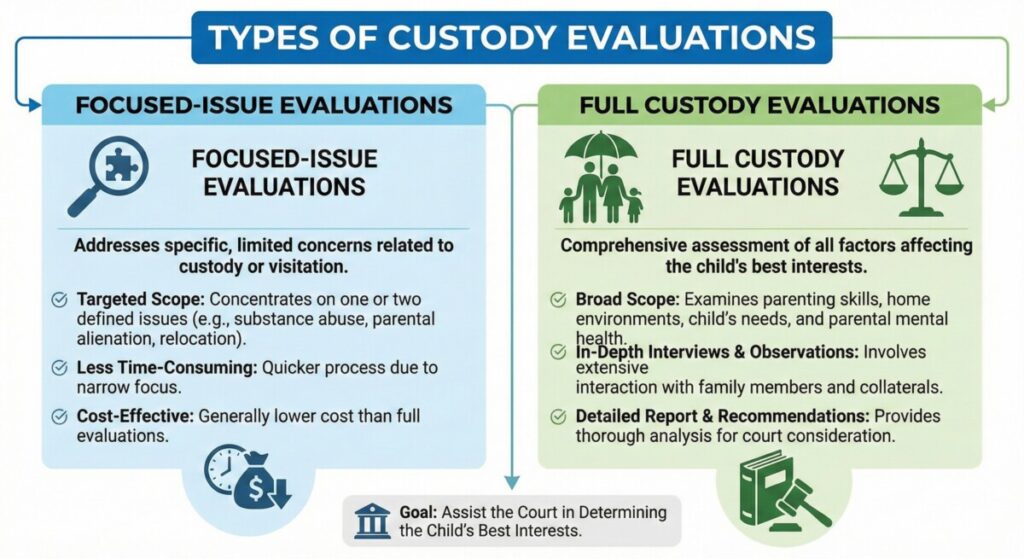
Types of Custody Evaluations

Not all evaluations are the same. Understanding the scope of yours helps set expectations.

Full Custody Evaluations

These are the most common in contentious cases. They cover every aspect of the family dynamic, including psychological testing, home visits, and comprehensive interviews. They result in a recommendation for legal and physical custody.

Focused-Issue Evaluations

Sometimes the court only needs answers on a specific topic. A focused-issue evaluation might look strictly at:

  • A parent’s potential relocation.
  • Allegations of substance abuse.
  • The mental health of one parent.
  • Whether a specific visitation schedule is working.

These are generally shorter and less expensive than complete evaluations but are limited in scope.

If you’re unsure what type of evaluation you’ll be facing, the team at AACS Counseling can walk you through the specifics and prepare you accordingly.

Role of Attorneys in Strengthening Your Position

Your attorney is your strategic partner during this process. They cannot sit in on the evaluation interviews, but they can prepare you for them.

Experienced family law attorneys often use mock evaluations. They will ask you tough, likely questions so you can practice answering without getting defensive or emotional. They can help you gather parenting class certificates or other proof of your dedication to improving your skills.

Attorneys also play a key role in witness preparation. If you have nannies, teachers, or family members who will speak to the evaluator, your attorney can help ensure they understand the process and what information is most relevant to the child’s welfare.

AACS Counseling works hand-in-hand with your legal counsel, offering evidence-based documentation and professional support that can reinforce your case.

After the Evaluation

Once the investigation concludes, the evaluator writes a confidential report. This document summarizes their findings and offers specific recommendations for custody, visitation schedules, and, at times, therapeutic interventions (such as family counseling).

The report is released to the attorneys and the court, but typically not directly to the parents to protect privacy. You will review it with your lawyer.

If the report is favorable, your attorney will likely use it to push for a settlement that mirrors the recommendations. If you strongly disagree with the findings, you have options. You can choose to contest the report in court. This might involve hiring an expert to review the evaluator’s methodology or cross-examining the evaluator during trial to expose biases or errors.

AACS Counseling can help you process the evaluation’s findings and support you in the following steps—whether that’s moving toward settlement, contesting a report, or strengthening your parenting approach.

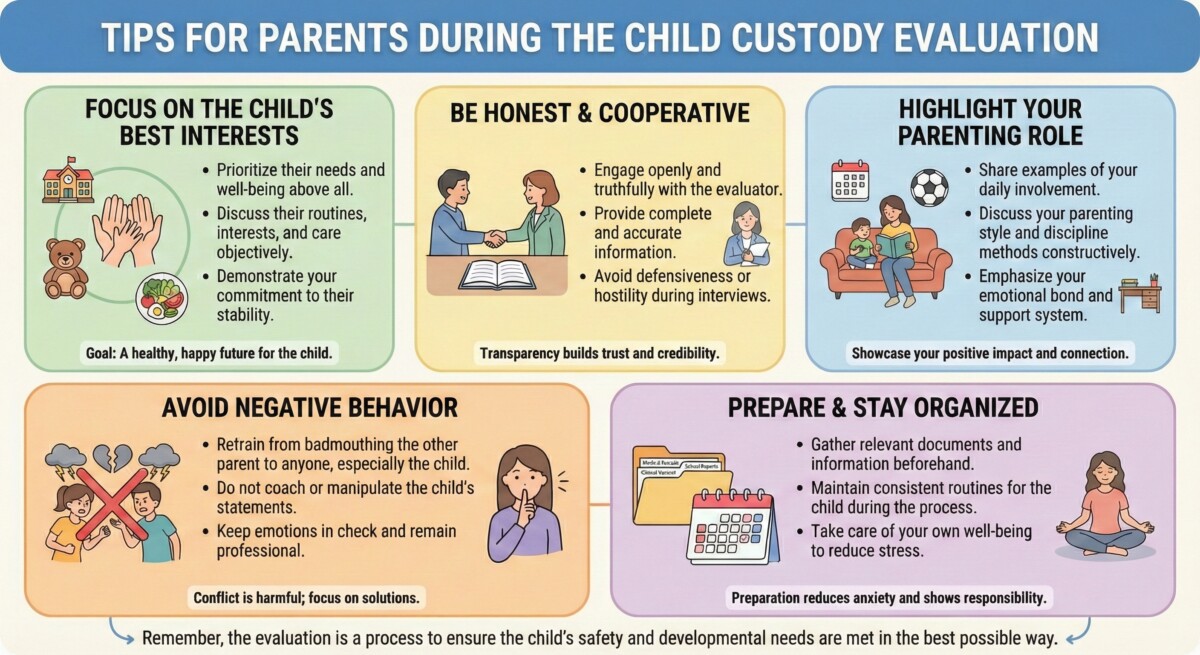
Tips for Parents During the Evaluation

Success in an evaluation often comes down to attitude and organization.

  • Be Honest: Evaluators are trained to spot deception. Admitting you aren’t perfect is far better than being caught in a lie. If you have a past mistake (like a DUI), own it and explain how you have learned from it.
  • Keep the Child Center Stage: Frame every answer around your child. Instead of saying, “I want full custody because I miss him,” say, “I believe he needs the stability of a consistent routine during the school week.”
  • Stay Organized: Keep copies of all documents you provide to the evaluator. If you promise to send a report card or a doctor’s note, do it immediately.
  • Dress and Act Appropriately: Treat appointments like a job interview. Arrive on time, dress neatly, and be polite to everyone in the office.

AACS Counseling helps you manage stress and present your best self in every interaction with an evaluator.

Frequently Asked Questions (FAQs)

What factors most influence outcomes?

The most influential factors are typically the stability of the home environment, the strength of the emotional bond between parent and child, and the parent’s willingness to facilitate a relationship with the other parent.

How do I choose the right evaluator?

Ideally, your attorney will help you select a professional with a reputation for neutrality and thoroughness. Look for someone with specific experience relevant to your case, such as working with special needs children or handling high-conflict divorces. If you need recommendations, AACS Counseling can connect you with trusted evaluators in your area.

What if I disagree with the evaluation report?

You are not bound to accept the report as the final word. Your attorney can file motions to challenge it, depose the evaluator, or introduce contradictory evidence during the trial. AACS Counseling can help you prepare documentation and emotional support for this process.

Conclusion

A child custody evaluation is undoubtedly one of the most stressful hurdles in family law proceedings. However, it is also an opportunity. It is a chance for a neutral expert to see the love, care, and stability you provide for your children.

By preparing thoroughly, focusing on your child’s well-being, and maintaining a professional demeanor, you can navigate this process effectively. Remember, the goal is a healthy, happy future for your children. Stay focused on that horizon, and lean on your legal and mental health support systems—including AACS Counseling—to guide you through.

References

What is the Difference Between I-601 and I-601A Hardship Waivers?

Navigating the U.S. immigration system can feel like walking through a legal labyrinth, especially when your family’s future is on the line. If you or a loved one is considered “inadmissible” to the United States, you may have heard of the I-601 and I-601A waivers. While they both address the concept of “Extreme Hardship,” they serve very different purposes.

At AACS Counseling, we help families bridge the gap between legal requirements and clinical proof. Understanding which waiver you need is the first step toward a successful application.

1. Form I-601: The Traditional Waiver

The I-601 Application for Waiver of Grounds of Inadmissibility is the broader of the two. It is designed for individuals who are either outside the U.S. and have been denied a visa at a consulate, or those inside the U.S. who are applying for an Adjustment of Status.

What it Covers:

  • Multiple Grounds: Unlike the I-601A, this waiver covers criminal history, immigration fraud, misrepresentation, and certain health-related grounds.
  • Unlawful Presence: It can also waive the 3- or 10-year bar for staying in the U.S. without a visa.

Timing and Location:

Historically, the I-601 is filed after a consular officer has officially determined you are inadmissible. This often means the applicant is already outside the U.S. and must wait abroad for a decision, which can lead to prolonged family separation.

2. Form I-601A: The Provisional Waiver

The I-601A Provisional Unlawful Presence Waiver was created specifically to reduce the time families spend apart.

What it Covers:

  • Unlawful Presence ONLY: This is the most critical distinction. If you have a criminal record or a history of fraud, the I-601A cannot help you. It only “forgives” the time you spent in the U.S. without legal status.

Timing and Location:

The I-601A is filed while the applicant is still inside the United States. You wait for the approval here with your family. Once approved, you then travel to your home country for your consular interview with the “provisional” waiver already in hand.

Key Comparison: I-601 vs. I-601A (2026 Data)

FeatureForm I-601Form I-601A
Primary UseFraud, Criminal, Health, Unlawful PresenceOnly Unlawful Presence
Applicant LocationUsually Outside the U.S.Must be Inside the U.S.
Qualifying RelativeSpouse or Parent (Citizen/LPR)Spouse or Parent (Citizen/LPR)
2026 Filing Fee$1,050$715 (Online) / $795 (Paper)
Median Processing~20.5 Months28.5 – 32 Months
Where to FileUSCIS LockboxUSCIS (HART Service Center)

The “Extreme Hardship” Requirement

Both waivers require you to prove that a Qualifying Relative (a U.S. citizen or Green Card holder spouse or parent) would suffer “extreme hardship” if you were not allowed to stay.

Note: Hardship to children is not directly considered as a “qualifying” factor for these waivers, though their suffering can be used to demonstrate the secondary impact on the qualifying spouse or parent.

Why a Clinical Evaluation is Essential

USCIS officers are trained to look for hardship that goes beyond the “normal” emotional distress of separation. This is where AACS Counseling plays a vital role. A professional psychological evaluation provides the objective, clinical evidence needed to prove your case:

  • Clinical Diagnoses: Documenting conditions like Major Depressive Disorder or PTSD that would worsen with separation.
  • Financial & Functional Stress: Assessing how the loss of a caregiver or provider would lead to a mental health crisis for the qualifying relative.
  • Expert Credibility: Moving your case from a “personal story” to a “professional clinical assessment.”

2026 Processing: The HART Service Center

In 2026, most I-601A applications are handled by the HART (Humanitarian, Adjustment, Removing Conditions and Travel Documents) Service Center. While the center is digitizing files to speed up the 30-month backlog, the scrutiny on “Extreme Hardship” evidence has never been higher. A well-documented file at the start can prevent a Request for Evidence (RFE), which can add another 6–12 months to your wait.

Frequently Asked Questions

  • Can I travel while my I-601A is pending?

Generally, no. Leaving the U.S. before the waiver is approved and your interview is scheduled can trigger the very bar you are trying to avoid.

  • What if I have an old DUI?

Even a minor criminal record can disqualify you from an I-601A. In this case, your attorney may recommend the I-601 instead.

  • Is an evaluation mandatory?

While not a legal requirement, most immigration attorneys highly recommend a psychological evaluation from a specialist like AACS Counseling to meet the high evidentiary bar.

Next Steps for Your Journey

Choosing the wrong waiver can lead to years of unnecessary delay or even a permanent bar from the United States. Always consult with a qualified immigration attorney before filing.

Failed a DOT Drug Test in 2026? Step-by-Step Legal Guide for Drivers in the U.S.

Failing a DOT drug test in 2026 is serious—but it does not automatically end your trucking career. Federal regulation (49 CFR Part 40) gives every driver a legal pathway to return to duty (RTD) through a DOT-qualified SAP Program.

This guide breaks down exactly what you must do legally, how fast you can return to work, how the Clearinghouse records your violation, and what mistakes delay your reinstatement.

What Legally Happens First When You Fail a DOT Drug Test in 2026

The moment you fail a DOT drug or alcohol test, federal regulations require:

1. Immediate Removal From Safety-Sensitive Duties

You cannot drive, operate heavy machinery, or perform any DOT-regulated job.

2. Employer Must Report the Violation to the FMCSA Clearinghouse

Under the 2026 reporting mandate, employers must submit your violation within 3 business days.

3. You Must Be Provided With a List of DOT-Qualified SAPs

This list must include only certified SAPs compliant with Part 40.

Failing to follow these steps puts employers at risk of civil penalties, so most fleets are strict.

Do You Need a SAP After Failing a DOT Drug Test? (Yes — Federal Law)

Every driver who failed a DOT drug test in 2026 must complete a SAP Evaluation.
There are no exceptions under Part 40.

During the SAP process, you must complete:

Without SAP clearance, you legally cannot return to duty for any employer in the U.S.

Step-by-Step: What You Must Do After Failing a DOT Drug Test in 2026

Step 1: Register or Sign Into the FMCSA Clearinghouse

Your violation and all SAP progress will be recorded in the Clearinghouse.

You must:

  • Add your new employer (if applicable)
  • Provide consent for RTD queries
  • Allow the SAP to update your case status

Step 2: Schedule Your DOT SAP Evaluation

Your SAP Evaluation includes:

  • Clinical interview
  • Substance use history
  • Mental health screening
  • Assessment of risk level
  • Recommendation for treatment or education

Step 3: Complete the SAP Treatment or Education Plan

Based on 2026 guidelines, drivers are usually required to complete:

  • Outpatient counseling
  • Education courses
  • Relapse prevention
  • Follow-up sessions

Your SAP determines the duration—but only the SAP can legally approve your progress.

Step 4: Follow-Up Evaluation and RTD Test

Once treatment is done, your SAP conducts a Face-to-Face Follow-Up Evaluation.

If cleared, you can take your Return-to-Duty Test.
A negative result is required before you return to driving.

Step 5: Begin Follow-Up Testing (1–5 Years)

After returning to duty, FMCSA requires “unannounced follow-up testing.”
This is determined solely by your SAP.

How to Avoid FMCSA Clearinghouse Delays in 2026

Clearinghouse delays can add weeks or months to your reinstatement.

Avoid these 2026 common mistakes:

❌ Starting SAP treatment before the SAP Evaluation

This invalidates your process.

❌ Not registering on the Clearinghouse

Your employer cannot query you → RTD delays.

❌ Choosing a non-qualified SAP

Only DOT-certified SAPs can update your status.

❌ Not completing the follow-up evaluation

Without this, your RTD test cannot be scheduled.

2026 Employer Reporting Rules You Must Know

In 2026, employers must legally:

✔ Report all violations within 3 days

This includes refusals, positive tests, and tampering.

✔ Complete annual Clearinghouse queries

For current employees.

✔ Conduct pre-employment queries for ALL new drivers

No driver can be hired before this check.

✔ Honor SAP treatment recommendations

Employers cannot override or alter SAP instructions.

Can You Still Work After Failing a DOT Drug Test in 2026?

Yes—but only after:

  1. Completing the SAP process
  2. Passing the RTD test
  3. Clearinghouse reflects “eligible for RTD test” and “negative RTD test result”

You cannot drive commercially until these steps are completed.

FAQ: Quick Legal Answers for Drivers

Is failing a DOT drug test a crime?

No, but it is a federal violation.

How long does a DOT violation stay on my record?

Clearinghouse: 5 years or until all SAP steps are completed (whichever is longer).

Can I change my SAP provider?

Yes, only before treatment begins.

Can a new employer hire me during the SAP process?

Yes, but you cannot drive until you pass the RTD drug test.

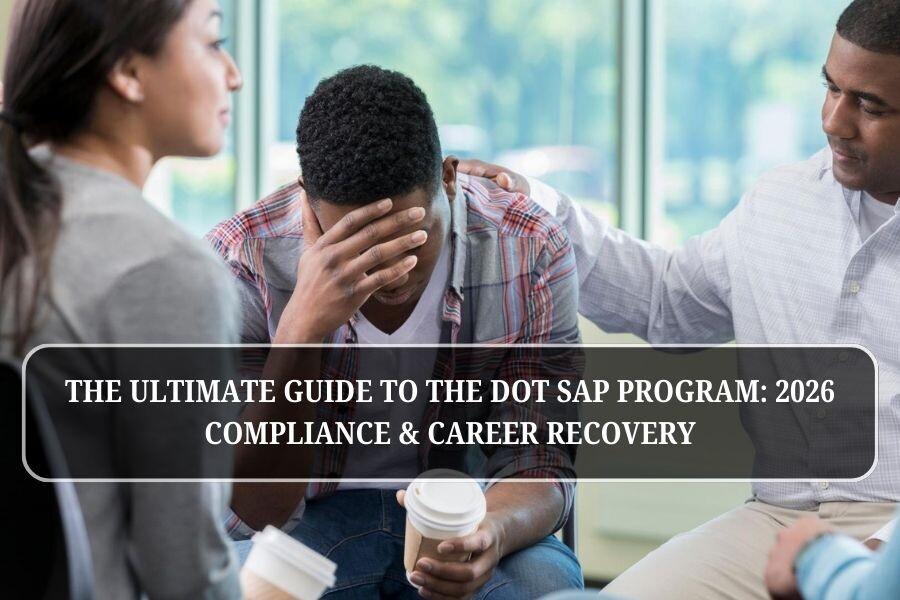
The Ultimate Guide to the DOT SAP Program in Georgia: 2026 Compliance & Career Recovery

For a commercial driver in Georgia, a positive drug test or an alcohol violation feels like a sudden dead end on a long highway. Whether you were flagged during a random screen at an Atlanta logistics hub or during a pre-employment check for a new carrier in Savannah, the result is the same: an immediate “Prohibited” status in the FMCSA Drug and Alcohol Clearinghouse.

In 2026, the stakes for Georgia CDL holders have never been higher. With the full implementation of Clearinghouse II and automated syncing between federal databases and the Georgia Department of Driver Services (DDS), a single violation now triggers a swift countdown toward a license downgrade.

But a violation doesn’t have to be the end of your career. The DOT SAP Program is the legal, regulated path back to the driver’s seat. At AACS Counseling, we specialize in guiding Georgia drivers through this complex process with expert evaluations and a clear roadmap for your return-to-duty.

What Is the DOT SAP Program?

The Substance Abuse Professional (SAP) Program is a mandatory safety protocol governed by 49 CFR Part 40. It is designed to ensure that any safety-sensitive employee who violates DOT drug and alcohol regulations is properly evaluated and, if necessary, treated before returning to work.

Definition & Purpose

A SAP is a licensed professional (such as those at AACS Counseling) who has undergone specialized DOT training and clinical certification. Their job is not to punish you, but to protect the public. The SAP serves as a “gatekeeper,” determining when a driver is clinically safe to return to safety-sensitive duties, such as operating a Class A CMV on Georgia’s busy interstates.

Who Must Complete It?

You are required to enter the SAP program if you:

  • Test positive for a controlled substance (including marijuana/THC).
  • Register a Breath Alcohol Concentration (BAC) of 0.04 or higher.
  • Refuse a test by failing to show up, leaving the site, or being unable to provide a specimen without a valid medical reason.
  • Tamper with, adulterate, or substitute a specimen.

Why Truck Drivers Are Talking About SAP in 2026

The trucking landscape in 2026 has shifted significantly. Here are the trends impacting Georgia drivers today:

1. The 24-Hour Reporting Rule

As of 2026, the FMCSA has tightened reporting windows. Employers, Medical Review Officers (MROs), and SAPs must now report violations and status changes within 24 hours. This means your “Prohibited” status hits the Clearinghouse almost instantly, leaving no room for “job hopping” to hide a failed test.

2. Georgia’s Automated CDL Downgrade

In 2025, Georgia fully integrated its DDS records with the federal Clearinghouse. If you are in “Prohibited” status and do not begin the SAP process, Georgia DDS is now required to downgrade your CDL to a non-commercial license within 60 days. This automated enforcement makes completing the SAP program the only way to save your commercial driving privileges.

3. Fentanyl and Expanded Testing Panels

A major update in late 2025 added Fentanyl to the standard DOT testing panel. This has led to an increase in SAP referrals as drivers who may have used tainted substances unknowingly are now being caught in random screens.

4. Mental Health Awareness

There is a growing trend among Georgia carriers to view the SAP program as a “rehabilitation” rather than a “termination.” At AACS Counseling, we see more employers supporting their drivers through the process to retain experienced talent amidst the ongoing driver shortage.

Step-by-Step SAP Process for Georgia Drivers

Navigating the return-to-duty (RTD) process can be overwhelming. Here is exactly how it works when you choose a Georgia DOT SAP provider like AACS Counseling:

Step 1: The Initial Evaluation

After your violation is reported, you must select a SAP in the Clearinghouse. Once you book an appointment with AACS Counseling, you will undergo a comprehensive clinical assessment. We look at your history, the circumstances of the violation, and your current safety risk.

Step 2: The Recommendation Plan

The SAP will prescribe a specific plan tailored to you. This is not always “rehab.” Depending on the severity, it could be:

  • Education: A series of classes on substance abuse safety.
  • Counseling: Short-term outpatient therapy or support groups.
  • Treatment: More intensive programs if a clinical dependency is identified.

Step 3: Progress Monitoring

While you complete your education or counseling, AACS Counseling remains your point of contact. We monitor your progress to ensure you are meeting the DOT’s requirements.

Step 4: The Follow-Up Evaluation

Once you complete your plan, you return to your SAP for a final “Return-to-Duty Eligibility” evaluation. If the SAP determines you have successfully complied, they will update your status in the Clearinghouse to “Eligible for RTD Testing.”

Step 5: The Return-to-Duty Test

Your employer (or a prospective employer) will send you for a “Return-to-Duty” drug and/or alcohol test. This test must be observed. Once the result is negative, the employer updates the Clearinghouse, and your status changes to “Not Prohibited.”

Common Driver Concerns & Misconceptions

“I failed for Marijuana, but it’s legal in other states. Why do I need SAP?” Even in 2026, the DOT maintains a zero-tolerance policy for THC. Regardless of state laws or the “rescheduling” of marijuana, it remains a prohibited substance for CDL holders. A positive test for THC is an automatic SAP referral.

How long does the program take?

The evaluation itself is fast—often scheduled within 24-48 hours at AACS Counseling. However, the education or treatment phase can take anywhere from a few days to several weeks. The sooner you start, the sooner you get back to work.

Does the violation stay on my record forever?

Violations stay visible in the Clearinghouse for 5 years or until you complete the RTD process and the follow-up testing plan, whichever is longer. Completing the SAP program shows future employers that you took accountability and are safe to hire.

SAP Program & the Georgia Regulatory Environment

Georgia is a massive hub for the transport industry. With I-75, I-85, and I-20 intersecting in Atlanta, and the Port of Savannah seeing record volume, Georgia employers are under intense scrutiny from the DOT.

Why Georgia Employers Care

A carrier that knowingly allows a “Prohibited” driver behind the wheel faces fines of up to $15,000+ per incident in 2026. Furthermore, Georgia’s “actual knowledge” rules mean that if an employer suspects a violation but fails to report it, they risk losing their operating authority.

Legal Protections

While the violation is public in the Clearinghouse, the specific clinical details of your counseling are protected by HIPAA. Your employer sees your eligibility status, not your private medical history.

Preparing for Your SAP Evaluation

To avoid delays in your return-to-duty process, come prepared to your appointment at AACS Counseling:

  1. Documentation: Bring a copy of the violation report or the letter from your MRO.
  2. Clearinghouse Access: Ensure you have registered your driver account and are ready to “designate” AACS Counseling as your SAP.
  3. Honesty: The SAP process is clinical. Being honest about your situation helps us create a plan that gets you cleared faster.

Return-to-Duty & Beyond: The Follow-Up Plan

Successfully passing your RTD test is a huge milestone, but the process continues. Your SAP will issue a Follow-Up Testing Plan.

  • The Minimum: At least 6 unannounced, observed tests in the first 12 months.
  • The Duration: This plan can last up to 5 years.

Managing this plan is the employer’s responsibility, but the driver must remain compliant to stay in “Not Prohibited” status.

Why Choose AACS Counseling for DOT SAP in Georgia?

If you are a driver in Atlanta, Augusta, Savannah, or Columbus, you need a SAP provider who understands both the federal rules and the local Georgia landscape.

  • Licensed Expertise: Our evaluators are fully DOT-qualified and stay up to date on the latest 2026 FMCSA changes.
  • Fast Turnaround: We know that every day off the road is a day without a paycheck. We offer expedited scheduling for initial evaluations.
  • Supportive Environment: We treat every driver with respect. Our goal is to see you succeed and maintain your livelihood.
  • Full Clearinghouse Integration: We handle the digital reporting so your status updates as quickly as the law allows.

FAQs: DOT SAP Program in Georgia

What triggers a DOT SAP referral in Georgia?

Any drug or alcohol violation reported by an MRO or employer to the Clearinghouse. This includes positive tests from random, pre-employment, post-accident, or reasonable-suspicion screens.

How long does a SAP evaluation take?

The initial clinical interview typically takes 1 to 2 hours. AACS Counseling provides a same-day or next-day report to initiate your education plan.

Can I work while in the SAP Program?

You cannot perform safety-sensitive duties (driving a CMV, loading, etc.). However, you can work in non-DOT roles, such as warehouse work or dispatch, if your employer allows it.

Will the SAP report go to my employer or FMCSA?

The SAP updates your status in the FMCSA Clearinghouse. Your current or future employer will see your progress and eligibility for the return-to-duty test.

Ready to Get Back on the Road? Contact AACS Counseling Today

Don’t let a violation stall your career indefinitely. Whether you are in Macon, Marietta, or Athens, AACS Counseling is your trusted partner for the DOT SAP Program in Georgia.

Our team is ready to help you navigate the Clearinghouse II updates and the Georgia DDS requirements. Let’s get you through the evaluation and back behind the wheel.

Contact AACS Counseling Now to Schedule Your SAP Evaluation

DOT SAP Program Explained for 2026: Legal Requirements, Costs & Safety Rules

If you’re a CDL driver, employer, or owner-operator facing a DOT drug or alcohol testing violation in 2026, you must complete the DOT SAP Program before returning to safety-sensitive duties.

This guide breaks down the DOT SAP Program Explained for 2026, including updated legal requirements under 49 CFR Part 40, safety rules, program costs, and employer responsibilities.

FMCSA continues tightening enforcement, and in 2026 the SAP process is more structured, traceable, and compliance-focused than ever.

1. What Is the DOT SAP Program in 2026?

The DOT SAP Program is a federally mandated return-to-duty process for any CDL driver who:

  • Tests positive on a DOT drug test
  • Tests 0.04 or higher on an alcohol test
  • Refuses a drug/alcohol test
  • Violates DOT drug and alcohol rules in any safety-sensitive role

The program ensures drivers receive professional evaluation, education/treatment, and follow-up testing before safely returning to work.

2. 49 CFR Part 40: Updated Interpretations for 2026

49 CFR Part 40 is the federal regulation that governs the entire SAP Evaluation. While the core rules remain unchanged, FMCSA added clarifications and stricter reporting expectations in 2026.

Key 2026 Highlights Under 49 CFR Part 40

✔ Faster reporting

SAPs must submit evaluation reports to the FMCSA Clearinghouse sooner, minimizing delays.

✔ More documentation

SAPs must provide detailed clinical justification for recommended treatment levels.

✔ Telehealth SAP evaluations remain approved

As long as they meet DOT-compliant behavioral health standards.

✔ Stronger verification of SAP credentials

FMCSA is targeting fake, unqualified SAP providers in 2026 audits.

✔ Stricter compliance for employers

Employers must update SAP and RTD status in real-time, not weeks later.

3. Safety-Sensitive Restrictions for Drivers in 2026

Once a violation occurs, DOT requires immediate removal from all safety-sensitive duties, including:

  • Driving a CMV
  • Performing roadside inspections
  • Loading/unloading hazardous materials
  • Equipment operation
  • Sleeper berth operation under dispatch
  • Any CDL-regulated task

Drivers cannot return to duty until they:

  1. Complete the initial SAP evaluation
  2. Complete all SAP-recommended treatment or education
  3. Undergo a follow-up evaluation
  4. Pass the Return-to-Duty test
  5. Begin Follow-Up Testing

Employers are legally prohibited from allowing non-cleared drivers to work.

4. Step-by-Step: How the DOT SAP Program Works in 2026

Here is the DOT SAP Program Explained for 2026 from start to finish:

Step 1 — DOT Violation Occurs

A positive test, alcohol violation, or refusal is entered into the FMCSA Clearinghouse.

Driver is immediately removed from safety-sensitive work.

Step 2 — Select a Qualified DOT SAP

Must be a DOT-qualified Substance Abuse Professional, not a regular counselor or therapist.

Red flag:

If they are not listed as DOT-compliant → the entire program may be rejected.

Step 3 — Initial SAP Evaluation

The SAP determines:

  • Past substance use history
  • Clinical risk level
  • Whether the driver needs education, treatment, or both
  • Program length and intensity

Step 4 — Complete Required Education or Treatment

May include:

  • Early intervention education
  • Individual counseling
  • Group counseling
  • Outpatient treatment
  • Intensive outpatient (IOP)
  • Rarely, residential treatment

Drivers must complete the exact plan provided by the SAP.

Step 5 — Follow-Up SAP Evaluation

SAP confirms whether the driver is ready for:

  • Return-to-Duty drug test
  • Return-to-work clearance

Driver becomes “Eligible for RTD Test” in the Clearinghouse.

Step 6 — Return-to-Duty Test

A DOT RTD test is conducted under direct observation.

Driver must test negative.

Step 7 — Follow-Up Testing Plan (Mandatory 2026 Requirement)

SAP creates a personalized follow-up testing plan lasting 1–5 years.

  • Minimum: 6 tests in the first 12 months
  • Tests must be unannounced
  • Employers must ensure compliance

5. Cost of the DOT SAP Program in 2026

Actual costs vary, but here are the average U.S. ranges for 2026:

SAP Program Costs Breakdown:
SAP ComponentCost Range (2026)
Initial Evaluation$300 – $500
Follow-Up Evaluation$150 – $300
Education Programs$150 – $400
Outpatient Treatment$700 – $2,000
Intensive Outpatient (IOP)$1,500 – $4,500
Return-to-Duty Test$55 – $85
Follow-up Testing (Year 1)$330 – $1,080
Total Cost for Most Drivers in 2026:

👉 $800 – $2,500
Moderate cases may reach $4,000–$7,000.

6. Employer Obligations in 2026

FMCSA increased employer responsibilities and penalties.

In 2026, employers must:

✔ Run pre-employment Clearinghouse queries

Before hiring any CDL driver.

✔ Conduct annual queries for all active drivers

No exceptions.

✔ Report all drug & alcohol violations within 24 hours

New stricter timeline.

✔ Report actual knowledge violations

Including observed use, possession, or admission.

✔ Update SAP and RTD statuses

Failure to update SAP completion or RTD eligibility leads to fines.

✔ Enforce follow-up testing plans

Employers are responsible—not SAPs.

✔ Maintain compliant records for DOT audits

FMCSA auditors will check logs for accuracy.

7. Why the DOT SAP Program Is More Important Than Ever in 2026

Because of FMCSA’s enhanced digital tracking:

  • Violations are harder to hide
  • Employers face steeper fines
  • Drivers face CDL downgrade risks
  • SAP documentation must be precise
  • RTD delays mean lost income

The DOT SAP Program is now a central safety, compliance, and legal requirement for all CDL operations in 2026.

8. FAQ’s

1. What is the DOT SAP Program in 2026?

It is a federally required process that helps CDL drivers return to safety-sensitive work after a drug or alcohol violation.

2. Did 49 CFR Part 40 change in 2026?

Core rules remain the same, but enforcement, SAP reporting deadlines, and documentation requirements are stricter.

3. How long does4. Can drivers use telehealth SAP evaluations in 2026?the SAP Program take in 2026?

Anywhere from one week to several months, depending on the SAP’s treatment recommendation.

4. Can drivers use telehealth SAP evaluations in 2026?

Yes—telehealth remains fully DOT-approved and widely used.

5. Do employers have more responsibilities in 2026?

Yes—employers must report violations within 24 hours, run queries, and enforce follow-up testing.

Call Now