DOT SAP Program Archives - Page 33 of 34 - AACS Counseling

Will SAP Program Completion Help You in a Future Legal Case? Here’s What to Know

Introduction: Can a SAP Program Help You in Court?

If you’ve completed a DOT SAP (Substance Abuse Professional) Program, you may wonder:
Can it benefit me in a future legal case?

Whether you’re facing DUI charges, family court disputes, or employment litigation, the answer is often yes—if you’ve fully complied with SAP requirements. In this blog, we’ll break down when, how, and why SAP completion might support your legal defense or credibility in 2025.

Understanding the DOT SAP Program: More Than Just DOT Compliance

The DOT SAP Program is a mandatory process under DOT 49 CFR Part 40 for safety-sensitive employees who test positive for drugs or alcohol. It involves:

  • Evaluation by a qualified Substance Abuse Professional

  • Completion of treatment or education

  • Return-to-duty testing and follow-up monitoring

But here’s the key:
Courts and legal entities are now recognizing SAP completion as a positive behavioral step, particularly when dealing with substance-related charges or custody matters.

When SAP Program Completion Helps You Legally

1. DUI/DWI Court Cases

Judges may reduce penalties, waive jail time, or expedite license reinstatement if you show:

  • SAP compliance

  • Negative return-to-duty and follow-up drug tests

  • Ongoing participation in treatment or support programs

2. Child Custody or Family Court

In custody battles, showing commitment to sobriety and treatment is critical. A completed SAP program with documented follow-ups may:

  • Demonstrate parental responsibility

  • Improve your standing with child protective services

  • Show long-term behavioral change

3. Employment Lawsuits

If you’re involved in a legal dispute with a former employer, proof of SAP completion can:

  • Show that you took proper steps to return to duty

  • Reduce liability claims

  • Strengthen your rehire potential or backpay claim

4. Criminal Defense

Attorneys often use SAP reports and follow-up test results to:

  • Support plea bargains

  • Reduce sentencing

  • Prove rehabilitation in substance-related cases

What Kind of Legal Proof Does a SAP Program Provide?

Your SAP provider can furnish the following documentation that holds legal weight:

  • Official SAP evaluation report

  • Completion certificate of recommended treatment/education

  • Return-to-duty negative test results

  • Follow-up testing schedule and results

  • MRO documentation and FMCSA Clearinghouse updates

Pro Tip: Always request these documents from your SAP provider and keep them for at least 5 years.

Limitations: When SAP Completion May Not Help

While helpful, SAP completion is not a legal shield. It does not erase violations or guarantee favorable rulings.

You may not see legal benefits if:

  • You failed follow-up testing after SAP completion

  • The court considers the SAP program insufficient without additional rehab

  • You failed to provide official documentation

How Lawyers Use SAP Records in 2025

In 2025, criminal defense attorneys, family lawyers, and employment law firms routinely use SAP documentation to:

  • Prove accountability and rehabilitation

  • Show compliance with DOT or employer mandates

  • Reduce long-term consequences for substance-related violations

Some even request expert testimony from SAP evaluators during trial or hearings.

How to Maximize the Legal Value of Your SAP Program

Here are a few tips to make your SAP program more effective if you anticipate future legal issues:

ActionLegal Impact
Work only with certified SAPsEnsures records are valid in court
Complete all follow-up testsDemonstrates long-term compliance
Keep thorough documentationHelps your attorney present a stronger case
Inform your lawyer earlyAllows them to strategize with SAP details
Follow through with any recommended support group or therapyShows a lifestyle change

Real Case Example (2024–2025)

A CDL driver in Georgia was involved in a DUI and faced a child custody dispute. After completing the SAP program, attending ongoing therapy, and maintaining clean tests, his SAP documents were presented in court. The judge acknowledged his commitment, leading to reinstated visitation rights and reduced penalties.

Conclusion: SAP Completion is a Legal Asset—If You Use It Right

So, will SAP program completion help you in a future legal case?
Absolutely—if it’s done properly, documented fully, and aligned with the case at hand. Whether you’re navigating DOT compliance or fighting for custody or justice, SAP program records can support your narrative of recovery and accountability.

Call to Action

Need help starting—or documenting—your SAP program for legal use? Contact AACS Counseling today. Our certified SAP professionals provide evaluations, compliance reports, and legal-ready documentation tailored to your situation.

📞 Schedule a confidential consultation and protect your future—on the road and in court.

Can You Drive for Amazon or Uber Freight After a SAP Violation? (2025 Rules & Reality)

Introduction: SAP Violations and Big-Name Freight Apps

In 2025, platforms like Amazon Relay and Uber Freight are more dominant than ever in the trucking and logistics world. But if you’ve had a DOT drug or alcohol violation and completed a SAP (Substance Abuse Professional) Program, you might wonder:
Can you still drive for Amazon or Uber Freight after a SAP violation?

The short answer is:
Yes, but with conditions.
Let’s break down how each company handles SAP-cleared drivers and what steps you need to take to be eligible.

What is a SAP Violation? (Quick Recap)

A SAP violation refers to:

  • A failed DOT drug/alcohol test

  • A refusal to test

  • Leaving a DOT-mandated safety-sensitive position without completing the SAP process

After a violation, you’re required to:

  1. Complete a SAP evaluation

  2. Finish treatment/education as recommended

  3. Pass a Return-to-Duty (RTD) drug test

  4. Complete follow-up testing over a defined period

Can You Drive for Amazon Relay After a SAP Violation?

✅ Yes—If You’ve Fully Completed the SAP Return-to-Duty Process

Amazon Relay works with owner-operators and carriers, many of whom require clean CDL records. However, Amazon’s key focus is DOT compliance—not permanent disqualification.

If you’ve:

  • Completed all SAP requirements

  • Passed a return-to-duty test

  • Are enrolled in follow-up testing

  • Have a valid CDL and active Clearinghouse record

—then Amazon Relay can allow you to onboard, depending on carrier discretion or your own carrier status.

⚠️ Things to Note:

  • Amazon doesn’t hire individual drivers directly; they contract freight partners or carriers who have their own policies.

  • Some partner carriers may choose not to hire drivers with a violation history, even if SAP is complete.

Can You Drive for Uber Freight After a SAP Violation?

✅ Possible—If You’re SAP-Cleared and Meet Uber’s Carrier Criteria

Like Amazon, Uber Freight contracts with carriers—not drivers. If you’re a fleet owner or small carrier, Uber looks at:

  • Your DOT number

  • Carrier safety rating

  • Driver eligibility under FMCSA regulations

If you, or your drivers, have:

  • Successfully completed the SAP process

  • A valid CDL with no outstanding violations

  • No pending DOT Clearinghouse blocks

Then Uber Freight may approve your carrier profile.

⚠️ Keep in Mind:

  • Uber Freight uses automated background checks, and any past violation may trigger manual review.

  • If your violation is recent, you might face temporary ineligibility, even if SAP is completed.

What Makes You Eligible Again?

RequirementNeeded for Amazon/Uber Freight
Full SAP Program Completion✅ Yes
Return-to-Duty Negative Test✅ Yes
Active CDL License✅ Yes
Clean Follow-Up Test HistoryStrongly Preferred
No Other Disqualifying FMCSA Issues✅ Required
Carrier Accepts SAP HistoryVaries by company

What to Do if You’re Rejected After SAP Completion

If Amazon or Uber Freight (or their partner carriers) still reject your application:

  1. Check Your Clearinghouse Record – Make sure everything is marked “complete.”

  2. Ask for SAP Documentation – Get official proof of program completion.

  3. Apply with Other Carriers First – Build recent experience with smaller fleets.

  4. Contact the Platform Directly – Ask if reapplication is allowed after a clean track record period.

Alternative Freight Platforms That May Accept SAP-Cleared Drivers

If Amazon or Uber Freight isn’t an option yet, consider:

  • DAT Load Board

  • TruckSmarter

  • Convoy (if resumed operations)

  • C.H. Robinson

  • Local owner-operator contracts

These platforms may offer more flexibility, especially if you are self-dispatched or working independently.

Legal and Compliance Reminders

  • FMCSA does not bar SAP-cleared drivers from employment.

  • Employers and platforms can set stricter internal policies.

  • SAP completion clears your federal record, but not always your employer reputation.

  • Keep all documents for at least 5 years in case of audits or reapplication reviews.

Conclusion: You Have a Path Forward

So—can you drive for Amazon or Uber Freight after a SAP violation?
Yes, but it depends on:

  • Your completion of SAP + follow-ups

  • Your CDL status

  • The policies of the carrier or platform you’re applying to

SAP completion doesn’t lock you out of the freight world forever. In fact, it can be a stepping stone toward professional redemption—especially if you maintain compliance moving forward.

Call to Action

Need help getting SAP-cleared and rebuilding your trucking career?
AACS Counseling provides nationwide SAP evaluations, return-to-duty monitoring, and clear documentation to support your reentry into platforms like Amazon Relay or Uber Freight.

📞 Contact us today for a confidential consultation and take control of your CDL future.

FMCSA Clearinghouse and Your Privacy in 2025: What CDL Drivers Need to Know

Introduction: FMCSA Clearinghouse and Your Privacy in 2025

If you’re a CDL driver using the DOT system, the FMCSA Clearinghouse and your privacy in 2025 are more connected than ever. With employers, TPAs, and federal auditors accessing your records, it’s essential to understand what’s public, what’s protected, and how to monitor your own file.

What the FMCSA Clearinghouse Actually Stores

The FMCSA Clearinghouse is a secure federal database that tracks:

  • DOT drug and alcohol violations

  • Return-to-duty (RTD) status

  • SAP program progress

  • Follow-up testing compliance

It was designed to protect highway safety, but CDL drivers are right to ask what it means for their privacy.

What’s Visible and What’s Protected in 2025

To protect FMCSA Clearinghouse and your privacy in 2025, here’s a breakdown of what’s accessible:

Accessible With Proper Consent:

  • Drug and alcohol violations

  • SAP completion and RTD test results

  • Follow-up testing plans

Not Publicly Visible:

  • Your medical or mental health records

  • SAP treatment notes or session content

  • Personal conversations with SAPs

  • Employer internal notes

🔐 Only employers, auditors, and you—the driver—can view Clearinghouse entries, and only with consent or legal need.

Who Can See Your FMCSA Record in 2025?

ViewerAccess Level
Prospective EmployersWith consent – full query
Current EmployersAnnual limited query
Third-Party Administrators (TPAs)Employer-delegated info only
FMCSA & DOT AuditorsFull access
YouFull personal access via portal
General Public❌ No access allowed

How to Protect Your CDL Record and Privacy

To keep control of your FMCSA Clearinghouse and your privacy in 2025, CDL drivers should:

  1. Log in regularly to check for errors or unauthorized access.

  2. Consent only to verified employers during job applications.

  3. Dispute any incorrect data through the FMCSA portal.

  4. Keep digital and physical copies of your SAP and RTD documents.

Common Myths About FMCSA Clearinghouse Privacy

  • ❌ Myth: Anyone can look up your DOT history.
  • ✅ Truth: Only employers with your consent can access it.

  • ❌ Myth: Completing the SAP Program makes your data public.
  • ✅ Truth: SAP details are stored securely and are not public-facing.

  • ❌ Myth: The Clearinghouse is a permanent record.
  • ✅ Truth: Most violations age out after 5 years.

Real Case Example: A Driver Saved His Record

In 2024, a CDL driver noticed that his SAP completion wasn’t updated in the Clearinghouse. He contacted both the employer and FMCSA support, submitted evidence, and the issue was resolved. Thanks to his vigilance, he remained eligible for a major carrier job.

How to Check and Manage Your Record

  • Visit the official FMCSA Clearinghouse Portal

  • Log in using your CDL credentials

  • Review employer queries

  • File a dispute if needed through the Driver Dashboard

Conclusion: Your Clearinghouse Privacy Is in Your Hands

The FMCSA Clearinghouse and your privacy in 2025 are governed by strict regulations—but staying informed is key. As a CDL driver, you have the right to monitor your record, control access, and protect your future in the industry.

Call to Action

Need help correcting a Clearinghouse error or completing your SAP return-to-duty process?
Contact AACS Counseling today. Our team offers expert SAP evaluations, Clearinghouse assistance, and compliance documentation—all tailored to protect your CDL career and your privacy.

The Driver’s Guide to Designating an SAP in the Portal

After a DOT drug or alcohol violation, the path back to the driver’s seat starts with one mandatory, digital step: designating your Substance Abuse Professional (SAP) in the FMCSA Clearinghouse portal. This is a common point of confusion and delay for many drivers. Your SAP cannot upload any documents or move your case forward until you complete this step.

Think of it like giving your SAP a digital key to your file. Without it, their hands are tied, and your return-to-duty process is stalled before it even begins.

This guide provides a literal “click here, then click there” walkthrough to help you navigate the portal and successfully designate your SAP, ensuring there are no unnecessary technical delays in getting you back on the road.

The First Step: Before You Log In

Before you even go to the website, make sure you have two key pieces of information:

  1. Your Login.gov Credentials: The Clearinghouse uses Login.gov for secure access. You will need your email, password, and access to your two-factor authentication method (e.g., your phone for a code).
  2. Your SAP’s Information: You need the exact name your SAP used to register in the Clearinghouse. Ask them for the precise spelling of their name or their company name as it appears in the database.

Step-by-Step Guide: Designating Your SAP

Follow these exact steps. Do not skip any.

Step 1: Go to the Clearinghouse Website

Open your web browser and navigate to the official FMCSA Clearinghouse homepage: https://clearinghouse.fmcsa.dot.gov/

Step 2: Log In to Your Account

On the homepage, locate the “Login” button, usually found in the top right corner of the screen. Click it. This will redirect you to the Login.gov sign-in page.

  • Enter your email address and password for your Login.gov account.
  • Complete the two-factor authentication step by entering the security code sent to your phone or using your selected authentication method.

Step 3: Access Your Driver Dashboard

After logging in, you will be taken to your personal Clearinghouse dashboard. This screen provides an overview of your record. Your violation should be clearly visible.

Step 4: Locate the “Designate SAP” Button

Look for the section detailing your violation. Within this section, you will see a prominent button or link that says “Designate Substance Abuse Professional.” This is your action item.

Step 5: Search for Your SAP

You will now be on the SAP search page. You have several fields to help you find your SAP, but the easiest way is by name.

  • In the “SAP Name” field, carefully type the first and last name of the SAP you have chosen. Spelling is critical. If you are unsure, use the exact information your SAP provided to you.
  • You can also search by the SAP’s company name if they are part of a larger organization.

Step 6: Select Your SAP from the List

After you enter the name and click search, the system will show a list of SAPs that match your query.

  • Review the list carefully. It will show the SAP’s name, city, and state.
  • Verify that you have found the correct individual.
  • Click the radio button (the small circle) next to the correct SAP’s name to select them.

Step 7: Confirm Your Designation

Once you have selected your SAP, a button will appear, usually labeled “Send Request” or “Designate SAP.”

  • Click this button to confirm your choice.
  • The system will ask you to review your selection one last time. If everything is correct, click “Confirm” or “Submit.”

What Happens Next?

You have now completed your part of the process. A designation request has been sent to the SAP’s Clearinghouse portal.

  • The SAP Must Accept: The SAP must now log into their account and accept your designation request.
  • Check Your Status: On your dashboard, the status of the designation will change from “Sent” to “Accepted” once they take action.

Your SAP can only begin uploading your initial assessment and follow-up reports after they have accepted your request. We recommend calling your SAP to let them know you have sent the request so they can accept it promptly.

Frequently Asked Questions

What if I can’t find my SAP in the portal?

The most common reason is a spelling error. Double-check the name with your SAP. If the spelling is correct and you still can’t find them, ask them to search for their own name in the database to ensure their registration is active and correct. It is also possible they are not a DOT-qualified SAP, which is a major red flag.

Can I change my SAP after designation?

This is strongly discouraged and difficult. Once you designate an SAP and they begin the evaluation process, you are generally expected to complete the process with them. “SAP shopping” because you disagree with their treatment recommendation is not permitted. You can only change SAPs under very specific circumstances, such as if the SAP becomes unavailable or retires, and it requires a formal transfer process that causes delays. Choose the right SAP the first time.

How long does the designation process take?

Your part—sending the request—takes only a few minutes. The total time depends on how quickly your SAP logs in and accepts the request. Most professional SAPs check their portal daily and will accept it within one business day. If it takes longer than 48 hours, call them to follow up.

Conclusion

Designating your SAP is the official starting pistol for your return-to-duty journey. While it may seem like a small clerical task, it is the critical link that connects you, your SAP, and the FMCSA. By following this simple, step-by-step guide, you can ensure you complete this task correctly and avoid the frustrating delays that can keep you out of the driver’s seat longer than necessary.

Facing a DOT Violation? Begin Your SAP Program Now with AACS Counseling

If you’re dealing with a DOT violation, it can feel overwhelming. The intricate processes, the legal implications, and the need for compliance can leave anyone stressed. Whether you’re a commercial driver worried about job security or an employer seeking guidance for an impacted employee, the DOT SAP Program is an essential step toward resolution. At AACS Counseling, we are here to support you every step of the way, ensuring the path to compliance is smoother and less daunting.

Understanding DOT Violations and Their Impact

The Department of Transportation (DOT) is responsible for maintaining the safety and integrity of the U.S. transportation system. As part of this mission, it enforces strict drug and alcohol testing protocols for safety-sensitive employees, especially for those holding a Commercial Driver’s License (CDL). A DOT violation occurs when an employee fails a drug or alcohol test or refuses to comply with testing requirements.

These violations are taken seriously because they directly impact public safety.

 Here are some common scenarios that constitute DOT violations:

Testing positive for drugs or alcohol during a random, pre-employment, or post-accident test.

  • Refusing to take a DOT-mandated drug or alcohol test.
  • Tampering with or substituting a sample during testing.
  • Operating a vehicle under the influence of drugs or alcohol.

The consequences of such violations are far-reaching. For employees, it often results in immediate removal from safety-sensitive duties. Beyond job loss, DOT violations can harm your professional reputation, future employment prospects, and financial stability. Employers, meanwhile, face compliance challenges, workforce disruptions, and operational risks.

Understanding the weight of these violations is vital, but more importantly, knowing your next steps can significantly impact your ability to recover from this setback.

The Role of the SAP Program in Resolving DOT Violations

The SAP program is the lifeline for individuals caught in the web of a DOT violation. Short for Substance Abuse Professional, an SAP evaluates employees who have violated DOT drug and alcohol regulations and recommends appropriate education, treatment, follow-up testing, and aftercare programs.

The program is mandatory for those seeking to return to DOT-regulated safety-sensitive positions. Through the SAP process, individuals receive the support and resources they need to address substance use issues and re-establish compliance with DOT requirements.

Here’s an outline of how the process works:

  • Initial SAP Assessment: The SAP conducts a thorough evaluation to understand the extent of the violation and determine appropriate treatment or education plans.
  • Completion of Recommended Program: The employee completes the SAP’s assigned education, treatment, or counseling. This might include substance abuse education, therapy sessions, or an inpatient treatment program, depending on the assessment.
  • Follow-Up SAP Evaluation: After completing the program, the SAP reevaluates the individual to ensure compliance and readiness to return to safety-sensitive work.
  • Return-To-Duty Testing: The employee must pass a return-to-duty drug and/or alcohol test before resuming work.
  • Follow-Up Testing Program: The SAP establishes a follow-up testing schedule for employees, which typically lasts 1-5 years to monitor long-term compliance.

The SAP program isn’t just about meeting regulations; it’s about giving individuals an opportunity to address substance use issues and return to productive work in a safer way.

Why AACS Counseling is the Partner You Need

AACS Counseling specializes in guiding individuals through the often-overwhelming SAP process. With extensive experience working with DOT-regulated employees, we’ve built a reputation for providing personalized, effective, and supportive care. Here’s why we’re uniquely qualified to assist you:

Expertise from Licensed SAP Professionals

At AACS Counseling, our team includes highly qualified Substance Abuse Professionals who are well-versed in DOT guidelines and compliance measures. Their expertise ensures that every step of the SAP process is handled according to DOT standards while addressing individual needs.

Comprehensive Services Under One Roof

We offer a complete range of services, including SAP evaluations, recommended education or treatment programs, return-to-duty testing coordination, and follow-up testing oversight. Whether you’re starting the program or navigating follow-up requirements, we’re with you every step of the way.

Tailored, Compassionate Support

Dealing with a DOT violation is stressful, and it’s easy to feel isolated or judged. At AACS Counseling, we prioritize compassion. Our counselors work to understand your unique situation and guide you through the program with empathy and respect.

Streamlined Compliance for Employers

Employers struggling with workforce disruptions or compliance challenges can also rely on AACS Counseling. We partner with organizations to streamline the SAP process, ensuring both employer and employee meet the necessary requirements with minimal disruptions.

How to Get Started with the SAP Program

How to Get Started with the SAP Program

Starting the SAP program may feel intimidating, but breaking it into manageable steps can simplify the process:

  • Find a Qualified SAP Provider: The first step is to locate a DOT-qualified Substance Abuse Professional. The DOT SAP guidelines can help you understand the qualifications to look for. AACS Counseling meets all DOT requirements, offering trustworthy expertise you can rely on.
  • Schedule Your Initial SAP Evaluation: During this evaluation, the SAP will assess your violation, substance use history, and overall situation. Be honest and open during this step; it helps ensure the recommendations meet your needs.
  • Complete the Recommended Program: Participate in the education, treatment, or counseling recommended by the SAP. Completing this phase is crucial for demonstrating readiness to return to work.
  • Follow the SAP’s Return-to-Duty Process: After completing the recommended program, schedule a follow-up evaluation with your SAP, pass your return-to-duty test, and adhere to any ongoing testing schedules.
  • Maintain Compliance: Finally, adhere to all future follow-up testing as recommended by your SAP. Meeting these requirements demonstrates your commitment to staying compliant and safe on the job.

The Importance of Compliance

Compliance with the SAP process and DOT regulations is non-negotiable for anyone in safety-sensitive roles. Beyond the individual benefits of regaining employment, compliance ensures that the transportation industry remains safe and trustworthy. Furthermore, adherence to regulations helps mitigate potential risks for employers, including regulatory penalties and liability issues.

By taking the SAP program seriously, individuals and organizations alike demonstrate their commitment to safety, accountability, and professional integrity.

FAQs About the SAP Process

What Happens If I Don’t Comply with the SAP Process?

Without completing the SAP program, you cannot legally return to a safety-sensitive role within a DOT-regulated industry. This could permanently impact your career in transportation.

What if I Disagree with My SAP’s Recommendation?

SAP recommendations are based on DOT regulations and their professional judgment. While you may discuss concerns with your SAP, following the program is mandatory for returning to work.

Are Employers Notified of My Violation?

Employers who initiated your drug or alcohol test will be notified of your violation and your compliance progress.

Does Insurance Cover SAP Services or Recommended Programs?

Coverage varies widely. Check with your insurance provider to determine eligibility for substance abuse treatment costs.

Additional Resources

For further information on DOT regulations, compliance, and the SAP program, check out these trusted resources:

Overcome Your DOT Violation with AACS Counseling

A DOT violation can feel like the end of the road, but with the right support, it can also be the beginning of a positive change. AACS Counseling is here to help you take the necessary steps toward compliance, regain your standing, and move forward in your career with renewed confidence.

If you or someone you know needs guidance through the SAP program, don’t wait. Contact AACS Counseling today to get back on track and start your recovery process with compassionate, expert support.

MRO vs SAP: Understanding Your DOT Drug Test Roles

A phone call after a DOT drug test can be nerve-wracking. When that call comes from a Medical Review Officer (MRO), it often means your career is about to take an unexpected turn. Understanding who you are talking to and what their role is can make a significant difference in navigating the next steps. Many drivers and employers confuse the roles of the MRO and the Substance Abuse Professional (SAP), but they play very different parts in the DOT drug testing process.

This post will clarify the difference between a Medical Review Officer vs SAP. We will explain what each professional does, when they get involved, and how they impact your ability to get back on the road. Knowing their distinct functions is crucial for managing the situation correctly and efficiently starting the Return-to-Duty process.

The Medical Review Officer (MRO): The Gatekeeper

Think of the MRO as the official gatekeeper of your drug test results. An MRO is a licensed physician with specialized training in substance abuse and pharmacology. Their primary job is to review and verify drug test results from the laboratory before they are reported to an employer.

When a lab detects a substance in your specimen, the result is not immediately reported as positive. First, it goes to the MRO. The MRO will contact you to conduct a private interview. This is your opportunity to provide a legitimate medical explanation for the result, such as a valid prescription for a medication you are taking. If you can provide verifiable proof of a valid prescription, the MRO may overturn the lab’s finding and report the test as negative to your employer.

However, if you cannot provide a legitimate medical reason, or if you admit to using a prohibited substance, the MRO will verify the test as positive. They are often the person who delivers the “bad news.” The MRO’s role is strictly limited to this verification process. Once they have reported a verified positive result or a refusal to test, their involvement in your case is over.

The Substance Abuse Professional (SAP): The Fixer

After an MRO reports a violation to your employer and the FMCSA Clearinghouse, your path forward involves a new expert: the Substance Abuse Professional (SAP). The SAP is the person who helps you “fix” the situation. They are your guide through the mandatory DOT SAP program, which is required for any driver who wants to return to safety-sensitive duties.

An SAP is a licensed or certified professional, such as a counselor, social worker, or psychologist, who has specific qualifications and training in DOT regulations. Their main role is to evaluate you and determine what steps you need to take to resolve issues related to your violation. This is not a punishment, but a process designed to ensure public safety.

Your journey with an SAP begins with a comprehensive, face-to-face qualified SAP evaluation. During this meeting, the SAP will assess your situation and create a personalized plan of education and/or treatment. They are an independent advocate for public safety, not for the driver or the employer. Their recommendations are final and must be followed precisely.

The Critical Hand-off: From MRO to SAP

A common and critical point of confusion is understanding when one role ends and the other begins. The MRO verifies the test; the SAP manages the recovery. The MRO cannot help you with the Return-to-Duty process. Their job is finished once the violation is confirmed.

Attempting to negotiate with the MRO or asking them for next steps will not move your case forward. The only professional who can manage your return to work is a qualified SAP. Once the MRO has finalized their report, your immediate priority should be to find and connect with an SAP to begin the evaluation process. The sooner you start, the sooner you can complete the requirements and get your FMCSA Clearinghouse status updated.

MRO and SAP Roles in the FMCSA Clearinghouse

The FMCSA Clearinghouse is the central database for all DOT drug and alcohol violations. Both the MRO and the SAP have mandatory reporting duties that directly impact your record.

  • The MRO reports the violation: The MRO is responsible for reporting your verified positive, adulterated, or substituted drug test result, as well as any refusals to test, to the Clearinghouse. This action officially places you in “prohibited” status, meaning you cannot perform any safety-sensitive functions for any DOT-regulated employer.
  • The SAP reports on your progress: The SAP has two reporting duties. They report the date of your initial evaluation and, most importantly, they report when you have successfully completed your prescribed education or treatment plan. This completion report is a necessary step before you can take your Return-to-Duty drug test.

MRO vs. SAP: A Quick Comparison

To simplify the differences, here is a quick breakdown of their distinct roles.

Feature

Medical Review Officer (MRO)

Substance Abuse Professional (SAP)

When they appear

During/Immediately after the drug test.

After a violation is officially recorded.

Primary Role

Verifies the lab result & checks for medical excuses.

Evaluates the driver and recommends treatment/education.

Can they clear you?

No, they only report the result.

Yes, they manage the Return-to-Duty path.

Who they work for

Usually the Third-Party Administrator (TPA) or the Employer.

Independent advocate for public safety.

Take the Next Step Today

Understanding the difference between an MRO and an SAP is the first step toward navigating a DOT violation successfully. The MRO confirms the problem; the SAP provides the solution. While a call from an MRO can be discouraging, it is not the end of your career. The Return-to-Duty process offers a clear, structured path back to the driver’s seat.

If you have already spoken with an MRO and have a verified violation, do not delay. Your next call should be to start your mandatory evaluation. Contact AACS Counseling today to connect with a qualified SAP and begin your journey back to work immediately.

Domestic Violence Assessment Georgia — AACS Counseling

alleged andIf you or someone you love is in immediate danger, please call 911 or the National Domestic Violence Hotline at 1-800-799-7233. You are not alone.

Domestic Violence Assessment Services in Georgia

If you have been referred for a domestic violence assessment in Georgia — whether by a court, a DFCS caseworker, an attorney, or your own choice — AACS Counseling is here to help. We provide professional, court-admissible family, domestic, and intimate partner violence assessments for individuals across the state of Georgia, conducted via secure HIPAA-compliant telehealth with same-day paperwork turnaround.

Georgia courts, family services agencies, and legal professionals rely on clinically thorough evaluations to guide decisions in domestic violence cases. At AACS Counseling, our licensed evaluators bring over 25 years of experience providing assessments that meet the standards required by Georgia courts and DFCS.

What Is a Domestic Violence Assessment in Georgia?

A domestic violence assessment is a structured clinical evaluation that examines the nature, severity, and risk level of abuse within a relationship or household. It is conducted by a licensed mental health professional and is designed to inform legal proceedings, safety planning, and treatment referrals.

In Georgia, domestic violence assessments are commonly required in family court cases, criminal proceedings involving family violence charges, DFCS child welfare investigations, and as a condition of probation or diversion programs. AACS Counseling has extensive experience providing evaluations that satisfy these specific Georgia legal and clinical requirements.

Who Needs a Domestic Violence Assessment in Georgia?

A domestic violence assessment in Georgia may be required or recommended for individuals who have been charged with a family violence offense. Individuals involved in custody disputes where domestic violence has been alleged, and victims seeking documentation for protective order proceedings. Parents under DFCS investigation and individuals referred through Georgia’s accountability or diversion courts.

Why Choose AACS Counseling for Your Georgia Domestic Violence Assessment?

AACS Counseling has served Georgia residents for over 25 years as a trusted provider of clinical evaluations and alternative sentencing solutions. Our assessments are accepted by Georgia courts, DFCS agencies, probation officers, and attorneys statewide.

Same-day evaluation paperwork. Statewide telehealth availability. Accepted by Georgia courts and DFCS.

We understand that navigating a domestic violence case in Georgia is stressful and often time-sensitive. That is why we offer same-day evaluation paperwork; flexible telehealth scheduling available Monday through Friday 9am–6pm and Saturday 9am–5pm; and a compassionate clinical team that treats every client with professionalism and dignity.

Domestic Violence Assessment Georgia

What to Expect from the Assessment Process

Our Georgia domestic violence assessment follows a structured, five-step clinical process. First, your evaluator confirms a safe, private environment for the session. Next, relevant background information and any court or legal documents are reviewed. A structured clinical interview is then conducted, followed by administration of validated assessment instruments. Finally, your evaluator prepares a comprehensive written report summarizing findings and recommendations, which can be submitted directly to your attorney, court, or DFCS caseworker.

Georgia Domestic Violence Laws and Assessment Requirements

Under Georgia’s Family Violence Act, family violence includes a range of offenses between household members. Including physical assault, stalking, criminal damage to property, and unlawful restraint. Courts frequently order clinical evaluations as part of sentencing, probation conditions, or custody proceedings under this statute. AACS Counseling’s evaluations are designed to meet these Georgia-specific legal requirements and are prepared in a format that is court-admissible and professionally defensible.

Family Violence Intervention Program (FVIP) in Georgia

Following a domestic violence assessment, many Georgia courts require participation in a state-approved Family Violence Intervention Program (FVIP). AACS Counseling offers FVIP classes designed to meet Georgia’s requirements, helping participants develop healthier responses to anger and conflict. And relationship stress through evidence-based cognitive-behavioral intervention.

Frequently Asked Questions — Georgia

Is a domestic violence assessment required for DFCS cases in Georgia?

Yes, DFCS frequently requires formal clinical evaluations in child welfare cases involving domestic violence allegations. AACS Counseling provides dedicated DFCS assessments that meet Georgia agency standards.

How quickly can I get my Georgia assessment paperwork?

AACS Counseling offers same-day access to evaluation paperwork upon completion of the assessment.

Is the assessment conducted in person or online?

All assessments are conducted via secure, HIPAA-compliant telehealth, available to all Georgia residents regardless of location.

Call AACS Counseling: 800-683-7745  |  Available Mon–Fri 9am–6pm & Sat 9am–5pm

Designating a Substance Abuse Professional: A Step-by-Step Guide

Receiving a drug or alcohol violation can feel overwhelming, but it doesn’t mean the end of your career. The Federal Motor Carrier Safety Administration (FMCSA) Clearinghouse outlines a clear path back to service. This process starts with one critical step: designating a qualified Substance Abuse Professional (SAP). This guide will walk you through how to officially link an SAP to your record, what to expect during the Return-to-Duty (RTD) process, and how your status changes along the way.

Understanding this process is the first step toward getting back on the road. We will cover how to select and designate your SAP in the Clearinghouse, the specific stages of evaluation and treatment, and the final steps needed to get your status back to “Not Prohibited.”

Step 1: Designating Your Substance Abuse Professional (SAP)

You cannot clear a violation on your own. You must be evaluated by a DOT-qualified SAP who will manage the first half of your recovery process. Before they can do anything, you must officially designate them in the FMCSA Clearinghouse.

How to Designate Your SAP

Follow these instructions carefully to connect with your chosen professional.

  1. Log In to the Clearinghouse: Navigate to the FMCSA Clearinghouse website and sign in. You will use your Login.gov credentials, so have that information ready.
  2. Access Your Dashboard: Once logged in, your dashboard will display your current status. If you have a violation, you will see a prominent button that says “Designate Substance Abuse Professional.” Click it to begin.
  3. Search and Select: A search field will appear. You need to type in your SAP’s full name exactly as they are registered in the system. Double-check the spelling and any credentials they may have included in their registered name.
  4. Send the Request: After selecting the correct professional, click “Send Request.” This action sends a notification to the SAP, who must then log in to their own Clearinghouse account to formally accept your designation.

It is vital to choose your SAP carefully. Once they accept your request, you generally cannot change to a different professional without going through a formal and often lengthy appeal process with the FMCSA.

Step 2: The Return-to-Duty (RTD) Process

With your SAP designated, your journey back to a “Not Prohibited” status begins. The SAP is responsible for entering key information into the Clearinghouse as you complete each phase.

Initial Evaluation

Your first meeting with the SAP is the Initial Evaluation. During this session, the professional will assess your situation and prescribe a specific education or treatment plan tailored to your needs. After this meeting, the SAP will log in to the Clearinghouse and enter the “Assessment Date,” officially documenting that your RTD process has started.

Compliance and Follow-Up

Once you successfully complete the prescribed education or treatment program, you will meet with your SAP for a follow-up evaluation. If the SAP determines that you have complied with the plan and are ready to move forward, they will enter the “Eligibility Date” into the Clearinghouse. This entry signals to the system that you are now eligible to take the final step.

Step 3: The Return-to-Duty Test

Even after your SAP has cleared you, your Clearinghouse status will remain “Prohibited.” The final hurdle is passing a Return-to-Duty drug test.

Who Orders the Test?

You cannot order an RTD test for yourself. It must be ordered by a current or prospective employer. If you are an owner-operator, your designated Consortium/Third-Party Administrator (C/TPA) will order the test. This test must be conducted under direct observation.

Changing Your Status to “Not Prohibited”

After you take the test, the laboratory reports the result to the Medical Review Officer (MRO), who then reports it to the employer. Once your employer receives a negative result, they are required to report it to the Clearinghouse. The result officially updates your status from “Prohibited” to “Not Prohibited.” At this point, you can resume your safety-sensitive functions. You should also notify your State Driver Licensing Agency (SDLA) so they can reinstate your commercial driver’s license (CDL) if it was downgraded.

Understanding Your Clearinghouse Status

Your status in the Clearinghouse dictates whether you can legally perform safety-sensitive functions. Here’s a simple breakdown of what each status means.

Status

What it Means

Can You Drive?

Prohibited

A violation has been recorded in your profile. The RTD process has either not started or is still in progress.

No. Your CDL may be downgraded by your state.

Eligible

Your SAP has determined you have successfully completed the required treatment and/or education. You are now ready for the RTD test.

No. You may only drive a commercial motor vehicle for the purpose of taking the RTD test.

Not Prohibited

A negative RTD test result has been reported by an employer. You have completed the process.

Yes. You are cleared to resume all safety-sensitive functions.

Navigating the FMCSA Clearinghouse after a violation requires careful attention to detail. By following these steps, you can confidently move through the Return-to-Duty process. Designating the right SAP, completing your prescribed plan, and passing your RTD test are the key milestones on your path back to the driver’s seat. If you have questions about your specific situation, your designated SAP is your best resource for guidance.

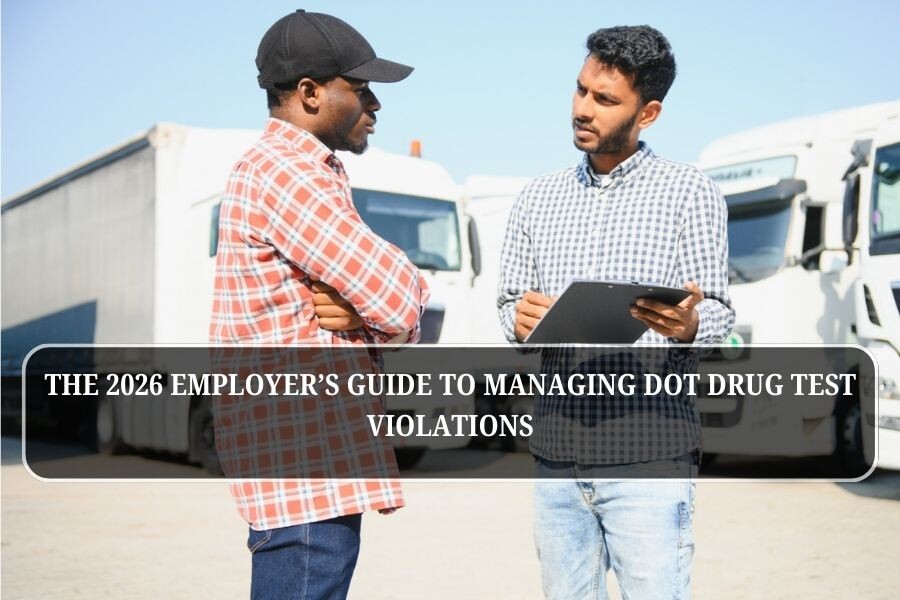
The 2026 Employer’s Guide to Managing DOT Drug Test Violations

If a driver tests positive on a drug test, employers must act fast. Legal requirements start right away. These obligations are strict and come with serious penalties. For fleet managers and safety officers, any mistake after a DOT drug test violation can be costly. With the 2026 FMCSA Clearinghouse updates, employers must follow the rules without error.

This guide gives you a clear path for handling DOT drug test violations. You will see exactly what you must do—from removing the driver at once to giving them the Substance Abuse Professional (SAP) referral list. By learning these steps, you can protect your business and keep up with DOT compliance for employers in 2026.

The Compliance Checklist for a Positive DOT Drug Test

Every time you receive a positive test result from your Medical Review Officer (MRO), you need to respond right away. Below is a quick checklist, based on 49 CFR Part 40, to help you stay compliant:

Each step is important. Missing even one can lead to fines or audit problems. Let’s break these down so you know exactly what to do.

Step 1: Immediate Removal (Zero-Grace Period)

As soon as you receive a verified positive or alcohol test result from the MRO, remove the employee from every safety-sensitive job. The law is clear under 49 CFR Part 40.23—act immediately. There is no grace period for this rule.

Safety-sensitive work includes more than just driving. It covers waiting to be dispatched, inspecting equipment, and loading or unloading. If a driver stays on these tasks after a violation, your company risks steep penalties. Therefore, never wait to act.

Step 2: The 24-Hour Clearinghouse Rule

The FMCSA Clearinghouse is now the central system for tracking DOT drug and alcohol violations. One major 2026 update is the new 24-hour reporting rule. Previously, you had up to three business days. Now, you only get 24 hours to report positive tests or refusals.

You must update your process to avoid missing this short window. Quick action prevents fines, which can start at $15,000 for each missed report. To avoid these costly mistakes, have a set reporting routine. The FMCSA Clearinghouse reporting requirements demand speed and accuracy.

Step 3: The Mandatory SAP Referral (49 CFR Part 40.287)

Many employers think they are done once they fire the driver. However, federal rules say otherwise. Even if you end a driver’s job, 49 CFR Part 40.287 requires you to give them a list of qualified Substance Abuse Professionals (SAPs).

This list must have names, addresses, and numbers for local SAPs. Just telling a driver to “find a SAP” is not enough. You must provide the official list. Auditors often check for this part of compliance. By giving the SAP list, you help drivers start the return-to-duty process—even if they don’t work for you anymore.

Understanding Liability and “Actual Knowledge”

Employer liability for a positive drug test does not stop with paperwork. The law includes the concept of “Actual Knowledge.” If you see a driver using drugs or alcohol on the job, you must act.

In 2026, any “Actual Knowledge” incidents must be treated as violations. You need to report them to the Clearinghouse quickly. Some common examples include:

  • An employee admits to substance abuse.
  • A supervisor directly sees an employee use drugs or alcohol.
  • You receive credible third-party information about substance use.

If you become aware of one of these situations, immediately remove the driver from safety-sensitive tasks. Next, document what happened. Report this to the Clearinghouse just like you would after a positive test. Because ignoring actual knowledge brings big risks, always take these reports seriously.

The Return-to-Duty (RTD) Workflow

Drivers can only return to safety-sensitive work after they complete the Return-to-Duty (RTD) process. While you may not keep every driver, knowing the steps is vital for DOT compliance. This process is guided by a qualified SAP.

Follow these steps to stay compliant:

  1. Initial SAP Evaluation: The driver meets face-to-face with a SAP for an assessment.
  2. Treatment or Education: After the evaluation, the SAP assigns a treatment or education plan. The driver must finish this program.
  3. Follow-Up SAP Evaluation: Once the program is complete, the driver visits the SAP, who decides if they are ready for return-to-duty testing.
  4. Observed RTD Test: If cleared, the employer arranges an observed drug test. Only a negative result allows the driver to move forward.
  5. Follow-Up Testing Plan: The SAP provides the employer with a testing plan. This plan involves at least six unannounced, directly observed tests within 12 months. The plan may extend up to 60 months.

Record every step in the FMCSA Clearinghouse. Both the SAP and employer must ensure the driver’s status is correct and up-to-date.

Protect Your Operation Through Diligent Compliance

In the end, managing a DOT drug test violation is not only about HR. It is also about safety and your legal responsibility. The 2026 rules require you to act quickly, report every detail, and follow strict steps. But, with a detailed policy and by following this checklist, you can reduce risk, avoid penalties, and stay committed to safety for everyone on the road.

What to Expect During a Court-Ordered Anger Management Evaluation

Receiving a court order for an anger management evaluation can feel daunting. You might be worried about the process, what the evaluator will ask, and how the results will affect your legal situation. Understanding what the evaluation entails can help reduce this anxiety and prepare you for a straightforward and professional assessment. This guide will walk you through the process, from the initial interview to the final report, so you know exactly what to expect.

The primary purpose of a court-ordered anger management evaluation is not to judge you. Instead, it is a clinical process designed to assess how you experience and express anger. An evaluator, typically a licensed mental health professional, uses standardized tools and interview techniques to determine if your anger patterns pose a risk to yourself or others. The goal is to provide the court with a clear, objective recommendation about whether anger management treatment is necessary.

The Assessment Process: A Step-by-Step Overview

While the specifics can vary slightly depending on the provider and state, most court-ordered anger management evaluations follow a structured format. The process is confidential between you and the evaluator, though the final report will be shared with the court and other authorized parties.

The Clinical Interview

The cornerstone of the evaluation is the clinical interview. This is a one-on-one conversation between you and the evaluator. The atmosphere is professional and non-judgmental. The goal is for the clinician to gather comprehensive information about your history, behaviors, and current circumstances.

You can expect questions covering several areas of your life, including:

  • The Incident: The evaluator will ask about the specific event that led to the court order. Be prepared to discuss what happened from your perspective.
  • Personal History: This includes your family background, upbringing, education, and employment history.
  • Relationship History: Questions may cover your past and present romantic relationships, friendships, and family dynamics.
  • Substance Use: The clinician will ask about your history with alcohol and drugs, as substance use can often be linked to anger-related issues.
  • Mental and Physical Health: You will discuss your overall health, including any past or present diagnoses or treatments.
  • History of Anger: The evaluator will explore your patterns of anger, asking how you typically feel and react when you get upset.

This interview usually lasts between 60 and 90 minutes. It is a crucial component that provides the context for any standardized tests you may take.

Standardized Assessment Tools

In addition to the interview, evaluators use scientifically validated assessment tools to measure anger objectively. These are typically self-report questionnaires that you complete on your own. They provide a standardized way to compare your responses to a general population, helping the clinician identify specific patterns of anger.

One of the most common and respected tools is the State-Trait Anger Expression Inventory-2 (STAXI-2). This test measures several dimensions of anger:

  • State Anger: How angry you feel at a particular moment.
  • Trait Anger: How often you get angry over time.
  • Anger Expression-In: The tendency to suppress your anger.
  • Anger Expression-Out: The tendency to express anger verbally or physically toward others.
  • Anger Control-In: Your ability to manage suppressed anger.
  • Anger Control-Out: Your ability to control outward expressions of anger.

The STAXI-2 helps the evaluator understand not just if you get angry, but how you experience and manage it. Other tools may also be used to screen for related issues like domestic violence risk or substance abuse, depending on the specifics of your case.

How to Prepare for Your Evaluation

Preparation can help you feel more confident and ensure the process goes smoothly. The key is not to rehearse answers but to be ready to engage honestly and openly.

Gather Your Documents

Before your appointment, collect any relevant paperwork. This includes the court order, police reports related to the incident, and contact information for your attorney or probation officer. Having this information on hand saves time and helps the evaluator understand the legal context of your assessment.

Be Open and Honest

The most important way to prepare is to commit to being honest. Evaluators are trained to detect inconsistencies, and attempts to minimize or hide information can negatively impact your report. Remember, the evaluator’s role is to assess, not to blame. Providing truthful and complete information allows them to make an accurate and fair recommendation. Acknowledging your struggles with anger is often seen as a sign of insight and a willingness to change.

Get a Good Night’s Sleep

Ensure you are well-rested before your appointment. The evaluation requires focus and clear thinking. Being tired or stressed can affect your ability to communicate effectively and complete the questionnaires accurately. Arrive on time to avoid feeling rushed.

The Final Report and Its Impact on Your Case

After you complete the interview and any questionnaires, the evaluator will analyze all the information. They will synthesize their findings into a comprehensive written report. This document is typically 3-7 pages long and provides a detailed summary of the assessment.

What’s Included in the Report?

The final report will include:

  • Background Information: A summary of your personal, social, and legal history.
  • Clinical Observations: The evaluator’s impressions of your mood, behavior, and attitude during the session.
  • Assessment Results: The scores from any standardized tools, like the STAXI-2, and an interpretation of what they mean.
  • Clinical Summary: An overall assessment of your anger patterns and any identified risk factors.
  • Recommendations: This is the most critical section for the court. The evaluator will state their professional opinion on whether you would benefit from anger management classes or other interventions.

How the Report Influences Legal Outcomes

The court relies heavily on the evaluator’s professional judgment. The recommendations in the report directly influence the judge’s orders.

If the report concludes that you have no significant issues with anger, the court may decide that no further action is needed. If it identifies problematic anger patterns, the judge will likely order you to complete a specific number of anger management sessions. The recommendation could range from a short 8-week program to a more intensive 26- or 52-week course.

A favorable report—one that shows you are insightful and willing to take responsibility—can be a positive factor in your case. It demonstrates to the court that you are proactive about addressing the issue. Conversely, a report that suggests a lack of honesty or an unwillingness to address anger can have negative consequences.

Next Steps

Facing a court-ordered anger management evaluation can be stressful, but it is also an opportunity. It provides a chance to gain insight into your emotional responses and demonstrate to the court that you are committed to positive change. By understanding the process, preparing properly, and participating honestly, you can navigate the evaluation with confidence and work toward a constructive outcome. If treatment is recommended, view it as a tool to build healthier coping skills for the future.

Call Now