DOT SAP Program Archives - Page 7 of 35 - AACS Counseling

SAP Evaluation for CDL Drivers After a Failed Drug Test

For a commercial driver, few things are as terrifying as hearing the words, “Your drug test came back positive.” In an instant, your livelihood is paused. The Federal Motor Carrier Safety Administration (FMCSA) has strict regulations that immediately disqualify you from operating a Commercial Motor Vehicle (CMV) upon a violation. However, this does not have to be the end of your career. The path back to the driver’s seat begins with one critical step: the SAP Evaluation for CDL Drivers.

This guide serves as the definitive legal and procedural resource for drivers navigating the aftermath of a failed drug test in 2026. We will strip away the confusion surrounding the Department of Transportation (DOT) Return-to-Duty process, explain the exact role of the Substance Abuse Professional (SAP), and provide a clear roadmap to help you regain your eligibility to drive. Whether you are a company driver or an owner-operator, understanding the SAP Evaluation for CDL Drivers is the key to unlocking your future.

Introduction: What Happens After a Failed Drug Test?

The moment a Medical Review Officer (MRO) verifies a positive drug test result—or an employer documents a refusal to test—a legal chain reaction is triggered.

  1. Immediate Removal: You are instantly removed from all safety-sensitive functions. This means you cannot drive a truck, load cargo, or perform vehicle maintenance.
  2. Clearinghouse Flag: The violation is reported to the FMCSA Clearinghouse, the federal database that tracks CDL driver violations. Your status changes to “Prohibited.”
  3. Job Consequences: Depending on your employer’s policy, you may be suspended or terminated. However, being fired does not clear your record. The violation follows you to every future employer until resolved.

The only way to remove the “Prohibited” status is to successfully complete the SAP Evaluation for CDL Drivers and the subsequent Return-to-Duty program. There is no waiting period that automatically clears your record; action is required.

Why Is a SAP Evaluation Mandatory for CDL Drivers?

The requirement for a SAP Evaluation for CDL Drivers is not an employer rule; it is federal law under 49 CFR Part 40. The Department of Transportation prioritizes public safety above all else. When a driver violates drug and alcohol rules, the DOT views it as a potential safety risk that must be assessed clinically.

The process is mandatory because:

  • Public Safety: A qualified professional must determine if the driver poses a risk to the motoring public.
  • Root Cause Analysis: It ensures that if a driver has a substance abuse problem, it is addressed through education or treatment before they return to the road.
  • Regulatory Gatekeeping: The SAP acts as the “gatekeeper.” No employer, no matter how desperate for drivers, can legally put you back behind the wheel until a SAP signs off on your return.

Ignoring the SAP Evaluation for CDL Drivers means you are effectively banned from commercial driving for life.

What Is a SAP Evaluation? (Definition and Purpose)

A SAP Evaluation is a comprehensive face-to-face clinical assessment conducted by a United States DOT-qualified Substance Abuse Professional (SAP). It is important to distinguish the SAP from a regular therapist or counselor. A SAP has specific training in DOT regulations and their primary responsibility is to the public, not to the driver or the employer.

The Two-Part Evaluation Structure

The SAP Evaluation for CDL Drivers involves two distinct meetings:

  1. The Initial Evaluation:
    In this first session, the SAP interviews you to understand the context of your violation and your history of substance use. Based on clinically validated criteria, they determine the severity of the issue. The outcome of this meeting is a recommendation for a specific course of education and/or treatment.
  2. The Follow-Up Evaluation:
    This second meeting occurs only after you have completed the recommended education or treatment. The SAP evaluates your compliance and progress. If satisfied, they issue a determination of eligibility for return-to-duty testing.

Purpose: The goal is not necessarily “rehab” for everyone. The goal is to ensure compliance with safety standards. For some, this means a short education course; for others, it means intensive treatment.

The Role of the FMCSA Clearinghouse in SAP Evaluations

Since its implementation, the FMCSA Clearinghouse has become the central nervous system of DOT compliance. For any SAP Evaluation for CDL Drivers, the Clearinghouse is where the official record lives.

How It Works for Drivers

  • Registration: You must register as a driver in the Clearinghouse to view your violation.
  • Designation: You must actively “designate” your chosen SAP in the portal. A SAP cannot upload any reports about you until you send them a request and they accept it.
  • Tracking: Every step of your DOT SAP Program is logged here.
    • Date of Initial Assessment.
    • Date of Eligibility for Return-to-Duty Testing.
    • Date of Negative Return-to-Duty Test.
    • Completion of Follow-Up Testing Plan.

Without the Clearinghouse, your SAP Evaluation for CDL Drivers is just paperwork. The digital record is what allows state DMVs and future employers to verify your status.

Step-by-Step SAP Evaluation Process for CDL Drivers

Navigating the bureaucracy can be daunting. Here is the exact workflow required for a compliant SAP Evaluation for CDL Drivers.

Step 1: Find a DOT-Qualified SAP

You need to locate a “Substance Abuse Professional” who is qualified under DOT rules. You can find one through your employer (if they provide a list), a C/TPA, or by searching online for “SAP Evaluation near me.”

  • Crucial: Verify they are registered in the FMCSA Clearinghouse.

Step 2: Designate the SAP

Log into your Clearinghouse account and send a designation request to the SAP. They must accept this request before the evaluation begins.

Step 3: Attend the Initial Evaluation

During this clinical interview, be honest. The SAP is trained to detect inconsistency. Trying to minimize your usage often leads to stricter treatment recommendations because it signals a lack of accountability.

  • Outcome: The SAP will give you a referral to an education or treatment provider.

Step 4: Complete the Prescribed Program

You must contact the provider the SAP referred you to (or one that meets the SAP’s criteria) and complete the required hours. This could be a 12-hour drug education class or an 8-week outpatient counseling program.

  • Note: The SAP manages the case but does not provide the treatment.

Step 5: Attend the Follow-Up Evaluation

Once you have discharge paperwork from your treatment provider, return to the SAP. They will conduct a second interview to verify you have complied with the plan.

Step 6: The Compliance Report

If the SAP is satisfied, they enter your “Eligibility for Return-to-Duty Testing” into the Clearinghouse and send a written report to your designated employer.

Step 7: The Return-to-Duty Drug Test

Your employer (or C/TPA for owner-operators) sends you for a directly observed drug test. Once the MRO reports a negative result to the Clearinghouse, your status changes to “Not Prohibited.”

How Long Does the SAP Evaluation Process Take for CDL Drivers?

Drivers often ask, “Can I get this done in a week?” The timeline for a SAP Evaluation for CDL Drivers varies based on the SAP’s clinical recommendation.

  • Minimum Timeline (Education Only): If the SAP assesses a low risk (e.g., a one-time marijuana violation with no dependency signs), they may prescribe a drug education course. This process—initial eval, course, follow-up eval—can take 2 to 3 weeks.
  • Moderate Timeline (Outpatient Treatment): If the assessment indicates a need for counseling, you might attend sessions 1-2 times per week for 6-8 weeks. Total time: 2 months.
  • Extended Timeline (Inpatient/Intensive): Serious substance abuse issues may require residential treatment or intensive outpatient programs (IOP), lasting 3 months or more.

Reality Check: There is no “one-day” SAP program. The process is designed to be rigorous. Rushing through it or looking for a “guaranteed pass” provider usually leads to non-compliance and wasted money.

SAP Evaluation Cost for CDL Drivers (2026)

The financial burden of a failed drug test falls squarely on the driver in most non-union cases. Understanding the SAP Evaluation cost helps you budget for your return.

Breakdown of Costs

  1. The SAP Fee: This covers the initial and follow-up evaluations, plus case management and Clearinghouse reporting.
    • Average Cost: $450 – $700.
  2. Education/Treatment Cost: You pay the treatment provider separately.
    • Education Classes: $100 – $300.
    • Counseling/Rehab: $500 – $5,000+ (often covered by health insurance).
  3. Return-to-Duty Test: $60 – $100.
  4. Follow-Up Testing: You will pay for (or have deducted from pay) at least 6 unannounced tests in the first year ($300 – $600 total).

Total Estimated Out-of-Pocket: For a standard education-based recommendation, expect to spend between $600 and $1,000 total. For treatment-based plans, costs rise significantly without insurance.

Online SAP Evaluation for CDL Drivers: Is It an Option?

In 2026, the Online SAP Evaluation is a widely accepted and legal option for CDL drivers, provided it meets strict DOT criteria.

The Rules for Remote Evaluations

The DOT allows SAP evaluations to be conducted via video conferencing (telehealth) if:

  1. Visual Quality: The technology allows for real-time, high-quality video and audio interaction.
  2. Security: The platform is secure and protects driver privacy.
  3. No Phone Calls: Audio-only evaluations are prohibited.

Benefits for Truckers

For a driver who lives in a rural area or is currently off the road without a vehicle, an Online SAP Evaluation is a lifeline. It eliminates travel time and allows you to choose from a broader range of qualified providers in your state, potentially lowering the cost and speeding up the appointment scheduling.

Common Mistakes CDL Drivers Make During the SAP Evaluation Process

The SAP Evaluation for CDL Drivers is a strict regulatory procedure. Small errors can cause major delays.

  1. Thinking “Time Heals All”: Waiting 6 months to start the process does not help. The violation stays “Prohibited” in the Clearinghouse forever until you complete the SAP process.
  2. Going to a “Friendly” Doctor: Your family doctor or a general marriage counselor cannot perform this evaluation. It must be a DOT-qualified SAP.
  3. Doctor Shopping: If you don’t like the SAP’s recommendation (e.g., they recommend rehab and you wanted a class), you cannot just go to another SAP. Once the initial evaluation starts, you are locked in. Shopping around is a violation of DOT rules.
  4. Self-Testing: You cannot go to a lab and pay for your own Return-to-Duty test. An employer or C/TPA must order it. A self-paid test is invalid for DOT purposes.
  5. Forgetting the C/TPA (Owner-Operators): Many owner-operators finish the evaluation but forget they need a C/TPA to order the return-to-duty test, leaving them in limbo.

How to Choose a Qualified SAP for CDL Drivers

Not all counselors are created equal. When searching for a provider, ensure they check these boxes to conduct a valid SAP Evaluation for CDL Drivers:

  1. Credentials: They must be a licensed physician, psychologist, social worker, EAP professional, or certified drug and alcohol counselor.
  2. DOT Qualification: They must have completed the specific DOT SAP training and passed the examination.
  3. Clearinghouse Registration: Ask explicitly, “Are you registered in the FMCSA Clearinghouse?” If they say no or seem unsure, hang up.
  4. Experience with CDL Rules: While all SAPs are DOT-qualified, some specialize in aviation or rail. Find one who understands the specific pressures and regulations of the trucking industry.

SAP Evaluation and the DOT Return-to-Duty Process Explained

Completing the SAP Evaluation for CDL Drivers is the major hurdle, but it is not the finish line. The “Return-to-Duty Process” continues after the SAP signs off.

The Return-to-Duty (RTD) Test

This is the only drug test where “Direct Observation” is federally mandated for everyone. A collector of the same gender will observe the urination to ensure no prosthetic devices or synthetic urine are used.

SAP Follow-Up Testing

Once you are back at work, the SAP sends your employer a schedule for follow-up testing.

  • Minimum: 6 unannounced tests in the first 12 months.
  • Maximum: Testing can continue for up to 60 months (5 years).
  • Confidentiality: The driver is never told when these tests will happen.

This ongoing testing is the safety net that ensures the SAP Evaluation for CDL Drivers has lasting effectiveness.

FAQs About SAP Evaluation for CDL Drivers

1. Can I drive a non-CDL vehicle while in the SAP process?

Yes. The DOT prohibition only applies to safety-sensitive functions (driving a CMV). You can work in a warehouse, drive a forklift (non-public road), or drive a non-commercial delivery van, provided the employer allows it.

2. Will a SAP evaluation remove the violation from my record?

No. The violation remains on your Clearinghouse record for 5 years OR until the entire SAP process (including follow-up testing) is complete—whichever is longer. However, completing the SAP Evaluation for CDL Drivers changes your status to “Not Prohibited,” allowing you to work.

3. How much does a SAP evaluation cost for CDL drivers?

The average cost for the SAP services (initial and follow-up) is between $450 and $700.

4. Can I use my health insurance for the SAP evaluation?

Most insurance plans do not cover the SAP evaluation fee itself, classifying it as a legal/forensic service. However, they often cover the treatment (counseling/rehab) prescribed by the SAP.

5. What happens if I fail a follow-up test?

Failing a follow-up test is a new violation. You are immediately removed from duty, and you must start the entire SAP Evaluation for CDL Drivers process over from the beginning with a new evaluation.

6. Can I do the SAP evaluation online?

Yes, provided the SAP uses secure video conferencing technology that meets DOT standards. Phone-only evaluations are not permitted.

7. Do I have to tell a new employer about my SAP evaluation?

Yes. Employers are required to query the Clearinghouse before hiring you. They will see your violation and whether you have successfully completed the SAP process.

8. How long does the SAP process take?

The minimum time is about 2-3 weeks for education-only cases. Treatment-based cases can take 8 weeks or longer.

9. What if I can’t afford the SAP evaluation?

Unfortunately, there is no federal funding for this. You must find a way to pay for it to regain your CDL eligibility. Some drivers work non-driving jobs to save up for the process.

10. Can I switch SAPs if I don’t like mine?

No. Once the initial evaluation begins, you cannot transfer to another SAP. You must finish the process with the SAP who started it, to prevent “doctor shopping.”

Final Thoughts: Getting Back Behind the Wheel

A failed drug test is a serious career obstacle, but it is a navigable one. The SAP Evaluation for CDL Drivers is not designed to punish you endlessly; it is designed to reset your safety status and provide a structured path back to work.

For CDL drivers, time is the enemy. Procrastination only extends the time you are out of the cab and losing income. By understanding the rules, budgeting for the SAP Evaluation cost, and committing to the process, you can reclaim your career. The trucking industry needs safe, compliant drivers. Take the first step today: find a qualified SAP, log into the Clearinghouse, and start your journey back to the road.


SAP Evaluation for Owner-Operators Without an Employer

For an independent owner-operator, a Department of Transportation (DOT) drug or alcohol violation is more than just a regulatory headache; it is an existential threat to your business. Unlike a company driver who might have a safety department to guide them (or fire them), you are on your own. You are the boss, but you are also the employee who just got sidelined. Navigating the SAP Evaluation for Owner-Operators presents a unique set of administrative and legal challenges that do not exist for standard fleet drivers.

The most common misconception is that because you are self-employed, you can manage the Return-to-Duty process entirely by yourself. This is false and dangerous. Federal regulations strictly prohibit an owner-operator from overseeing their own testing. This guide is the definitive resource for independent truckers facing this crisis in 2026. We will break down exactly how to handle the SAP Evaluation for Owner-Operators, the mandatory role of Third-Party Administrators (C/TPAs), and the specific FMCSA Clearinghouse steps required to save your business.

Introduction: The Unique Challenges for Owner-Operators

When a company driver fails a drug test, they are usually fired, and they go home to figure out their next move. When an owner-operator fails a test, their truck—their primary asset—stops generating revenue immediately. The insurance payments, truck notes, and authority costs continue to pile up while the wheels are stopped.

The SAP Evaluation for Owner-Operators is the only legal pathway to restart your business. However, the process is riddled with pitfalls specifically for the self-employed:

  • Conflict of Interest Rules: You cannot order your own Return-to-Duty test.
  • Clearinghouse Management: You must manage your own “Employer” account while also navigating the “Driver” side of the portal.
  • Cost Burden: There is no company to potentially cover costs; every dollar comes out of your pocket.

Understanding these distinctions is critical. A mistake here doesn’t just mean a delay; it could mean a permanent revocation of your operating authority or your CDL.

Why Is a SAP Evaluation Mandatory for Owner-Operators?

The requirement for a SAP Evaluation for Owner-Operators is grounded in 49 CFR Part 40. The Federal Motor Carrier Safety Administration (FMCSA) mandates that any person performing safety-sensitive functions who violates drug and alcohol regulations must be removed from duty immediately.

As an owner-operator, you wear two hats:

  1. The Employee: The person driving the truck.
  2. The Employer: The entity responsible for safety compliance.

When the “Employee” fails a test, the “Employer” (you) is legally obligated to stand them down. You cannot simply wait a few months and start driving again. The violation is recorded in the FMCSA Clearinghouse. State DMVs now query this database and will downgrade your CDL to a non-commercial status if the SAP Evaluation for Owner-Operators is not completed and the Return-to-Duty process finalized. Without this evaluation, your CDL is essentially frozen.

What Is a SAP Evaluation? (Definition and Purpose)

A SAP Evaluation is a clinical assessment conducted by a qualified Substance Abuse Professional (SAP). It is the federally mandated starting point for the Return-to-Duty process.

For owner-operators, it is crucial to understand that the SAP works for the public interest, not for you. Even though you are paying the bill, the SAP’s primary duty is to ensure you do not pose a safety risk to the traveling public.

The Two-Step Process

The SAP Evaluation for Owner-Operators consists of two mandatory face-to-face (or video) meetings:

  1. Initial Evaluation: The SAP reviews your violation and history. They determine if you have a substance abuse problem and prescribe education or treatment.
  2. Follow-Up Evaluation: After you finish the prescribed plan, the SAP re-evaluates you to ensure compliance. If satisfied, they issue a notice of compliance.

Key Distinction: The SAP is the gatekeeper. They do not provide the treatment (to avoid conflicts of interest), and they do not administer the drug tests. They simply assess the plan and verify compliance.

The Role of the FMCSA Clearinghouse for Owner-Operators

The FMCSA Clearinghouse is the digital backbone of the entire system. For owner-operators, it is twice as complicated because you must manage two distinct roles within the system.

1. The Driver Role

You must register as a driver to:

  • View your own violation record.
  • Designate your SAP. This is a critical step. You must log in and select your chosen SAP so they can enter your assessment data.

2. The Employer Role

You must also have an employer account (linked to your DOT number) to:

  • Report the violation (if it was an owner-operator refusal or actual knowledge violation).
  • Designate a C/TPA. This is mandatory. Since you cannot manage your own Return-to-Duty testing, you must designate a Consortium/Third-Party Administrator in the Clearinghouse to handle the reporting of your negative tests.

If you fail to manage both sides of the Clearinghouse, your SAP Evaluation for Owner-Operators will stall. The SAP might do their part, but if you haven’t set up the Employer side correctly with a C/TPA, you cannot move to the testing phase.

Step-by-Step SAP Evaluation Process for Owner-Operators

This roadmap is designed specifically for the independent driver. Follow these steps precisely to avoid regulatory dead-ends.

Step 1: Stand Down Immediately

Do not drive. Do not move the truck for any commercial purpose. Any operation of a CMV while in “Prohibited” status is a severe federal offense that can lead to fines and permanent disqualification.

Step 2: Hire a C/TPA (If You Haven’t Already)

As an owner-operator, you are likely already part of a random testing consortium. Contact them immediately. Tell them you have a violation and will need them to manage your Return-to-Duty process. If your current C/TPA doesn’t handle Return-to-Duty cases, find one that does.

Step 3: Find a DOT-Qualified SAP

Search for a SAP. You can use the Clearinghouse list or search online for “SAP Evaluation near me.” Verify they are DOT-qualified and willing to work with owner-operators.

Step 4: Designate the SAP in the Clearinghouse

Log into your Driver account and send the request to the SAP. They must accept it before the appointment.

Step 5: The Initial Evaluation

Attend the meeting. Be honest. Receive your recommendation for education or treatment.

Step 6: Complete the Education/Treatment

Pay for and attend the prescribed course or counseling. This is done with a separate provider, not the SAP.

Step 7: The Follow-Up Evaluation

Return to the SAP. Once they confirm compliance, they will update the Clearinghouse to show you are eligible for Return-to-Duty testing.

Step 8: The C/TPA Orders the Test

CRITICAL: You cannot send yourself for a drug test. Your C/TPA must order the Return-to-Duty test. It must be directly observed.

Step 9: Back on the Road

Once the negative result is posted by the MRO, your status changes to “Not Prohibited.” You can resume driving.

How to Manage the SAP Process Without an Employer

The hardest part of the SAP Evaluation for Owner-Operators is the lack of guidance. A fleet driver has a safety manager telling them what to do. You have to be your own safety manager.

The “Self-Service” Trap

The biggest trap owner-operators fall into is trying to “self-service” the testing.

  • Rule: 49 CFR § 40.305 explicitly states that an employer who is also the employee (owner-operator) must use a C/TPA to manage the return-to-duty and follow-up testing.
  • Why? To prevent you from scheduling tests only when you know you’re clean, or skipping unannounced tests. The C/TPA acts as the objective third party.

Managing the Paperwork

You need to keep a meticulous paper trail.

  1. Keep copies of the SAP’s initial and follow-up reports.
  2. Keep proof of completion for your education/treatment.
  3. Ensure your C/TPA has the SAP’s follow-up testing plan.
  4. Keep the Chain of Custody forms for every test.

If you are audited by the DOT (which becomes more likely after a violation), they will want to see this specific paper trail proving you did not manage the process yourself.

SAP Evaluation Cost for Owner-Operators (2026)

There is no sugarcoating it: this is expensive. And as an owner-operator, it is 100% tax-deductible as a business expense (consult your CPA), but it still hurts cash flow.

Breakdown of Expected Costs

  1. SAP Evaluation Fee: $450 – $750.
    • Includes the initial and follow-up meetings and Clearinghouse data entry.
  2. Education/Treatment: $200 – $3,000+.
    • A simple 12-hour class might be $200.
    • If you need outpatient counseling or rehab, costs skyrocket unless you have private health insurance.
  3. C/TPA Management Fees: $100 – $500.
    • Many C/TPAs charge a “Return-to-Duty Management Fee” to oversee your schedule and order the tests.
  4. Return-to-Duty Test: $70 – $100.
  5. Follow-Up Tests: $400 – $800 (for the first year).
    • You must pay for at least 6 unannounced tests.

Total Estimated First-Year Cost: $1,500 – $5,000+ (excluding lost revenue).

Online SAP Evaluation for Owner-Operators: Is It an Option?

Yes, and for owner-operators, the Online SAP Evaluation is often the smartest business choice.

Efficiency

Time is money. Driving 3 hours to a SAP’s office is a day of lost productivity (even if you aren’t hauling freight, you could be doing maintenance or administrative work). An online evaluation takes 90 minutes from your home office.

DOT Compliance

As long as the SAP uses secure, real-time video technology that meets DOT standards, it is fully legal for owner-operators.

Availability

If you are based in a rural area, local SAPs might be scarce or expensive due to lack of competition. Accessing a nationwide network of online SAPs allows you to shop for competitive pricing and faster scheduling.

Warning: Do not use a provider that offers “phone only” evaluations. These are illegal and will be rejected during a DOT audit, forcing you to restart the process and pay again.

Common Mistakes Owner-Operators Make During the SAP Process

We see independent drivers make the same errors repeatedly. Avoid these to save your business.

  1. Self-Ordering Tests: You go to a lab and ask for a “Return to Duty” test. The lab performs it. The DOT rejects it because it wasn’t ordered by a C/TPA. You just wasted $80.
  2. Forgetting to Designate the C/TPA: You finish the SAP process, but no one can schedule your test because you haven’t linked a C/TPA in the Clearinghouse.
  3. Ignoring the Follow-Up Schedule: Once you are back driving, the C/TPA will tell you when to test. If you ignore a request or say “I’m too busy with a load,” that is considered a Refusal to Test. A refusal is a new violation. You are back to square one, Prohibited status, and have to start a new SAP Evaluation for Owner-Operators.
  4. Closing the Business to Hide: Some drivers think they can close their authority, wait a year, and reopen under a new DOT number to wipe the slate clean. The Clearinghouse tracks the driver’s CDL, not just the DOT number. The violation will follow you to any new company you start or join.

How to Choose a Qualified SAP for Owner-Operators

When searching for a provider, you need someone who understands the owner-operator dynamic.

  1. Ask: “Do you work with owner-operators?” Some SAPs prefer to work only with large fleets because the paperwork is standardized. Ensure they are comfortable communicating with your C/TPA.
  2. Verify Clearinghouse Registration: This is non-negotiable.
  3. Check Turnaround Time: Ask how quickly they issue reports. As an owner-operator, every day counts. You want a SAP who submits the “Eligibility for Testing” update the same day you complete your follow-up.
  4. Look for Electronic Capabilities: A SAP who uses secure email and digital portals will move faster than one who relies on snail mail.

SAP Evaluation and the DOT Return-to-Duty Process Explained

The relationship between the SAP Evaluation for Owner-Operators and the Return-to-Duty (RTD) process is symbiotic.

  • The SAP creates the roadmap and gives the green light.
  • The C/TPA drives the car (orders the tests).
  • You are the passenger who must comply with both.

The Follow-Up Testing Plan

This is the long tail of the process. The SAP will send a confidential testing plan to your C/TPA.

  • Frequency: Minimum 6 tests in 12 months.
  • Duration: Up to 5 years.
  • Execution: Your C/TPA is legally required to schedule these tests without giving you advance warning. They might call you and say, “You have to test today.” You must stop what you are doing and test. Failure to do so is a career-ending violation.

FAQs About SAP Evaluation for Owner-Operators

1. Can I be my own C/TPA?

No. DOT regulations strictly prohibit an owner-operator from acting as their own C/TPA for Return-to-Duty purposes. You must hire an external entity.

2. How much does a SAP evaluation cost for owner-operators?

Expect to pay between $450 and $750 for the evaluation services.

3. Will I lose my authority if I have a violation?

Not necessarily, provided you do not drive. However, if you are caught driving while “Prohibited,” you face civil penalties, and your authority could be revoked.

4. Can I just hire a driver to drive my truck while I do the SAP process?

Yes. As long as you are not performing safety-sensitive functions, you can manage your business and hire a compliant driver to keep the truck moving.

5. Does the SAP report to my insurance company?

No. The SAP reports to the Clearinghouse. However, insurance companies may query your MVR or the Clearinghouse upon renewal, which could affect your premiums or coverage eligibility.

6. Can I do the SAP evaluation online?

Yes, online evaluations are fully compliant and often more efficient for owner-operators.

7. What happens if I can’t afford the SAP process right now?

You remain in “Prohibited” status indefinitely. You cannot drive a CMV until you complete the process. The violation stays on your record for 5 years or until compliance is met.

8. Do I need to tell my C/TPA about my violation?

Yes. They likely already know if they managed the test, but if the violation happened elsewhere (e.g., a roadside inspection), you must inform them so they can manage the Return-to-Duty process.

9. Can I switch C/TPAs during the SAP process?

Yes, but it is paperwork-heavy. You must ensure the new C/TPA receives the SAP’s follow-up testing plan directly from the SAP.

10. How long does the process take?

Minimum 2-3 weeks for education-based cases. Longer for treatment-based cases.

Final Thoughts: Regaining Your Independence on the Road

For an owner-operator, the SAP Evaluation is not just a regulatory hoop; it is the key to unlocking your business. The feeling of helplessness—seeing your truck parked while bills arrive—is overwhelming, but there is a clear, structured path forward.

Do not try to cut corners. The FMCSA has closed the loopholes that used to allow independent drivers to slip through the cracks. The Clearinghouse sees all. Your best strategy is to embrace the process: hire a competent C/TPA, find a qualified SAP Evaluation for Owner-Operators, and execute the plan with the same discipline you apply to running your business.

Compliance is the price of admission to the industry. Pay the price, complete the work, and get back to doing what you do best—moving America’s freight. If you are sitting in “Prohibited” status today, make the call. Your road to recovery starts with that first

SAP Evaluation and FMCSA Clearinghouse: Step-by-Step Guide

If you drive for work in a safety-sensitive job regulated by the Department of Transportation (DOT), a failed drug or alcohol test can quickly stop your career. The way back is not simple; the government requires a specific return-to-duty process. Now, everything you do in this process gets tracked in the FMCSA Clearinghouse, a secure online system. You need to know how the SAP Evaluation and FMCSA Clearinghouse work together if you want to drive again.

This guide shows you, step by step, how these two important parts of the process connect. You’ll learn what actions you and your employer must take, and you’ll find out how your Substance Abuse Professional (SAP) uses the Clearinghouse system to update your status. By understanding the link between the SAP Evaluation and FMCSA Clearinghouse, you can move through the process more easily and avoid unnecessary delays.

Introduction: Why the FMCSA Clearinghouse Matters

Before the FMCSA Clearinghouse existed, some drivers with violations could switch to new companies without telling them about past drug or alcohol issues. Companies had to rely on background checks that sometimes missed important information. As a result, drivers might return to safety-sensitive jobs before finishing the required process.

That all changed with the Clearinghouse. Now, this central database holds real-time information about every Commercial Driver’s License (CDL) and Commercial Learner’s Permit (CLP) holder’s drug and alcohol program violations. When you start a DOT SAP Evaluation, every action you—or your employer—take gets logged here.

Here’s why the Clearinghouse matters:

  • It keeps the official record of your violation.
  • You use it to connect with your SAP.
  • Employers check it to verify your return-to-duty status.
  • The system logs your steps from violation to completed follow-up testing.

You can no longer rely on paper paperwork alone. The digital record is what matters when you want to go back to work.

What Is the FMCSA Clearinghouse? (Definition and Purpose)

The FMCSA Clearinghouse is an online database run by the Federal Motor Carrier Safety Administration. It helps make roads safer by making sure companies and drivers handle drug or alcohol violations correctly.

How does it work?

  • The Clearinghouse lets doctors, employers, and SAPs report violations, test refusals, and milestones for returning to work.
  • Employers must check the Clearinghouse before hiring and at least once a year while you’re working.
  • Every driver can log in to check their own record, fix mistakes, or monitor their current status.
  • State agencies use the Clearinghouse to downgrade licenses if a driver has a violation.

Whenever you need to prove compliance, the Clearinghouse serves as the single source of truth.

How Does the FMCSA Clearinghouse Work for SAP Evaluations?

The Clearinghouse doesn’t just store info—it takes an active role in your journey back to work. As you move through the DOT SAP Program, each step gets logged. Transitioning from one step to the next keeps your status moving forward.

Let’s look at the key steps:

  1. Violation Entry: An MRO or your employer adds your violation to the Clearinghouse. Your status changes to “Prohibited,” so you can’t legally drive.
  2. SAP Designation: You log in and choose a DOT-qualified SAP. This links them directly to your violation.
  3. SAP Reporting: After you attend your initial evaluation, the SAP logs the date in the Clearinghouse. After you complete treatment and a follow-up evaluation, the SAP logs your eligibility for a return-to-duty test.
  4. Employer or C/TPA Reporting: Once you pass your Return-to-Duty (RTD) test, your employer or C/TPA logs your negative result.
  5. Status Update: After all steps, your status changes from “Prohibited” to “Not Prohibited.” Only then can you legally get back to driving.

Because employers, SAPs, and drivers all enter data, it’s important to know what needs to happen at every stage. Otherwise, mistakes can slow you down.

Step-by-Step Guide to the SAP Evaluation Process in the Clearinghouse

Let’s break down exactly what you need to do in the Clearinghouse. These steps will help you avoid getting stuck.

Step 1: Violation Is Reported

Your employer or the MRO reports your failed drug or alcohol test. At this point, you can no longer perform any job that’s considered safety-sensitive. You’ll see a “Prohibited” status next to your name in the Clearinghouse system.

Step 2: Register and Give Consent

To move forward, you must create your Clearinghouse account. When you sign up, agree to let employers check your record. Without this, nobody can hire you for driving jobs. Logging in lets you view your status and manage what happens next.

Step 3: Designate Your SAP

After choosing a DOT-qualified SAP (for example, by searching “SAP Evaluation near me”), log in and add them to your case online. Go to your violation record, click “Designate a SAP,” and provide their information. The system will send a request to the SAP for approval.

Step 4: SAP Accepts and Adds Details

Once your SAP accepts your request, they’ll document the date of your initial evaluation in the Clearinghouse. Even though your status stays “Prohibited,” the new note shows you’re working through the process.

Step 5: SAP Logs Compliance Data

After you finish your treatment and follow-up evaluation, your SAP updates the Clearinghouse to show you’re eligible to take your return-to-duty drug test. This keeps your process moving and avoids confusion for employers or your C/TPA.

Step 6: Employer Reports Negative Test

When you pass the RTD test, your employer or C/TPA reports this result. Finally, your status will change online to “Not Prohibited,” allowing you to legally drive again.

By following each of these steps in order, you make sure your return-to-duty process is recorded correctly.

How to Register in the FMCSA Clearinghouse as a Driver

Many drivers find the online registration confusing, but you can complete it by following these steps:

  1. Go to the Official Website: Visit the official FMCSA Clearinghouse website. Registration is always free. You don’t need to use any site that charges a fee.
  2. Create a login.gov Account: The Clearinghouse uses login.gov for security. Set up your account (they’ll use email and phone verification).
  3. Link Your CDL: Enter your CDL details exactly as shown on your license when prompted.
  4. Prove Your Identity: The system will ask questions to make sure you are who you say you are.
  5. Give Consent: Agree to limited queries, and remember, you’ll need to approve full queries each time you apply for a new job.

How Employers Use the FMCSA Clearinghouse for SAP Evaluations

Employers have several important jobs when using the Clearinghouse:

  • They report violations if a driver fails a drug or alcohol test or refuses testing.
  • After you pick a SAP, employers can check this in the system.
  • Companies must check the Clearinghouse before putting you behind the wheel, and at least once a year after hiring you.
  • When you pass your RTD test, your employer is responsible for entering that result.
  • After you finish your required follow-up tests, your employer must update the Clearinghouse.

If employers miss any of these steps, the FMCSA can fine them and may stop them from hiring drivers in the future.

Common Mistakes Drivers Make in the Clearinghouse

You can easily delay your return-to-duty by making small mistakes in the Clearinghouse. Learn from these common errors:

  1. Not Registering Promptly: Without registering, you cannot officially designate a SAP or start your process.
  2. Entering Wrong CDL Details: Double check your license number and issuing state. Typos will slow everything down.
  3. Forgetting to Designate Your SAP: Completing the evaluation with a DOT SAP is not enough. Always log in and officially connect your SAP or your information will not get updated.
  4. Not Providing Consent for Queries: When you apply to a new employer, be sure to respond quickly to any requests in your Clearinghouse inbox.
  5. Assuming You Can Drive Too Soon: Even after passing the RTD test, check your status online. Wait until your record says “Not Prohibited” before starting work.

SAP Evaluation Cost and Clearinghouse Fees Explained

Understanding which fees you’ll pay helps you plan ahead.

SAP Evaluation Cost

You’ll pay your SAP for their time and expertise. The cost usually covers both your first and second appointments (initial and follow-up evaluations) plus time spent reporting your case in the Clearinghouse.

  • Average Fee: $450 to $750 for most drivers.
  • What Is Included: Both meetings, SAP record keeping, and Clearinghouse updates.

Clearinghouse Fees

On your end as a driver, using the Clearinghouse is free. Never pay to register or link to a SAP. Employers pay for “Query Plans” that let them search employee records, but they do not pass this cost to you.

Your only direct cost with the SAP Evaluation and FMCSA Clearinghouse will be for your SAP’s services.

Online SAP Evaluation and Clearinghouse Integration

These days, many drivers use an Online SAP Evaluation. This approach is not only convenient but also works smoothly with the Clearinghouse process.

Here’s how an online SAP evaluation fits with the Clearinghouse:

  1. Find a DOT-qualified SAP offering video appointments.
  2. Designate them in the Clearinghouse.
  3. Complete your evaluation via secure video call.
  4. The SAP logs in right away and enters all necessary information to update your status.

Thanks to this digital connection, you save time and avoid paperwork getting lost. If your state allows it, SAPs from across the country can provide evaluations and update your Clearinghouse record almost immediately.

FMCSA Clearinghouse and Owner-Operators: Special Considerations

If you are an owner-operator, you face extra steps since you are both the “employer” and “employee.”

Managing Two Accounts

You must set up:

  1. A Driver Account—to track your violation and designate your SAP.
  2. An Employer Account—to manage your compliance and oversee reporting.

The C/TPA Requirement

DOT rules ban you from handling your own drug testing. Instead, you must hire a Consortium/Third-Party Administrator (C/TPA). In your Employer account, add your C/TPA.

Why is this important? The C/TPA will officially report your RTD and follow-up test results in the Clearinghouse. Without hiring a C/TPA and adding them as required, you could complete your SAP evaluation but still never regain your driving privileges.

FAQs About SAP Evaluation and FMCSA Clearinghouse

1. Do I need to register in the Clearinghouse before a SAP evaluation?

Absolutely. Register as a driver and designate your SAP before they can update your information in the Clearinghouse.

2. How can I check if my SAP is registered in the Clearinghouse?

Search for them under “Designate a SAP.” If they do not appear, they are not qualified for the DOT process.

3. When will my Clearinghouse status change after my RTD test?

The MRO usually updates your status within 2-3 business days after your negative RTD test.

4. Do my employers see the evaluation details in the Clearinghouse?

No. Employers see your status and whether you’re eligible to return to duty but do not have access to your private clinical information.

5. What if I find an error in my Clearinghouse record?

Submit a “DataQ” challenge on the FMCSA portal, and provide documents that support your case.

6. How long does a violation stay in the Clearinghouse?

Violations stay for five years after you finish all steps or until you complete the SAP process, whichever is longer.

7. Can I add a SAP to my record before registering in the Clearinghouse?

No. Registering comes first.

8. Will I be charged a fee to designate my SAP in the Clearinghouse?

Never. The service is free for all drivers.

9. How do I let a new employer check my SAP history?

Approve their full query request through your Clearinghouse account.

10. What happens if I avoid or do not finish the SAP process?

Your “Prohibited” status will never change, and neither employers nor state agencies will allow you to drive.

Final Thoughts: Navigating the Clearinghouse with Confidence

The FMCSA Clearinghouse makes every step of your journey—from violation to return-to-duty—visible and trackable. By paying close attention to your Clearinghouse status, you gain control over your own career. Register early, double-check your records, find a DOT-qualified SAP, and always use a C/TPA if you are an owner-operator. Taking these steps will help you move through the process faster and with fewer headaches.

If you encounter problems, don’t give up. Each completed step brings you closer to reinstating your CDL and getting back on the road. Let the Clearinghouse be your guide—and your record of your hard work to comply.

AACS Counseling Announces the Cheapest and Fastest DOT SAP Program Nationwide

Virtual Evaluations, Fast Return-to-Duty, and Interest-Free Financing Help Employees Get Back to Work

For employees regulated by the U.S. Department of Transportation (DOT), a Substance Abuse Professional (SAP) evaluation is required after a drug or alcohol violation before returning to safety-sensitive work.

Now, AACS Counseling is streamlining the process, making it faster, more affordable, and fully accessible nationwide. With over 30 years of experience, AACS Counseling offers the cheapest total cost DOT SAP Program in the United States, providing virtual evaluations that expedite the return-to-duty process, often clearing clients to return to work in just a few days.

Virtual Process Makes Returning to Work Faster and Easier

Unlike traditional SAP providers requiring in-person visits and lengthy scheduling, AACS Counseling conducts every step of the DOT SAP process virtually. Evaluations, follow-up sessions, and documentation are completed securely online, eliminating the need for travel and reducing delays.

“Our goal is to help employees return to work as quickly and safely as possible,” said a spokesperson for AACS Counseling. “Because our entire program is virtual, clients save time, money, and stress. They can meet DOT requirements from the comfort of home and get back to earning their income faster.”

Agencies Under DOT

Flexible, Interest-Free Financing Options

AACS Counseling understands that a violation can cause both professional and financial strain. To ensure that no one is delayed by cost, the company offers flexible, interest-free financing, allowing clients to complete their SAP program now and pay later after they’ve returned to work.

This unique “Get Cleared First, Pay Later” model makes AACS Counseling the most accessible DOT SAP Program provider nationwide, offering both affordability and convenience.

Frequently Asked Questions About the DOT SAP Program

1. What Is the DOT SAP Program?

The DOT SAP Program is required for employees in safety-sensitive roles who have violated drug or alcohol testing regulations. It includes an evaluation, education, or treatment recommendations, as well as a follow-up review before clearance to return to duty.

2. Who Needs a DOT SAP Evaluation?

Employees regulated by the FMCSA, FAA, FRA, FTA, PHMSA, or USCG are required to complete a SAP program following a violation.

3. How Long Does It Take?

Most clients working with AACS Counseling are cleared to return to work within just a few days of completing their program.

4. How Much Does It Cost?

AACS Counseling offers the cheapest total cost nationwide, with transparent pricing and no hidden fees.

5. Is Everything Done Online?

Yes — all evaluations and follow-ups are conducted virtually, expediting the process while maintaining DOT compliance.

6. Do You Offer Payment Plans?

Yes. AACS Counseling offers interest-free financing, allowing clients to get cleared to work and pay later.

Why Choose AACS Counseling?

  • Cheapest Nationwide DOT SAP Program
  • Fully Virtual & Secure Evaluations
  • Fastest Return-to-Duty Turnaround in the Industry
  • Interest-Free Financing Available
  • Over 30 Years of Experience Nationwide
  • DOT-Compliant under 49 CFR Part 40

Get Back to Work Fast with AACS Counseling

Whether you’re a CDL driver, pilot, railroad employee, pipeline worker, or transit professional, AACS Counseling provides the most affordable, compliant, and convenient way to complete your SAP Program.

With virtual access, fast turnaround, and interest-free financing, AACS Counseling helps employees get cleared and return to work quickly — without financial stress.

Call Today: 800-683-7745

Email: info@aacscounseling.com

Website: www.aacscounseling.com

About AACS Counseling

AACS Counseling is a nationwide provider of Substance Abuse Professional (SAP) evaluations, DOT return-to-duty programs, and substance use assessments. With over 30 years of experience, AACS Counseling helps professionals meet federal, DISA, and licensing requirements efficiently and affordably.

The company’s virtual service model enables clients to complete all evaluations and documentation online, ensuring convenience, compliance, and confidentiality throughout the process.

The National Standard for Court-Ordered Mental Health Assessments in 2026

Legal proceedings are stressful enough without the added confusion of finding the right evaluator. When a judge orders a mental health evaluation, the stakes are incredibly high. Your freedom, your custody rights, or your professional license may hang in the balance.

In 2026, the landscape of forensic psychology has shifted dramatically. The days of driving across state lines to find a qualified specialist are largely behind us. Virtual forensic evaluations have become the new national standard, offering a lifeline to defendants and legal professionals who need speed, accuracy, and rigorous adherence to clinical guidelines.

This guide breaks down exactly what constitutes a valid mental health assessment for court in today’s legal environment. We will explore how telehealth meets strict interstate standards and what you need to know to ensure your evaluation holds up under cross-examination.

The Evolution of Court-Ordered Assessments

The legal system moves slowly, but necessity breeds innovation. Prior to recent years, courts were often skeptical of anything that didn’t happen face-to-face in a clinical office. However, the widespread adoption of secure telehealth technologies has forced a re-evaluation of these old norms.

Today, virtual assessments are not just “accepted”—they are often preferred for their efficiency and accessibility. But acceptance comes with caveats. Courts now demand a higher level of standardization to ensure that a virtual assessment is just as rigorous as an in-person one.

For a mental health assessment for court to be valid in 2026, it must adhere to two primary clinical frameworks: the DSM-5-TR and the ASAM Criteria.

The Role of DSM-5-TR

The Diagnostic and Statistical Manual of Mental Disorders, Fifth Edition, Text Revision (DSM-5-TR) remains the gold standard for diagnosis in the United States. Whether you are in New York or Nevada, a diagnosis of Major Depressive Disorder or Post-Traumatic Stress Disorder must meet the specific criteria outlined in this manual.

In a forensic setting, “close enough” doesn’t cut it. Your evaluator must document exactly which criteria you meet and providing evidence for each. Virtual evaluations allow clinicians to use digital screening tools that integrate directly with DSM-5-TR coding, reducing human error and increasing the defensibility of the diagnosis in court.

The Importance of ASAM Criteria

While the DSM-5-TR handles diagnosis, the American Society of Addiction Medicine (ASAM) Criteria handles placement. This is critical for cases involving substance use, DUI charges, or drug courts.

Courts want to know: “What level of care does this person need?”

  • Do they need inpatient detox?
  • Do they need intensive outpatient therapy?
  • Is standard outpatient counseling sufficient?

A valid court-ordered assessment must map the diagnosis to a specific ASAM Level of Care. This standardization is what allows an assessment performed by a specialist in Texas to be interpreted clearly by a judge in Florida. The language of ASAM is universal across state lines.

Virtual Forensic Evaluations: Meeting Interstate Legal Standards

One of the most common questions defendants ask is: “Can I use an evaluator from another state?”

The answer in 2026 is largely yes, provided specific conditions are met. This is a game-changer for those living in rural areas or those seeking a specific type of forensic expert not available locally.

The Psychology Interjurisdictional Compact (PSYPACT)

The biggest driver of this change is PSYPACT. This interstate compact allows licensed psychologists to practice telepsychology across state lines in participating states. As of 2026, the vast majority of US states have enacted PSYPACT legislation.

This means a psychologist licensed in a PSYPACT state can legally perform a mental health assessment for court for a client in another PSYPACT state without obtaining a separate license. This drastically widens your pool of potential evaluators, allowing you to choose based on expertise rather than just geography.

Ensuring Out-of-State Validity

Even with PSYPACT, you must ensure the court accepts the report. Here is the checklist for out-of-state validity:

  1. Licensure Verification: Ensure the evaluator is licensed in their home state and authorized to practice in yours via compacts like PSYPACT or specific telehealth waivers.
  2. Forensic Specialization: Not all therapists are forensic evaluators. A clinical therapist focuses on treatment; a forensic evaluator focuses on objective assessment for legal questions. Courts prefer the latter.
  3. State-Specific Mandates: Some states have specific forms or mandatory reporting structures (e.g., specific DUI assessment forms). A competent virtual evaluator will research these specific local requirements before accepting your case.

HIPAA-Compliant Telehealth for Courts

Privacy is paramount in legal cases. When you undergo a virtual assessment, you are discussing sensitive details about your history, criminal charges, and mental health.

Courts require that this data be handled with the highest level of security. Standard video calling apps like FaceTime or standard Skype are generally not acceptable for forensic evaluations because they are not HIPAA-compliant.

What Does HIPAA Compliance Look Like?

A professional forensic practice will use encrypted platforms designed specifically for healthcare.

  • End-to-End Encryption: This ensures that no third party can intercept the video feed or audio.
  • Secure Client Portals: Documents like police reports, medical history, and the final evaluation report should be transferred via a secure portal, not standard email.
  • Identity Verification: The evaluator must verify your identity at the start of the session, usually by viewing a government-issued ID on camera. This prevents fraud and assures the court that the person being evaluated is indeed the defendant.

If an evaluator suggests using a non-secure platform, consider it a red flag. It could jeopardize the admissibility of your assessment in court.

The Process: What to Expect in a Virtual Assessment

Understanding the process can reduce anxiety. Here is a typical workflow for a court-ordered evaluation in 2026.

1. The Intake and Record Review

Before you even speak to the doctor, they need context. You or your attorney will upload relevant documents to a secure portal. This usually includes:

  • The court order specifying what is being assessed.
  • Police reports or arrest records.
  • Prior medical or mental health records.
  • Collateral information (letters from employers, family, etc.).

2. The Clinical Interview

This is the core of the mental health assessment for court. It usually takes place via a secure video link. The evaluator will ask about:

  • Psychosocial History: Your upbringing, education, and relationships.
  • Medical and Mental Health History: Past diagnoses, hospitalizations, and medications.
  • Substance Use History: Detailed patterns of drug or alcohol use.
  • The Legal Incident: Your perspective on the events that led to the court case (evaluators are trained to ask this in a way that respects your legal rights, but be sure to consult your attorney on what you should discuss).

3. Psychometric Testing

This is what separates a forensic evaluation from a simple therapy session. You may be asked to complete standardized psychological tests online. These tests have validity scales to detect if a person is “faking good” (minimizing problems) or “faking bad” (exaggerating problems).

These objective scores provide data to back up the evaluator’s clinical opinion, making the report much harder for a prosecutor to dismantle.

Turnaround Times for Legal Documentation

In the legal world, deadlines are rigid. A missed deadline can result in a continuance, extra legal fees, or even a bench warrant.

Traditional in-person evaluations often have waitlists of 3 to 6 months. Virtual forensic practices have revolutionized this timeline. Because they can utilize a network of evaluators across multiple time zones, turnaround times have shrunk significantly.

Standard Turnaround in 2026:

  • Appointment Availability: Usually within 3 to 5 business days.
  • Report Generation: Typically 5 to 10 business days after the final interview and testing are complete.
  • Expedited Services: Many specialized firms offer 24-to-48-hour rush services for emergency hearings.

When hiring an evaluator, get the turnaround time in writing. Ensure they understand your court date and the deadline for filing evidence, which is often several days before the actual hearing.

Addressing Common “People Also Asked” Questions

To ensure you have a comprehensive understanding, let’s address some frequent queries regarding court-ordered assessments.

Does a judge have to approve a virtual assessment?

In most jurisdictions, you do not need special pre-approval for the method of the assessment (virtual vs. in-person) as long as the evaluator is qualified. However, if the court order specifically names a local provider, your attorney may need to file a motion to allow you to use an outside expert via telehealth. Most judges grant these motions readily to prevent delays.

Can a mental health assessment help my case?

Absolutely. A well-written report humanizes you. It shifts the narrative from “criminal defendant” to “individual with treatable needs.” It can provide the judge with a rationale for leniency, such as recommending diversion programs or probation with treatment conditions instead of incarceration.

What if I disagree with the assessment results?

A forensic evaluation is an objective opinion, not a negotiation. However, if you believe there are factual errors, point them out immediately so they can be corrected. If you disagree with the clinical conclusion, your attorney can hire a second expert to review the data or conduct a separate evaluation.

Conclusion: Securing Your Future with the Right Evaluation

The landscape of the mental health assessment for court has evolved to prioritize access, speed, and clinical rigor. In 2026, you are no longer limited by the experts in your immediate zip code. You have the right to seek out the best forensic talent available to support your case, ensuring that your evaluation is conducted with the highest adherence to DSM-5-TR and ASAM standards.

If you are facing a legal challenge, do not leave this critical component to chance. Work with your legal counsel to select a forensic evaluator who understands the nuances of virtual testimony and interstate practice. A professional, authoritative report is one of the most powerful tools you can bring into the courtroom.

Next Steps

  1. Consult Your Attorney: Confirm the specific requirements of your court order.
  2. Verify Credentials: Ensure any virtual evaluator is licensed to practice in your jurisdiction (often via PSYPACT).
  3. Prepare Your Records: Gather all medical and legal documents early to speed up the process.
  4. Book Early: Even with faster virtual timelines, secure your slot well before your court filing deadline.

What Questions are on a Mental Health Assessment?

Embarking on a mental health journey often begins with an assessment. This initial step helps mental health professionals understand your unique situation and tailor the best possible support. For many in the United States, the idea of a mental health assessment can feel daunting. You might wonder what to expect, what kind of questions will be asked, and how to prepare.

At AACS Counseling, we believe in transparency and empowering individuals with knowledge. This guide will demystify the mental health assessment process, outlining the common questions and categories you might encounter.

The Purpose of Mental Health Assessments

Mental health assessments are comprehensive evaluations designed to gather detailed information about an individual’s emotional, psychological, and social well-being. They are not tests to pass or fail, but rather a conversation to build a complete picture of your mental health.

Understanding Your Current State

The primary goal is to understand your current symptoms, challenges, and concerns. This includes identifying specific mental health conditions, such as depression, anxiety, PTSD, or bipolar disorder. Professionals look for patterns and severity.

Guiding Treatment Plans

The information collected during an assessment is crucial for developing an effective and personalized treatment plan. It helps determine the most appropriate therapeutic approaches, whether that involves individual therapy, group counseling, medication management, or other interventions.

Monitoring Progress

Assessments also establish a baseline against which future progress can be measured. By revisiting certain questions over time, both you and your counselor can track changes and adjust treatment as needed to ensure optimal outcomes.

Common Categories of Questions in a Mental Health Assessment

Mental health professionals typically follow a structured approach to ensure all vital areas are covered. While the exact questions may vary, they generally fall into several key categories.

Demographics and Background Information

This initial set of questions helps create a profile and understand your life context.

  • What is your full name, age, and preferred pronouns?
  • What is your current living situation?
  • What is your educational background and employment status?
  • What is your relationship status and family composition?

Presenting Concerns and Symptoms

This is where you’ll discuss why you are seeking help now. Counselors want to understand the nature and impact of your current challenges.

  • What brings you in today?
  • When did these problems start, and how long have they been occurring?
  • How do these symptoms affect your daily life, work, or relationships?
  • What have you tried so far to address these issues?
  • Have you experienced changes in sleep, appetite, or energy levels?

Psychiatric History

Your past experiences with mental health are important indicators for future treatment. This helps professionals understand any patterns or previous interventions.

  • Have you had mental health concerns in the past?
  • Have you previously received mental health treatment (therapy, medication, hospitalization)?
  • What were the diagnoses, if any, and what was the outcome of previous treatments?

Medical and Family History

Physical health and family genetics can play a significant role in mental well-being.

  • Do you have any current medical conditions or chronic illnesses?
  • What medications are you currently taking, including over-the-counter drugs and supplements?
  • Is there a family history of mental illness, substance abuse, or neurological conditions?
  • When was your last physical examination?

Social and Environmental Factors

Your environment and social connections greatly influence mental health. Questions in this area explore your support systems and daily stressors.

  • What is your social support system like (friends, family, community)?
  • Do you feel safe in your home and community?
  • Are you experiencing significant stressors such as financial difficulties, relationship conflicts, or work-related issues?
  • What are your hobbies and interests? How do you typically cope with stress?

Substance Use and Addiction

Understanding any substance use is critical as it can often co-occur with or exacerbate mental health conditions.

  • Do you use alcohol, tobacco, or recreational drugs? If so, how often and how much?
  • Have you ever felt concerned about your substance use or tried to cut back?
  • Has substance use impacted your relationships, work, or health?

Safety and Risk Assessment

This is a crucial part of any mental health assessment to ensure immediate safety and prevent harm. These questions are asked directly and without judgment.

  • Have you had thoughts of harming yourself or ending your life? If so, do you have a plan or intent?
  • Have you engaged in self-harming behaviors?
  • Have you had thoughts of harming others?
  • Have you experienced trauma, abuse, or neglect?

Strengths and Coping Mechanisms

An assessment isn’t just about problems; it’s also about identifying your strengths and resources. This helps build resilience and inform treatment strategies.

  • What are your personal strengths and positive qualities?
  • What brings you joy or a sense of purpose?
  • How have you successfully coped with challenges in the past?
  • What are your goals for therapy and for your mental health?

Standardized Screening Tools You Might Encounter

In addition to conversational questions, mental health professionals often use standardized screening tools. These questionnaires provide objective measures and help track symptoms over time. At AACS Counseling, we utilize various evidence-based tools to ensure accurate and effective care.

PHQ-9 (Patient Health Questionnaire-9) for Depression

This widely used self-report questionnaire consists of nine questions that screen for the presence and severity of depressive symptoms over the past two weeks. It helps identify potential depression and monitors treatment response.

GAD-7 (Generalized Anxiety Disorder 7-item scale) for Anxiety

Similar to the PHQ-9, the GAD-7 is a brief, seven-item scale used to screen for and assess the severity of generalized anxiety disorder. It helps quantify anxiety levels and track changes.

ASQ (Ask Suicide-Screening Questions) for Suicide Risk

The ASQ is a brief screening tool designed to identify youth and adults at risk for suicide. It’s often integrated into broader assessments, especially in clinical settings, to ensure safety.

DSM-5-TR (Diagnostic and Statistical Manual of Mental Disorders, Fifth Edition, Text Revision) Measures

Mental health professionals in the US rely on the DSM-5-TR for diagnostic criteria. While not a questionnaire for patients, clinicians use its guidelines to inform their questions and evaluate symptoms against established diagnostic standards. This ensures a consistent and accurate diagnostic process.

What to Expect During Your Assessment

Most initial mental health assessments last between 60 to 90 minutes. You will meet with a licensed mental health professional, such as a therapist, counselor, psychologist, or psychiatrist. The environment is designed to be confidential, supportive, and non-judgmental. It’s a two-way street; you’re also assessing whether the professional and the practice feel like a good fit for you.

Preparing for Your Mental Health Assessment with AACS Counseling

There’s no need to prepare extensively, but a few simple steps can help you make the most of your assessment.

  • Be Honest: The more open and honest you are, the more effectively your counselor can help you.
  • Jot Down Notes: If you find it helpful, make a list of your main concerns, symptoms, or any questions you have beforehand.
  • Bring a List of Medications: Include any prescriptions, over-the-counter drugs, and supplements.
  • Ask Questions: Don’t hesitate to ask your counselor about their approach, what to expect from therapy, or any concerns you might have.

At AACS Counseling, we prioritize creating a safe and welcoming space for all our clients. We understand that taking the first step can be challenging, and we are here to guide you through the process with compassion and expertise.

Frequently Asked Questions About Mental Health Assessments

What is the difference between a mental health assessment and a diagnosis?

A mental health assessment is the comprehensive process of gathering information about your mental health. A diagnosis is the specific identification of a mental health condition (e.g., Major Depressive Disorder, Generalized Anxiety Disorder) based on the criteria gathered during the assessment, often using tools like the DSM-5-TR.

How long does a typical mental health assessment take?

Initial mental health assessments in the US typically last between 60 to 90 minutes. Follow-up sessions are usually shorter, around 45-60 minutes, focusing on ongoing therapy and progress.

Will my mental health assessment be confidential?

Yes, absolutely. Mental health professionals are bound by strict confidentiality laws (such as HIPAA in the US). Information shared in an assessment is private, with limited exceptions such as immediate risk of harm to yourself or others, or mandated reporting of child/elder abuse.

Do I need to bring anything to my first appointment?

It’s helpful to bring a list of any current medications you are taking (including dosages), any relevant medical history, and a list of questions or concerns you might have. However, nothing is strictly “required” beyond yourself.

Can a mental health assessment be done online?

Yes, many mental health assessments can be conducted effectively via telehealth platforms. This allows for convenient access to care from the comfort of your home, provided you have a private and stable internet connection. AACS Counseling offers secure online counseling options.

What if I don’t know how to answer some of the questions?

It’s perfectly normal not to have all the answers. Your counselor is there to help you explore your thoughts and feelings. You can always say “I don’t know,” or “I haven’t thought about that before.” The assessment is a collaborative process, not a test.

Conclusion

A mental health assessment is a powerful first step toward understanding yourself better and achieving mental well-being. By exploring various aspects of your life and experiences, a mental health professional can create a clear path forward for your healing journey. At AACS Counseling, our dedicated team is committed to providing thorough, compassionate, and personalized care to support you every step of the way. Reaching out is a sign of strength, and we are here to listen.


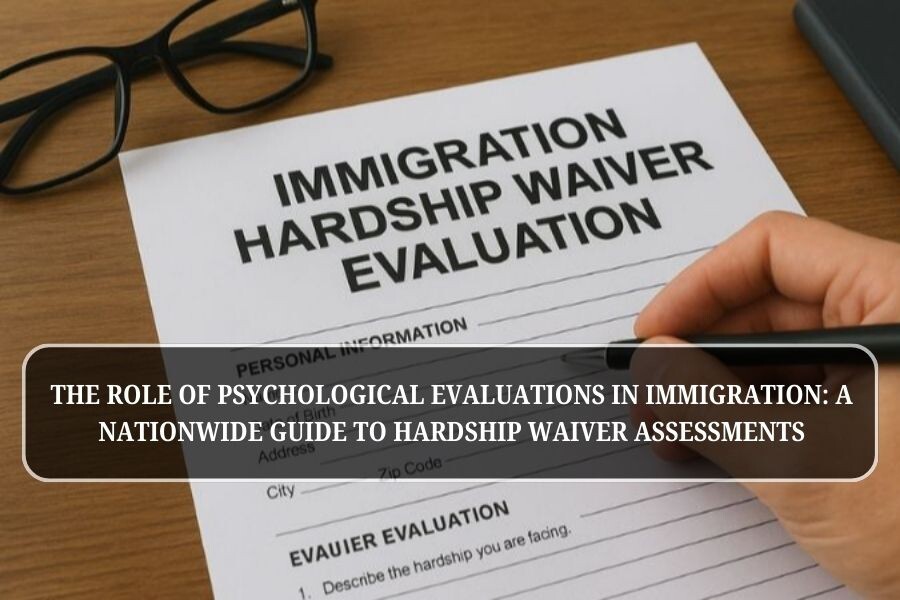
The Role of Psychological Evaluations in Immigration: A Nationwide Guide to Hardship Waiver Assessments

Navigating the United States immigration system is one of the most stressful experiences a family can face. When the success of your case depends on proving “Extreme Hardship,” a standard letter is rarely enough. In 2026, the Immigration Hardship Waiver Assessment has become a critical piece of evidence for USCIS officers deciding the fate of I-601 and I-601A waivers.

At AACS Counseling, we specialize in providing board-certified, forensic-level psychological evaluations for immigration cases in all 50 states.

What is an “Extreme Hardship” Assessment?

An Immigration Hardship Waiver Assessment is an in-depth clinical evaluation that documents the mental, emotional, and psychological impact that a deportation or separation would have on a “qualifying relative” (usually a U.S. citizen or permanent resident).

Because immigration law is Federal, our assessments are valid in any jurisdiction, from the USCIS field offices in New York to the immigration courts in Los Angeles.

Why Professionals Choose Nationwide Virtual Evaluations

In 2026, the trend in immigration law is Digital Advocacy. Secure telehealth allows you to work with specialists who specifically understand immigration law, rather than a local generalist who may not know USCIS requirements.

  • Specialized Expertise: We understand the nuances of the I-601, I-601A, VAWA, and U-Visa forms.

  • Multilingual Support: We provide culturally sensitive evaluations that respect the background of the applicant.

  • Fast Turnaround: Immigration deadlines are strict. Our virtual workflow allows us to deliver comprehensive reports in a fraction of the time of traditional clinics.

People Also Asked: 2026 Immigration FAQ

  • “Can a therapist in Georgia evaluate me if I live in Texas?” Yes. Immigration is a federal matter. Our clinical reports meet the national standards required by the Department of Homeland Security (DHS) and USCIS.

  • “How does the evaluation prove ‘Extreme Hardship’?” We look at factors such as chronic mental health conditions, the impact on children, financial dependencies, and the safety of the country of origin. We translate these human experiences into the clinical language that immigration officers look for.

  • “Is a virtual assessment as strong as an in-person one?” In 2026, the answer is a resounding yes. USCIS routinely accepts evaluations conducted via HIPAA-compliant video conferencing, recognizing it as a valid and professional medium for forensic interviews.

Specialized Evaluations We Provide

  1. I-601 and I-601A Waivers: Documenting the extreme hardship of a spouse or parent.

  2. VAWA (Violence Against Women Act) Assessments: Helping victims of domestic abuse document their trauma.

  3. U-Visa and T-Visa Applications: For victims of crimes or human trafficking who have suffered mental or physical abuse.

  4. Asylum Claims: Documenting PTSD and the psychological impact of persecution.

A Partner for Your Immigration Attorney

We don’t just work for you; we work with your legal team. Our clinicians are trained to produce reports that supplement the legal arguments made by your attorney, providing a professional medical and psychological foundation for your case.

Take the Next Step in Your Immigration Journey

Your future in the United States is too important to leave to chance. Ensure your “Extreme Hardship” is documented with the clinical precision it deserves.

Book Your Nationwide Immigration Assessment Today, Call AACS Counseling at 800-683-7745 for a confidential consultation.

What Is a Family Violence Intervention Program (FVIP)? A Complete US Guide

Family Violence Intervention Programs (FVIPs) play a crucial role in addressing domestic violence across the United States. These programs aim to hold offenders accountable while prioritizing the safety and well-being of victims. Understanding what FVIPs entail, their structure, and their effectiveness is vital for communities, legal professionals, and individuals seeking assistance.

In many cases, FVIPs are mandated by courts as an alternative to incarceration for individuals charged with domestic battery or related offenses. They are designed to educate participants about the dynamics of abuse, promote non-violent behavior, and foster positive change within relationships.

AACS Counseling is committed to providing comprehensive information and resources on such critical programs. We believe that informed communities are better equipped to tackle the complex issue of family violence effectively.

What Are FVIPs and Who Are They For?

A Family Violence Intervention Program (FVIP) is a structured educational and therapeutic program for individuals who have perpetrated family violence. These programs are often referred to as Batterer Intervention Programs (BIPPs).

The core objective of an FVIP is to stop abusive behavior, ensure victim safety, and promote offender accountability. Participants learn to recognize abusive patterns, understand the impact of their actions, and develop non-violent communication and coping strategies.

Typically, courts mandate participation in an FVIP following a domestic violence conviction or as part of a diversion agreement. However, some individuals may seek these programs voluntarily.

Adult vs. Juvenile Programs

FVIPs cater to both adult and juvenile populations, recognizing that family violence can manifest across all age groups.

Adult Programs

These are the most common FVIPs, targeting individuals charged with domestic battery, assault, or other family violence offenses. They focus on re-educating adults about power and control dynamics, challenging abusive beliefs, and teaching anger management and conflict resolution skills.

Juvenile Programs

Increasingly, states are implementing specific FVIPs for young offenders. For example, in Palm Beach County, Florida, and recognized by NACo, diversion programs target juveniles aged approximately 9-18 charged with domestic battery or assault. These youth FVIPs aim to intervene early and prevent future violence.

Juvenile programs often involve voluntary participation, mediation, case plans, and supervision. They may include services like counseling, substance abuse support, telemental health, and even home or school visits as needed.

How FVIPs Work: Structure and Requirements

FVIPs generally follow a structured curriculum designed to dismantle beliefs that perpetuate violence. Programs emphasize that abuse is a choice, not a loss of control, and hold participants responsible for their actions.

Most programs operate in a group setting, facilitating peer interaction and accountability. Participants engage in discussions, exercises, and role-playing to practice new behaviors. The curriculum covers topics such as:

  • Understanding the cycle of violence
  • Identifying power and control tactics
  • Developing healthy communication skills
  • Managing anger and stress constructively
  • Recognizing the impact of abuse on victims and children
  • Promoting gender equality and respect

Court-ordered FVIPs often require strict attendance and compliance. Failure to complete the program can result in further legal consequences, including incarceration.

State Variations (e.g., Georgia 24 Weeks)

The structure and duration of FVIPs vary significantly by state. These differences reflect local laws, available resources, and philosophical approaches to intervention.

For instance, in Georgia, certified Family Violence Intervention Programs are typically 24 weeks long. They are court-mandated under O.C.G.A. 19-13-16 and certified by the Department of Community Supervision.

Other states may have different requirements. Many batterer intervention programs follow a 52-week model. It is essential for individuals to understand the specific mandates in their state or jurisdiction. AACS Counseling can help guide you to appropriate resources for understanding your local requirements.

Effectiveness and Recidivism Data

The effectiveness of FVIPs and BIPPs in reducing domestic violence recidivism is a subject of ongoing research and evaluation. While no program guarantees a complete cessation of violence, studies indicate positive outcomes for program completers.

A study by the Texas Council on Family Violence, which analyzed 1,667 participants, found that 78% of FVIP completers avoided rearrest, compared to 69.5% of non-completers. Specifically for family violence rearrests, completers showed significantly lower rates:

GroupRearrest Rate (1-year)Rearrest Rate (3-year)
FVIP Completers1.1%2.9%
FVIP Non-CompletersHigher than completersHigher than completers

The Duluth Model, a widely recognized framework for batterer intervention, also demonstrates positive impacts. Evaluations of Duluth Model programs showed 47% lowest further assaults for court-mandated participants, compared to 59% for those receiving usual police intervention. Furthermore, 60% of victims reported feeling safer, and 69% experienced no recent physical abuse at a 1-year follow-up after the abuser’s program attendance.

These statistics highlight the potential of FVIPs as a critical tool in breaking the cycle of violence and supporting victims.

Costs, Certification, and Access

Participating in an FVIP involves various considerations, including costs, program certification, and accessibility.

Costs

Program fees vary by state and provider. In Georgia, for instance, FVIP classes typically average $25-30 per session, with a maximum of $60. Many programs offer a sliding scale fee structure for indigent participants to ensure accessibility, reflecting a commitment to helping individuals regardless of their financial situation.

Certification

FVIPs must be certified by a state-appointed authority to ensure they meet specific standards and curriculum requirements. In Georgia, the Department of Community Supervision handles this certification. Other states have similar certifying bodies. Certification ensures that programs are evidence-based and prioritize victim safety and offender accountability.

Access

Access to FVIPs can be a challenge, particularly for individuals in low-income or rural areas. Programs aim to offer services through various modalities, including in-person and increasingly, telemental health options. Common services included within a typical FVIP are:

  • Individual and group counseling
  • Case management and personalized case plans
  • Regular supervision and progress monitoring
  • Referrals for substance abuse support
  • Life skills development and education
  • Mediation services (especially in juvenile diversion programs)

AACS Counseling understands the importance of accessible and certified programs. We strive to provide information that helps individuals find appropriate FVIPs that meet their needs and legal requirements.

Victim Safety and Best Practices

At the heart of every effective Family Violence Intervention Program is a steadfast commitment to victim safety. These programs are not just about changing offender behavior; they are about protecting those who have been harmed.

Best practices for FVIPs include:

  • Victim-Centered Approach: Programs must prioritize the physical and emotional safety of victims above all else. This includes ensuring victims are not blamed for the abuse.
  • Offender Accountability: FVIPs teach participants to take full responsibility for their actions, challenging justifications and excuses for violence.
  • Coordinated Community Response: Effective programs integrate with victim advocacy services, law enforcement, courts, and child protective services. This ensures a consistent, comprehensive approach to domestic violence.
  • Regular Evaluation: Ongoing evaluation of program effectiveness, including feedback from victims, is crucial for continuous improvement. The Duluth Model, for example, heavily emphasizes this aspect.

When an abuser attends a program, victims often report feeling safer. This sense of security is a direct outcome of the program’s focus on accountability and the broader community’s coordinated efforts.

State-by-State Directory (Overview)

As discussed, the landscape of Family Violence Intervention Programs varies significantly across the United States. There is no single federal standard for FVIPs, meaning each state develops its own laws, requirements, and certification processes. This decentralized approach can make navigation challenging for individuals seeking specific information.

For example, while Georgia mandates a 24-week program, other states may require 52 weeks of participation. Costs, curriculum specifics, and certifying bodies also differ widely. For precise, state-specific details, individuals should consult their local court system or state domestic violence coalition.

State (Example)Typical Program LengthEstimated Session CostCertifying Body (Example)
Georgia24 weeks$25-60 (sliding scale)Dept. of Community Supervision
TexasVariable (often 18-36 weeks or 52 hours)VariableTexas Council on Family Violence (TCFV) provides standards and resources, programs are often certified at local level
FloridaVariable (often 26-52 weeks)VariableFlorida Certification Board (for some programs), or local court-approved

When searching for a program, use terms like “batterer intervention programs near me” or “court mandated DV classes [your state]” to find local, certified options. AACS Counseling recommends verifying the certification status of any program you consider, as this ensures compliance with state standards and a commitment to effective intervention.

FAQs and Next Steps

What is a Family Violence Intervention Program (FVIP)?

An FVIP is a structured program designed to educate individuals who have perpetrated family violence, helping them understand abusive behaviors, develop non-violent coping mechanisms, and take accountability for their actions. It aims to prevent future violence and ensure victim safety.

How long is a court-mandated FVIP in Georgia?

In Georgia, court-mandated FVIPs typically require 24 weeks of participation. These programs are certified by the Department of Community Supervision and adhere to specific state guidelines.

Are FVIPs only for adults or also for juveniles?

FVIPs exist for both adults and juveniles. While adult programs are common for convicted offenders, juvenile diversion programs target young people aged 9-18 charged with domestic battery, offering early intervention and support services.

What happens if you complete a batterer intervention program?

Successful completion of a court-mandated program often results in the fulfillment of legal obligations, potentially leading to reduced sentences, probation completion, or the dismissal of charges. More importantly, completers show significantly lower rates of recidivism and an improved understanding of healthy relationship dynamics.

How much do FVIP classes cost?

Costs for FVIP classes vary by state and provider. In Georgia, sessions may range from $25 to $60, often with a sliding scale available for those with limited financial means. It’s best to inquire directly with certified programs in your area for exact fees.

Can FVIPs reduce domestic violence recidivism?

Yes, research indicates that FVIPs can significantly reduce domestic violence recidivism. Studies, like the one from the Texas Council on Family Violence, show that program completers have lower rates of rearrest for family violence compared to those who do not complete the program.

What is the difference between FVIP and anger management classes?

While anger management may be a component of an FVIP, the programs are distinct. FVIPs address the broader dynamics of power and control in abusive relationships, recognizing that domestic violence is often a pattern of chosen behaviors, not just a result of uncontrolled anger. Anger management, by itself, is generally insufficient to address the complexities of family violence.

If you or someone you know needs to understand more about Family Violence Intervention Programs, or requires support related to domestic violence, AACS Counseling is here to help. Our resources and guidance can connect you with appropriate programs and support services in your community, fostering a path toward safety and accountability.

How Long Does a US Immigration Hardship Waiver (I-601A) Take in 2026?

Navigating the United States immigration system can feel like a complex journey, especially when facing issues like unlawful presence. The I-601A Provisional Unlawful Presence Waiver offers a path forward for many, allowing individuals to seek a waiver while still in the U.S. However, a common question for applicants is: “How long will this process actually take?”

Understanding the current processing times for the I-601A Immigration Hardship waiver in 2026 is crucial for planning your future. These timelines can fluctuate significantly due to various factors, including USCIS workload, the complexity of your case, and how thoroughly your application is prepared. At AACS Counseling, we understand the anxiety that comes with these wait times and aim to provide clear, up-to-date information to help you manage expectations.

Current I-601A Processing Times in 2026

The processing times for Form I-601A, Application for Provisional Unlawful Presence Waiver, are subject to change and can vary. As of early 2026, applicants are experiencing varied waits, with some estimates extending beyond two years.

USCIS Data & Average Wait Times

Official USCIS data, as analyzed by various immigration law firms, provides insight into the current landscape. While individual cases differ, average and median processing times give a general idea of what to expect.

  • As of January 2026, the average processing time for an I-601A waiver is approximately 28.5 months.
  • For fiscal year 2025 (FY2025), the median processing time was around 32 months.
  • Approximately 80% of I-601A cases were completed within 37 months, according to recent legal analysis. Other reports indicate that 80% of cases in early 2024 took up to 43.5 months.

It is important to remember that these are averages. Simpler cases with strong evidence might be processed more quickly, sometimes within 8-14 months, while more complex applications often take longer.

Historical Trends: A Look Back

Understanding past trends can help contextualize current wait times. The I-601A processing times have seen notable fluctuations over recent fiscal years:

Fiscal Year (FY)Median I-601A Processing Time (Months)
FY202011.2 months
FY202117.1 months
FY202231.7 months
FY202343.0 months
FY202441.2 months

These historical figures demonstrate a general increase in processing times, reflecting growing backlogs and demand. This trend underscores the importance of submitting a complete and robust application from the outset.

I-601A vs. I-601 Waiver: Key Differences

Many applicants confuse the I-601A Provisional Waiver with the traditional I-601 Waiver. While both address inadmissibility, their application processes and specific purposes differ significantly.

The I-601A Provisional Unlawful Presence Waiver is specifically for individuals in the U.S. who are inadmissible solely due to unlawful presence. It allows them to apply for the waiver before leaving the U.S. for their consular interview. This aims to minimize the time spent abroad and the risk of being denied re-entry.

The I-601 Application for Waiver of Grounds of Inadmissibility is broader. It covers various grounds of inadmissibility, including unlawful presence, but also criminal offenses, fraud, and misrepresentation. This waiver is typically filed *after* a consular interview abroad, or in some cases, with USCIS for adjustment of status. Its median processing time is generally shorter, around 20.5 months according to DHS data, but it requires the applicant to be outside the U.S. for a potentially indefinite period.

Factors Affecting Your I-601A Timeline

Several variables can influence how long your I-601A waiver takes. Understanding these factors can help you prepare a stronger application and potentially reduce delays.

  • USCIS Workload and Backlogs: The volume of applications USCIS receives directly impacts processing times. High application volumes often lead to increased backlogs and longer waits.
  • Case Complexity: Straightforward cases with clear evidence of extreme hardship tend to be processed faster. Cases involving complex legal issues, extensive criminal history, or difficult-to-prove hardship often require more scrutiny and time.
  • Completeness and Accuracy of Application: A fully completed application with all required documentation is essential. Missing information or errors will almost certainly cause delays.
  • Geographic Location: While I-601A waivers are processed centrally, the USCIS service center’s specific workload can indirectly affect overall timeliness. Regions with higher immigration populations, like California, Texas, and Florida, often experience more significant backlogs.

Common Delays to Watch For

Despite careful preparation, certain issues can still extend your processing time:

  • Requests for Evidence (RFEs): If USCIS believes your application lacks sufficient evidence or clarity, they will issue an RFE. This pauses your case until you provide the requested information.
  • Administrative Processing: Some cases may undergo additional administrative review for various reasons, adding unforeseen delays.
  • Consular Processing Delays:Even after I-601A approval, delays can occur during the subsequent consular interview process abroad, depending on the embassy’s specific workload and procedures.
  • Changes in Immigration Policy: New policies or changes to existing regulations can sometimes impact processing priorities and timelines.

Strategies for Responding to RFEs (Request for Evidence)

Receiving an RFE can be disheartening, but it’s not a denial. It’s an opportunity to strengthen your case. Prompt and thorough responses are key.

When you receive an RFE, carefully read every detail. Understand exactly what additional information or documentation USCIS requires. Do not guess or assume. Gather all requested evidence, ensuring it is well-organized, clearly labeled, and directly addresses the points raised in the RFE. Sometimes, the RFE asks for clarification or specific details about your extreme hardship claim or supporting documents. At AACS Counseling, we advise clients to respond comprehensively and within the given deadline, typically 30 to 87 days. Missing this deadline could lead to denial.

Step-by-Step I-601A Provisional Waiver Process

The I-601A provisional waiver process involves several distinct stages, each requiring careful attention

  1. File Form I-130 / I-140: The first step is to have a U.S. citizen or Legal Permanent Resident (LPR) relative file a qualifying immigrant petition on your behalf.
  2. I-130 Approval and Visa Availability: Once the I-130 (or I-140) is approved, you must wait for your visa category to become current according to the Visa Bulletin.
  3. File Form I-601A: Only after your visa is available and you’ve paid the immigrant visa processing fee to the National Visa Center (NVC) can you file Form I-601A with USCIS. This is submitted while you are still in the U.S.
  4. Biometrics Appointment: USCIS will schedule a biometrics appointment to collect fingerprints, photos, and signatures.
  5. USCIS Decision: USCIS processes the I-601A application. This is the stage where the prolonged wait times occur.

Eligibility Checklist

To be eligible for an I-601A provisional waiver, you generally must meet the following criteria:

  • Be at least 17 years old at the time of filing.
  • Be physically present in the United States.
  • Be the beneficiary of an approved immediate relative (spouse, parent, or unmarried child under 21 of a U.S. citizen) or family preference (certain relatives of U.S. citizens or LPRs) petition.
  • Have an immigrant visa case pending with the Department of State (DOS) based on the approved petition.
  • Be inadmissible only on account of unlawful presence (more than 180 days but less than 1 year, or 1 year or more).
  • Demonstrate that your U.S. citizen or LPR spouse or parent would suffer “extreme hardship” if you were denied admission to the U.S.
  • Not be subject to any other grounds of inadmissibility.

What Happens After I-601A Approval?

An I-601A approval is a significant milestone, but it’s not the final step. Here’s what typically follows:

  • Consular Interview Scheduling: After approval, the NVC will schedule your immigrant visa interview at a U.S. Embassy or Consulate abroad. The time for scheduling can vary by country, from a few weeks to several months.
  • Travel Abroad: You will then travel to your home country for the immigrant visa interview. The provisional waiver protects you from the unlawful presence bar upon your return.
  • Visa Issuance: If the consular officer approves your visa, it will be issued, and you can return to the U.S. as a Lawful Permanent Resident.
  • Green Card: Upon entry to the U.S. with your immigrant visa, your Green Card will be mailed to you.

The entire process, from I-601A approval to receiving your Green Card, can take several more months. Working with an experienced immigration attorney and a compassionate support team like AACS Counseling can make this intricate journey more manageable.

Preparing Compelling Evidence

Gathering comprehensive evidence is paramount for a successful extreme hardship claim. Here’s a list of document examples:

  1. Medical Documentation: Doctor’s letters, diagnoses, treatment plans, prescriptions, and therapist notes for the qualifying relative (or applicant, if relevant to relative’s hardship).
  2. Financial Records: Bank statements, tax returns, employment letters, mortgage/rent agreements, utility bills, and evidence of debts (e.g., student loans, credit card statements) for the qualifying relative.
  3. Psychological Evaluations: Assessments from licensed mental health professionals detailing the emotional and psychological impact of separation on the qualifying relative.
  4. Educational Records: School enrollment, transcripts, or specialized educational needs of children, if applicable, showing disruption if the qualifying relative were to relocate or separate.
  5. Community Ties: Letters from community leaders, religious figures, employers, or volunteer organizations detailing the qualifying relative’s contributions and reliance on their presence.
  6. Affidavits: Sworn statements from the qualifying relative, family members, friends, or colleagues describing the hardship.
  7. Country Conditions Information: Evidence of adverse conditions in the applicant’s home country if the qualifying relative would be forced to relocate there (e.g., lack of medical care, safety concerns, economic instability).

The more detailed and well-supported your evidence, the stronger your case for extreme hardship. This is where the expertise of an immigration professional, like those who collaborate with AACS Counseling, becomes invaluable.

Why Expert Guidance Matters

Given the complexities, ever-changing processing times, and the high standard of “extreme hardship,” seeking professional guidance for your I-601A waiver is highly recommended. An experienced immigration attorney can help you:

  • Determine your eligibility for the waiver.
  • Strategize the most effective way to demonstrate extreme hardship.
  • Compile and organize all necessary documentation.
  • Craft a persuasive legal argument.
  • Respond effectively to RFEs and other USCIS communications.
  • Navigate the post-approval consular process.

While hiring a lawyer does not guarantee a faster processing time, it significantly increases the likelihood of approval by ensuring your application is complete, accurate, and compelling. This proactive approach can help you avoid common pitfalls and delays. AACS Counseling works alongside trusted legal professionals to ensure you receive comprehensive support.

Frequently Asked Questions (FAQs)

How long does I-601 waiver take in 2026?

As of early 2026, the median processing time for an I-601 waiver is around 20.5 months. This can vary based on the specific USCIS office or consular post, case complexity, and current backlogs.

What is extreme hardship for immigration waiver?

Extreme hardship refers to suffering that goes beyond the normal difficulties of separation or relocation. USCIS considers the cumulative effects of various factors, including medical, financial, educational, and psychological impacts on a qualifying U.S. citizen or LPR spouse or parent.

Can I check my I-601A status online?

Yes, you can check your I-601A case status online using the receipt number provided by USCIS. Visit the official USCIS website and enter your 13-character receipt number to get updates on your application.

What causes delays in hardship waiver processing?

Common causes of delays include high USCIS caseloads, requests for evidence (RFEs) due to incomplete or unclear applications, administrative processing, and the overall complexity of the case. Backlogs at specific service centers can also contribute.

How to prepare evidence for I-601A approval?

Prepare comprehensive evidence including medical records, financial documents, psychological evaluations, educational records, affidavits, and proof of community ties. All evidence should directly support your claim of extreme hardship to your U.S. citizen or LPR spouse or parent.

Are there premium processing options for waivers?

No, unfortunately, premium processing is not available for I-601A or I-601 waivers. These forms are not currently eligible for expedited processing for an additional fee.

What happens if I get an RFE on my waiver?

If you receive a Request for Evidence (RFE), you must provide the requested information or documentation within the specified deadline. Your case is paused until USCIS receives your response. A timely and thorough response is crucial to avoid denial and further delays.

Conclusion

The I-601A Provisional Unlawful Presence Waiver offers a critical pathway for many individuals to resolve their immigration status. However, the journey involves significant waiting periods, with average processing times stretching to over two years in 2026. These timelines can be influenced by numerous factors, including USCIS backlogs, the thoroughness of your application, and your ability to demonstrate extreme hardship.

Given the complexities, understanding the process and preparing a robust application are essential. While no one can guarantee a specific processing time, a meticulously prepared case can help mitigate delays. For personalized guidance and support throughout this challenging process, consider consulting with experienced immigration professionals. AACS Counseling is dedicated to helping individuals and families navigate their immigration journeys with confidence and clarity.

What to Do If You Get a DUI in Another State: A Complete Guide

Getting a Driving Under the Influence (DUI) charge is a stressful experience, and the complexities multiply significantly when it happens in a state other than your home state. You face not only the laws of the arresting state but also potential repercussions in your state of residence. Understanding these dual challenges is crucial for navigating the legal process successfully.

This guide provides a comprehensive overview of what to expect and the steps you should take if you receive an out-of-state DUI. It covers everything from immediate actions to long-term consequences, helping you prepare for the road ahead. Remember, while this information is designed to be helpful, it is not a substitute for legal advice. For personalized guidance and support during this challenging time, resources like AACS Counseling can be invaluable.

Immediate Steps After an Out-of-State DUI Arrest

The moments immediately following a DUI arrest in another state are critical. Your actions during this time can significantly impact the outcome of your case. Understanding your rights and responsibilities is paramount.

Request a DMV Hearing

Upon arrest for a DUI, the arresting state’s Department of Motor Vehicles (DMV) or equivalent agency will likely initiate administrative action against your driving privileges within that state. This administrative suspension is separate from any criminal penalties.

You typically have a very limited window—often just 7 to 10 days—to request an administrative hearing to challenge this suspension. Failing to do so usually results in an automatic suspension of your right to drive in the arresting state. According to research, in Arizona, an administrative per se suspension can be 90 days, starting 30 days post-arrest unless a hearing is requested.

Contact a Lawyer

The most important step you can take after an out-of-state DUI arrest is to contact a qualified attorney. A lawyer specializing in DUI cases in the arresting state is essential. They understand local laws, court procedures, and how to best represent your interests.

An experienced attorney can advise you on your rights, represent you at court dates (sometimes without your physical presence for misdemeanor cases), and work to protect your driving privileges. This legal guidance is vital for navigating the complex legal systems of two different states. Beyond legal representation, AACS Counseling offers programs that can support you through the emotional and educational aspects of a DUI charge.

License Suspension in Two States

One of the most concerning aspects of an out-of-state DUI is the potential for dual license suspensions. This means your driving privileges could be suspended in both the state where you were arrested and your home state.

The arresting state will first suspend your driving privileges within its borders. Your home state is then typically notified of the conviction. Depending on interstate agreements, your home state may then impose its own suspension, which can sometimes be longer or include additional requirements than the arresting state’s penalties.

For example, if the arresting state suspends your license for six months, your home state might impose a one-year suspension. This dual impact underscores the severity of out-of-state DUI charges.

Interstate Driver’s License Compact Explained

The primary mechanism by which states communicate DUI convictions is the Interstate Driver’s License Compact (IDLC). Most U.S. states are members of this agreement. The Compact ensures that member states report traffic violations, including DUIs, to an offender’s home state.

How the Compact Works

When you are convicted of a DUI in a Compact member state, that state reports the conviction to your home state’s DMV. Your home state then typically treats the out-of-state conviction as if it occurred within its own jurisdiction, applying its own penalties, points, or suspension periods.

However, the Compact generally requires that the DUI laws be “substantially similar” for the home state to honor the suspension or apply equivalent penalties. An attorney can sometimes challenge the home state’s recognition of an out-of-state conviction if the laws are not considered substantially similar.

It is important to note that not all states are members of the IDLC, and some member states have varying interpretations or requirements for how they process out-of-state convictions. Checking the specifics for your home state and the arresting state is crucial.

Penalties and Fines Breakdown

The penalties for a DUI vary significantly by state and depend on factors such as your blood alcohol content (BAC), prior offenses, and whether there were any aggravating circumstances (e.g., an accident or minors in the vehicle).

Generally, DUI penalties involve a combination of jail time, substantial fines, license suspension, mandatory education programs, and the installation of an ignition interlock device (IID).

Example Penalties for a First-Time DUI

Here’s a general overview, using Arizona as a primary example, as it’s a state with high regional interest for these queries:

Penalty TypeFirst-Time DUI (Standard)First-Time Extreme DUI (BAC 0.15%+)Repeat Offender (General)
Jail TimeMinimum 10 days (9 possibly suspended)Minimum 30 daysSignificantly longer (e.g., 90 days to 6 months+)
Fines & FeesAt least $1,500Up to $2,500Thousands more, plus surcharges
License Suspension90 days (AZ administrative)90 days (AZ administrative)Typically 1 year or more
Ignition Interlock Device (IID)12 months12 monthsLonger period (e.g., 18-24 months)
DUI Education/TreatmentMandatoryMandatoryMandatory, potentially more intensive

Beyond these, you may incur court costs, probation fees, and community service requirements. The financial burden alone can be substantial.

Long-Term Consequences of an Out-of-State DUI

The impact of an out-of-state DUI extends far beyond the initial penalties. These charges can create lasting repercussions that affect various aspects of your life.

  • Increased Insurance Rates: A DUI conviction, even if out-of-state, will almost certainly increase your car insurance premiums. Many insurers will classify you as a high-risk driver, leading to significantly higher rates for several years.
  • Job Opportunities: A criminal record, including a DUI, can affect future employment prospects. Some professions, particularly those requiring driving, licensing, or security clearances, may be unattainable or jeopardized. This is a crucial area where AACS Counseling can provide support for personal development and managing consequences.
  • Travel Restrictions: Certain countries, such as Canada, have strict policies regarding individuals with DUI convictions. Even a single misdemeanor DUI can make you inadmissible to Canada without special permission.
  • Commercial Driver’s License (CDL) Impact: For those holding a CDL, an out-of-state DUI can be particularly devastating. Even a first offense can lead to disqualification from commercial driving for a year or more, depending on federal and state regulations. A second offense can result in a lifetime disqualification.
  • Immigration Consequences: For non-citizens, a DUI conviction can have serious immigration consequences, potentially affecting visa status, green card applications, or even leading to deportation in certain circumstances. It is essential for non-citizens to seek legal counsel immediately.

State-Specific Impacts: AZ, CA, and TX Examples

While the general framework of DUI laws is similar across states, specific penalties and administrative processes can vary. Here’s a brief look at how an out-of-state DUI might be handled in popular tourist/travel states:

AspectArizona (AZ)California (CA)Texas (TX)
First-Time BAC 0.08%+ Suspension (Arresting State)90 days (administrative, unless hearing requested)4 months (administrative, unless hearing requested)90 days to 1 year (administrative)
Home State ReportingVia IDLCVia IDLCVia IDLC
Ignition Interlock (First Offense)12 months6 months minimum6 months to 2 years
Hardship License AvailabilityLimited (after initial hard suspension period)Yes (after initial 30-day hard suspension)Yes (Occupational License)
DUI School/EducationMandatoryMandatory (3-9 months)Mandatory (DWI Education Program)

Hardship Licenses

A hardship license, often called a restricted or occupational license, may allow you to drive for specific purposes (like work, school, or medical appointments) during your suspension period. The availability and requirements for a hardship license vary significantly by state. Both your home state and the arresting state may have different rules, and you might need to apply in both jurisdictions or fulfill specific requirements from each. Consulting with an attorney is essential to understand your options.

DUI Action Checklist: Your First 30 Days

This checklist provides a general timeline of crucial actions to consider after an out-of-state DUI arrest:

Within 24-48 Hours: Remain silent except for basic identification. Do not discuss your case with anyone other than your attorney. Arrange for bail if necessary and secure transportation.

Within 7-10 Days (Varies by State): Contact a lawyer in the arresting state immediately. Instruct your lawyer to request an administrative hearing with the arresting state’s DMV to contest your automatic license suspension. This deadline is critical and often missed.

Within the First Week: Your attorney will begin gathering evidence, reviewing police reports, and advising you on court appearances. Discuss strategies for both the administrative hearing and the criminal case.

Throughout the Process: Communicate regularly with your attorney. Attend all required court dates and administrative hearings, or ensure your attorney appears on your behalf if permissible (usually for misdemeanors). Begin exploring DUI education or counseling resources, such as those offered by AACS Counseling, to demonstrate proactive responsibility.

Beyond 30 Days: If convicted, comply fully with all court-ordered penalties (fines, jail, DUI school, IID installation). Check with both your arresting state’s DMV and your home state’s DMV regarding license reinstatement requirements and any dual suspensions or requirements.

Frequently Asked Questions About Out-of-State DUIs

What happens to my driver’s license if I get a DUI in another state?

Your driver’s license can be suspended in the state where you received the DUI. Through the Interstate Driver’s License Compact, your home state will likely be notified and may impose its own separate suspension or additional penalties.

Does my home state suspend my license for an out-of-state DUI?

Yes, in most cases. If your home state is a member of the Interstate Driver’s License Compact, it will typically treat the out-of-state DUI conviction as if it occurred within its borders and apply its own penalties, including license suspension.

How long does an out-of-state DUI stay on my record?

The duration an out-of-state DUI stays on your record varies by state. Some states keep DUI convictions on your driving record for 5-10 years, while others, like California, can keep it for 10 years, and some even indefinitely on your criminal record. This can impact future employment, insurance, and travel.

Can I drive in my home state during an out-of-state DUI suspension?

Generally, no. Since your home state will typically suspend your license upon receiving notice of the out-of-state DUI, driving during that suspension would be illegal and could result in further penalties.

Do all states report DUI convictions to each other?

Most states (45 out of 50) are members of the Interstate Driver’s License Compact, which facilitates the reporting of DUI convictions to your home state. However, some states, like Georgia, Massachusetts, Michigan, Tennessee, and Wisconsin, are not members, which can affect the reporting process, though other interstate agreements may still apply.

Can a lawyer handle my out-of-state DUI court dates without me?

For misdemeanor DUI charges, an attorney can often appear on your behalf, especially for preliminary hearings. However, for felony DUIs or at certain critical junctures of a misdemeanor case, your personal appearance may be mandatory. Your attorney can advise you on specific requirements.

Will an out-of-state DUI increase my car insurance rates?

Yes, an out-of-state DUI conviction will almost certainly lead to a significant increase in your car insurance rates. Insurers consider a DUI a major risk factor, leading to higher premiums for several years.

Navigating Your Next Steps

Receiving an out-of-state DUI is a serious matter with complex legal and personal consequences. The dual challenges of managing administrative and criminal proceedings in a foreign jurisdiction, along with the impact on your home state, can be overwhelming.

Seeking qualified legal counsel in the arresting state is your first and most critical step. Additionally, support services, such as those provided by AACS Counseling, can offer guidance and educational programs to help you understand and address the underlying issues related to your DUI. Taking proactive measures is key to mitigating the long-term impact of an out-of-state DUI conviction.

Call Now