For years, the transportation industry has buzzed with rumors about new drug testing methods. Drivers heard whispers about swabs replacing cups and changes to how the Department of Transportation (DOT) handles safety. Those rumors are now reality.
As of 2026, oral fluid testing is no longer “coming soon.” It is a fully implemented, primary testing option for DOT-regulated employers. This shift represents one of the most significant updates to 49 CFR Part 40 in decades.
Whether you are a fleet manager or a CDL holder, you need to understand how this change affects your daily operations and your career. This guide breaks down why the DOT added this method, how it changes “directly observed” tests, and what happens if you test positive.
The 2026 Shift: Oral Fluid Testing is Here
The transition is complete. While urine testing remains the standard for many companies, the DOT now officially recognizes oral fluid (saliva) testing as an equivalent alternative. This isn’t a pilot program or a limited experiment. It is a federally approved method that employers can utilize right now.
This update gives safety directors flexibility. They can use oral fluid testing for all testing reasons, including pre-employment, random, reasonable suspicion, post-accident, return-to-duty, and follow-up testing. If you are a driver, you need to be prepared for a mouth swab just as much as you are prepared for a urine collection.
Why the DOT Added Saliva Testing
The DOT didn’t add oral fluid testing just for variety. They introduced it to solve specific, long-standing problems inherent in urine testing. The two primary drivers for this change are integrity and efficiency.
Combating Cheating
The most critical advantage of oral fluid testing is the difficulty of cheating. In the world of urine testing, the market for “synthetic urine” and prosthetic devices has grown sophisticated. Drivers attempting to mask drug use often try to substitute samples behind the privacy of a closed stall door.
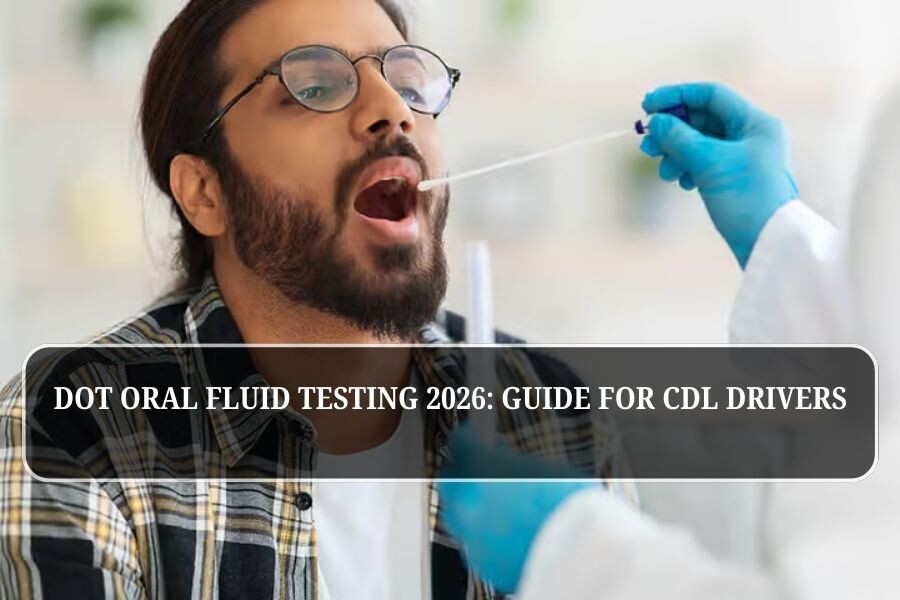
With oral fluid testing, privacy is not a factor in the same way. The collection is 100% observed. The collector watches the device go into your mouth, stays present while you hold it there, and watches it go back into the vial. There is no opportunity to swap the sample or introduce a neutralizing chemical. Because the sample comes directly from your body in front of a witness, the validity of the test is virtually guaranteed.
Solving the “Shy Bladder” Problem
For years, “shy bladder” syndrome has caused headaches for drivers and employers. Under 49 CFR Part 40.193, if a driver cannot provide a sufficient urine specimen, they must drink fluids and wait up to three hours. This kills productivity and costs money.
Oral fluid testing eliminates this delay. If a driver cannot provide a urine sample, the collector can now immediately switch to an oral fluid test. There is no three-hour wait and no need to drink excessive amounts of water. The problem is solved in minutes rather than hours.
A Better Way for “Directly Observed” Tests
One of the most uncomfortable aspects of DOT regulations is the “directly observed” collection. This is mandatory for Return-to-Duty (RTD) and Follow-up tests after a violation. In a urine collection, this requires a same-gender observer to watch the urine leave the body to ensure no cheating devices are used. It is invasive and often embarrassing for everyone involved.
Oral fluid testing is a game-changer for these scenarios. Because every oral fluid test is inherently observed (face-to-face), there is no need for the intrusive nature of an observed urine collection.
For drivers going through the Return-to-Duty process in 2026, this is a massive improvement. You simply sit opposite the collector and swab your mouth. It maintains the high security the DOT requires without the invasion of privacy associated with observed urine tests.
Saliva Drug Test vs Urine Test: Detection Windows
It is important to understand the science behind the swab. Oral fluid testing and urine testing look for the same drugs, but they see them differently.
- Urine Tests: These detect drug metabolites. They are excellent at seeing historical use—what you did a few days ago. However, it can take time for drugs to metabolize and appear in urine.
- Oral Fluid Tests: These detect the parent drug. They are superior at detecting recent use. A saliva test can identify drugs consumed within minutes or hours prior to the test.
This makes oral fluid testing particularly effective for reasonable suspicion and post-accident scenarios. If a safety manager suspects a driver is under the influence right now, a swab is often the more accurate tool for confirming current impairment versus past usage.
Employer Choice and the SAP Process
There is a common misconception that drivers can choose their test method. This is false.
The choice of test—urine or oral fluid—belongs exclusively to the employer. In some cases, the laboratory or collection site may make the determination based on logistics or “shy bladder” protocols. A driver cannot demand a swab if the employer has ordered a urinalysis, and refusing the employer’s chosen method constitutes a “Refusal to Test,” which is a career-ending violation.
The Consequences Remain the Same
If you fail an oral fluid test, the consequences are identical to failing a urine test.
- You are immediately removed from safety-sensitive functions.
- The violation is reported to the FMCSA Drug and Alcohol Clearinghouse.
- You must complete the Return-to-Duty process with a Substance Abuse Professional (SAP).
Do not mistake the “easier” collection method for a more lenient policy. The DOT holds oral fluid positives to the exact same legal and safety standards as urine positives. There is no “easier” way out of a violation.
Conclusion
The inclusion of oral fluid testing in 2026 streamlines the drug testing process. It closes loopholes for cheaters, solves the shy bladder delay, and offers a less invasive option for observed tests.
For professional drivers, the best strategy is compliance. Understand that a swab is now as standard as a cup. By staying informed about these regulations, you protect your CDL and contribute to safer roads for everyone.
Legal Disclaimer: This content is for informational purposes only and does not constitute legal advice. DOT regulations and 49 CFR Part 40 guidelines are subject to change. Drivers and employers should consult the official DOT Office of Drug and Alcohol Policy and Compliance (ODAPC) or legal counsel for the most current regulations and compliance requirements.