
For many parents, the phrase “child custody evaluation” triggers a wave of anxiety. It feels like your entire life, your parenting style, and your relationship with your children are being put under a microscope. If you are currently navigating a custody dispute, you likely have dozens of questions keeping you up at night. Will the evaluator understand my bond with my child? What if I say the wrong thing?
Take a deep breath. While the process is rigorous, it is designed with a single, crucial goal: to determine your child’s psychological best interests, helping you stay focused on what truly matters during preparation.
At AACS Counseling, we are here to support you at every stage of your child custody evaluation. This guide breaks down the evaluation process step-by-step, covers what evaluators look for, the specific questions you might face, and practical strategies to help you navigate this challenging time with confidence and grace.
Understanding Child Custody Evaluations
A child custody evaluation is a comprehensive investigation conducted by a mental health professional typically a psychologist or psychiatrist. It usually occurs when parents cannot agree on a parenting plan or when a judge needs more information to rule on custody and visitation.
Unlike a standard court hearing, where lawyers argue on your behalf, an evaluation is a forensic assessment. This means the evaluator acts as a neutral investigator. Their job is not to take sides but to gather objective data about your family dynamics. They assess the children’s needs and each parent’s ability to meet them.
Knowing that support from counselors and attorneys is available can reassure you, helping you feel less isolated and more confident during this process.
Ultimately, the evaluator provides a detailed report and recommendation to the court. While the judge has the final say, these recommendations carry significant weight because they come from an expert who has observed the family firsthand.
The Child Custody Evaluations Process
The process begins when the court appoints a specific evaluator, or when both parties agree on a private professional. Once the appointment is official, the clock starts ticking. However, patience is essential; a thorough investigation generally takes at least two months, and complex cases can take longer.
Steps in the Investigation
You should expect a multi-faceted approach to data gathering. The evaluator will not rely on a single interview to form an opinion. Instead, they will use several methods:
- Interviews: You will participate in individual interviews to discuss your background, parenting philosophy, and concerns. The evaluator will also interview the children (depending on their age) and potentially other adults involved in the children’s lives, such as teachers, doctors, or therapists.
- Home Visits and Observations: The evaluator typically visits each parent’s home. This allows them to see the environment where the child lives and observe interactions between you and your child in a natural setting.
- Record Reviews: Expect to sign releases for school records, medical files, and police reports. The evaluator reviews these to identify patterns in stability, attendance, and health care management.
- Psychological Testing: In many complete evaluations, parents undergo psychological testing to screen for personality disorders or mental health issues that could impact parenting capacity.
AACS Counseling can help you prepare for each of these phases, offering expert guidance on what evaluators are looking for and how you can present your parenting strengths authentically.
Special Circumstances
If your case involves allegations of domestic violence, substance abuse, or child neglect, the process adapts to address these safety concerns.
If there is a history of domestic violence, safety is the priority. You can request separate interviews to avoid being in the same room as the other parent. It is also vital to provide the evaluator with copies of any existing restraining orders or police reports immediately. The evaluator’s role in these scenarios shifts to include a risk assessment to determine whether unsupervised visitation is safe for the child.
AACS Counseling offers specialized support in high-conflict and trauma situations, helping you gather the proper documentation and communicate your concerns in a way that prioritizes your child’s well-being.
Key Questions in a Child Custody Evaluation
Evaluators ask targeted questions to assess specific areas of your life. Being prepared for these topics can help you answer honestly and clearly without getting confidence.
Parenting Capacity
These questions assess your daily involvement and ability to care for the child.
- “Describe your child’s daily routine from the moment they wake up until they go to sleep.”
- “How do you handle medical decisions? Who takes the child to the doctor?”
- “What discipline methods do you use when your child breaks a rule?”
- “How do you support your child’s educational needs?”
Co-Parenting Dynamics
The court favors parents who can facilitate a relationship with the other parent.
- “How do you communicate with the other parent about childcare or schedule changes?”
- “Describe your willingness to support the child’s relationship with the other parent.”
- “What positive attributes does the other parent bring to the child’s life?”
Home Environment
This assesses stability and logistical support.
- “Who lives in your household, and what is their relationship to the child?”
- “What childcare support do you have (e.g., grandparents, babysitters)?”
- “How does your work schedule impact your parenting time?”
Child-Focused Questions
These demonstrate how well you know your child as an individual.
- “What activities does your child enjoy most?”
- “How does your child react after returning from visits with the other parent?”
- “What are your child’s greatest strengths and biggest challenges?”
AACS Counseling can work with you to practice responding to common questions and highlight your dedication to your child’s needs.
Preparing for a Child Custody Evaluation
Preparation involves organizing your caregiving responsibilities by documenting who manages daily tasks like school drop-offs, medical visits, and activities, which can serve as objective proof of your involvement.
Start by documenting your caregiving responsibilities. Create a log or calendar that shows who takes the children to school, who attends medical appointments, and who manages extracurricular activities. If you are the primary parent handling these tasks, documentation serves as objective proof.
Next, focus on child-focused home preparation. Ensure your home is clean, safe, and appropriate for children. This doesn’t mean it needs to look like a model home, but it should be functional. The child should have a dedicated sleeping space and a study area. Verify that safety measures, like smoke detectors and secure storage for medications or firearms, are in place.
Finally, practice neutral communication. During the evaluation, you might feel tempted to vent about your ex-partner’s flaws. Resist this urge. Unless there is a safety issue (like abuse), disparaging the other parent often reflects poorly on you. Focus on your relationship with your child, not your conflict with your ex.
If you need help getting organized or shaping how you communicate, AACS Counseling offers dedicated preparation sessions to help you manage stress, plan documentation, and approach the evaluation with confidence.
Types of Custody Evaluations
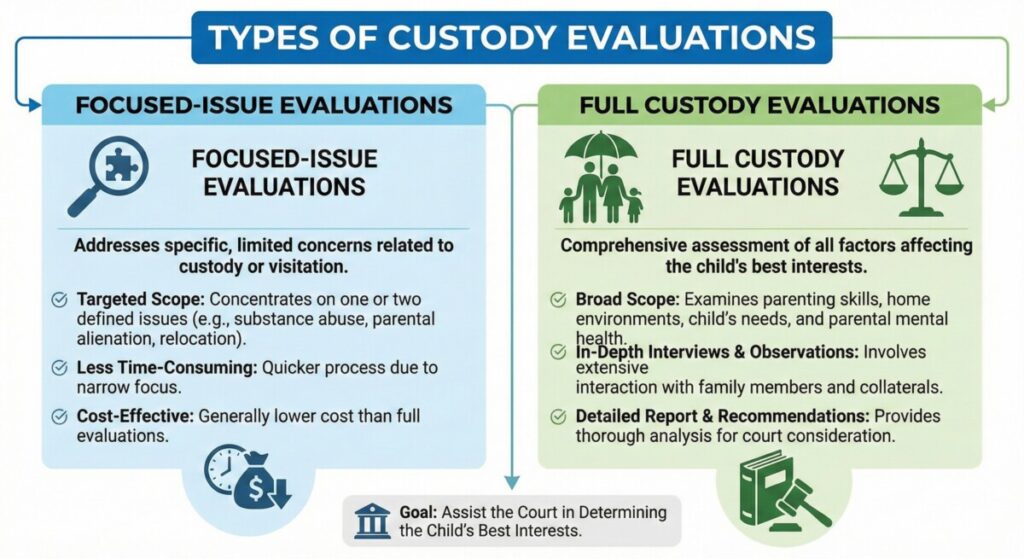
Not all evaluations are the same. Understanding the scope of yours helps set expectations.
Full Custody Evaluations
These are the most common in contentious cases. They cover every aspect of the family dynamic, including psychological testing, home visits, and comprehensive interviews. They result in a recommendation for legal and physical custody.
Focused-Issue Evaluations
Sometimes the court only needs answers on a specific topic. A focused-issue evaluation might look strictly at:
- A parent’s potential relocation.
- Allegations of substance abuse.
- The mental health of one parent.
- Whether a specific visitation schedule is working.
These are generally shorter and less expensive than complete evaluations but are limited in scope.
If you’re unsure what type of evaluation you’ll be facing, the team at AACS Counseling can walk you through the specifics and prepare you accordingly.
Role of Attorneys in Strengthening Your Position
Your attorney is your strategic partner during this process. They cannot sit in on the evaluation interviews, but they can prepare you for them.
Experienced family law attorneys often use mock evaluations. They will ask you tough, likely questions so you can practice answering without getting defensive or emotional. They can help you gather parenting class certificates or other proof of your dedication to improving your skills.
Attorneys also play a key role in witness preparation. If you have nannies, teachers, or family members who will speak to the evaluator, your attorney can help ensure they understand the process and what information is most relevant to the child’s welfare.
AACS Counseling works hand-in-hand with your legal counsel, offering evidence-based documentation and professional support that can reinforce your case.
After the Evaluation
Once the investigation concludes, the evaluator writes a confidential report. This document summarizes their findings and offers specific recommendations for custody, visitation schedules, and, at times, therapeutic interventions (such as family counseling).
The report is released to the attorneys and the court, but typically not directly to the parents to protect privacy. You will review it with your lawyer.
If the report is favorable, your attorney will likely use it to push for a settlement that mirrors the recommendations. If you strongly disagree with the findings, you have options. You can choose to contest the report in court. This might involve hiring an expert to review the evaluator’s methodology or cross-examining the evaluator during trial to expose biases or errors.
AACS Counseling can help you process the evaluation’s findings and support you in the following steps—whether that’s moving toward settlement, contesting a report, or strengthening your parenting approach.
Tips for Parents During the Evaluation
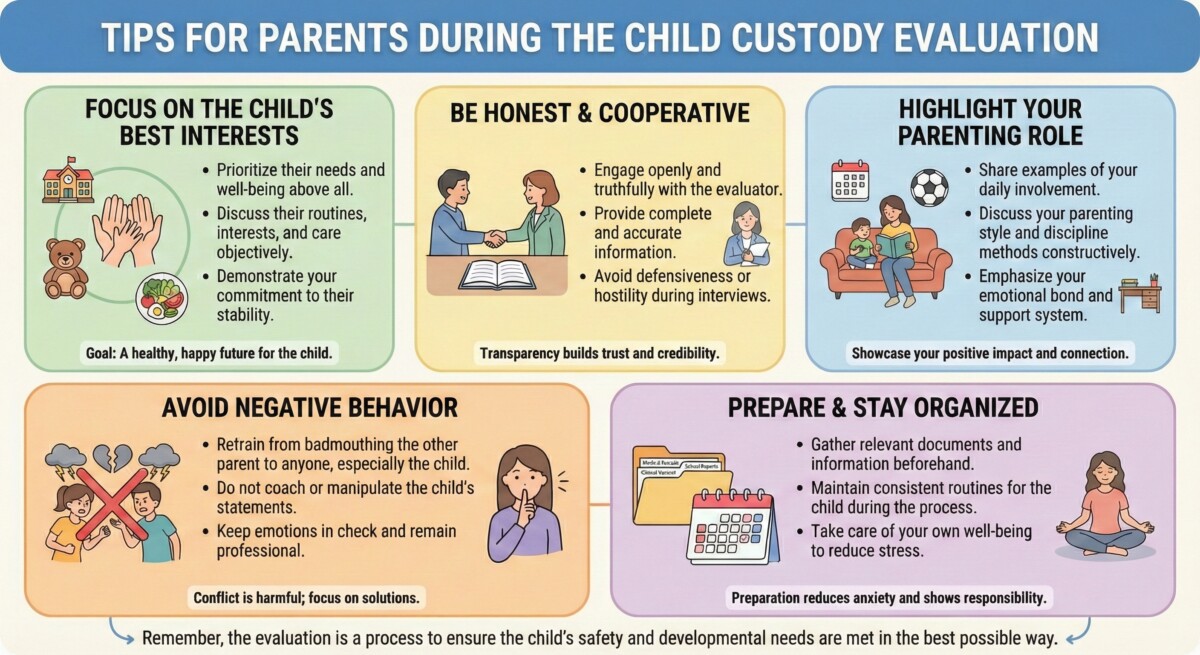
Success in an evaluation often comes down to attitude and organization.
- Be Honest: Evaluators are trained to spot deception. Admitting you aren’t perfect is far better than being caught in a lie. If you have a past mistake (like a DUI), own it and explain how you have learned from it.
- Keep the Child Center Stage: Frame every answer around your child. Instead of saying, “I want full custody because I miss him,” say, “I believe he needs the stability of a consistent routine during the school week.”
- Stay Organized: Keep copies of all documents you provide to the evaluator. If you promise to send a report card or a doctor’s note, do it immediately.
- Dress and Act Appropriately: Treat appointments like a job interview. Arrive on time, dress neatly, and be polite to everyone in the office.
AACS Counseling helps you manage stress and present your best self in every interaction with an evaluator.
Frequently Asked Questions (FAQs)
What factors most influence outcomes?
The most influential factors are typically the stability of the home environment, the strength of the emotional bond between parent and child, and the parent’s willingness to facilitate a relationship with the other parent.
How do I choose the right evaluator?
Ideally, your attorney will help you select a professional with a reputation for neutrality and thoroughness. Look for someone with specific experience relevant to your case, such as working with special needs children or handling high-conflict divorces. If you need recommendations, AACS Counseling can connect you with trusted evaluators in your area.
What if I disagree with the evaluation report?
You are not bound to accept the report as the final word. Your attorney can file motions to challenge it, depose the evaluator, or introduce contradictory evidence during the trial. AACS Counseling can help you prepare documentation and emotional support for this process.
Conclusion
A child custody evaluation is undoubtedly one of the most stressful hurdles in family law proceedings. However, it is also an opportunity. It is a chance for a neutral expert to see the love, care, and stability you provide for your children.
By preparing thoroughly, focusing on your child’s well-being, and maintaining a professional demeanor, you can navigate this process effectively. Remember, the goal is a healthy, happy future for your children. Stay focused on that horizon, and lean on your legal and mental health support systems—including AACS Counseling—to guide you through.
References
- American Psychological Association. (2010). Guidelines for Child Custody Evaluations in Family Law Proceedings
- California Courts. Child Custody Evaluations
- Georgia OCGA § 19-9-3 Child Custody Factors
- Child Custody Evaluations: Process and Tips
- Custody X Change. Georgia Custody Evaluations Guide
- For personalized support, counseling, or resources specific to your situation, contact AACS Counseling or consult with a qualified family law attorney.