Qualified SAP Counselor, Author at AACS Counseling - Page 8 of 33

DOT Clearinghouse 2026 Update: How SAP Results Affect Driver Records

DOT Clearinghouse 2026 Update: How SAP Results Affect Driver Records

Since 2020, the FMCSA Drug & Alcohol Clearinghouse has changed how every CDL driver is tracked, hired, suspended, or cleared for work.
But 2026 brings new updates that directly affect:

  • SAP Program reporting
  • Return-to-Duty timelines
  • Employer access to driver records
  • How long violations stay visible
  • What carriers see in your Clearinghouse profile

If you’re a CDL driver or employer, understanding these changes is critical.
This guide breaks down how SAP results now affect your driver record in 2026 — and how to protect your driving career.

What the Clearinghouse Tracks in 2026

Every DOT violation and every SAP-related action is logged — permanently.

The Clearinghouse records:

  • Positive drug or alcohol tests
  • Refusals to test
  • Actual knowledge violations
  • SAP initial evaluation
  • SAP education/treatment completion
  • Follow-up evaluation
  • Return-to-Duty test results
  • Follow-up testing plan

These records determine whether a driver is Prohibited or Eligible to return to duty.

How SAP Results Affect Your Driver Record

SAP results control the entire workflow inside the Clearinghouse.

Here’s how each step impacts your record:

1. SAP Initial Assessment (Triggers PROHIBITED Status)

Once a driver enters the DOT SAP Program:

  • Their Clearinghouse status becomes Prohibited
  • Employers cannot hire or retain the driver
  • Driver cannot perform safety-sensitive duties

This status stays locked until the RTD test is completed.

2. SAP Recommendations Show on Your Record

In 2026, employers see general categories such as:

  • Education program required
  • Treatment counseling required
  • Outpatient or multi-session requirements

They do not see sensitive personal details — only required actions.

3. SAP Follow-Up Evaluation (Eligibility Review)

Once you complete your recommendations:

  • SAP submits a Follow-Up Report
  • MRO and employer now can begin RTD scheduling
  • You’re cleared to take the RTD observed test

This updates your Clearinghouse with:

✔ “DOT SAP Program Completed
✔ “Eligible for Return-to-Duty Test

4. Return-to-Duty Test Result (Controls ‘NOT PROHIBITED’ Status)

A negative observed drug test is the ONLY action that removes your Prohibited status.

When the MRO uploads the result, your status immediately becomes:

NOT PROHIBITED — Eligible for Employment

This is the most important update on your record.

5. Follow-Up Testing Plan (Visible to Employers)

Once you complete RTD:

  • Employer receives your SAP follow-up plan
  • They must conduct all tests
  • Non-compliance must be reported

The plan can include:

  • 6–12 months (minimum)
  • Random drug/alcohol tests
  • Observed tests if required

This plan is fully visible inside your Clearinghouse employer profile.

How Long SAP Results Stay on Your Clearinghouse Record

Clearinghouse Entry Time Visible
DOT violation 5 years or until follow-up plan is complete
SAP Initial Evaluation Permanent internal record
SAP Recommendations Until RTD test is completed
RTD Negative Test Permanent
Follow-up Testing Plan Visible during testing period

This means your violation does not disappear when you complete SAP — but your eligibility changes.

2026 Clearinghouse Updates (Important Changes)

FMCSA has confirmed several updates rolling out through 2025–2026:

1. Faster Employer Reporting Requirements

Carriers must now report:

  • Refusals
  • Actual knowledge
  • Follow-up test results

Within 24 hours, not 72 hours.

This speeds up the RTD timeline but also means violations get logged faster.

2. Clearinghouse-to-State Syncing

States are now required to check Clearinghouse status before issuing or renewing:

  • CDL licenses
  • CLPs
  • Endorsements

Drivers cannot renew if they are in Prohibited status.

3. Real-Time SAP Documentation Uploads

SAPs are required to submit:

  • Assessment
  • Completion report
  • Follow-up plan

Directly through the Clearinghouse portal.

This removes delays previously caused by manual uploads.

4. Employers See “Eligibility Status” More Clearly

In 2026, employer dashboards highlight:

🔵 Eligible (RTD Completed)
🔴 Prohibited (SAP Required / In-Progress)

This makes hiring decisions faster — which benefits SAP-cleared drivers.

How SAP Results Impact CDL Job Opportunities in 2026

Positive Outcomes After SAP Program:

✔ You can apply for any CDL job
✔ Many carriers prefer SAP-cleared drivers
✔ You’re considered low-risk after completing a follow-up plan
✔ Your Clearinghouse shows accountability and compliance

Negative Outcomes If You Ignore SAP:

❌ Prohibited status stays forever
❌ You cannot be hired anywhere in the U.S.
❌ You may lose your CDL at renewal
❌ Violations remain unaddressed

How Employers Use SAP Results When Hiring

Recruiters and safety managers view:

  • Your violation date
  • RTD completion
  • Follow-up plan status
  • Employer testing responsibilities
  • Whether you completed your SAP quickly

Completing SAP fast shows reliability and increases your hiring chances.

Call-to-Action

At AACS Counseling, we help CDL drivers clear their Clearinghouse status fast:

Same-day SAP Evaluations
FMCSA-compliant documentation
✔ Nationwide telehealth
Fast Return-to-Duty approval
✔ Affordable services for every driver

Start your DOT SAP Program today and become Eligible for Employment faster.

How to Return to Duty Faster After a DOT Violation (2026 Guide)

How to Return to Duty Faster After a DOT Violation (2026 Guide)

A DOT violation can feel overwhelming—suddenly your CDL job is gone, your Clearinghouse status turns Prohibited, and your income stops.
But here’s the good news:

Most CDL drivers can return to duty in as little as 3–10 days

IF they follow the right steps.

This 2026 guide shows you the fastest, most effective way to complete the DOT SAP Program, clear your Clearinghouse status, and get back behind the wheel legally.

Why the Return-to-Duty (RTD) Process Matters

The DOT Return-to-Duty process ensures that:

  • Drivers are safe to operate commercial vehicles
  • Treatment or education is completed
  • FMCSA requirements are met
  • Employers can legally hire SAP-cleared drivers

Without finishing the RTD process, you cannot get a CDL job anywhere in the U.S.

Step-by-Step: The Fastest Path to RTD in 2026

Below is the exact sequence that leads to the fastest reinstatement.

STEP 1 — Choose a SAP Immediately (Same Day)

The #1 mistake drivers make is waiting.

Every day you delay choosing a SAP = another day lost.

To return faster:

✔ Choose a DOT-qualified SAP
Select them in the FMCSA Clearinghouse
✔ Schedule the appointment ASAP

Telehealth SAPs offer same-day evaluations and are much faster than in-person offices.

STEP 2 — Complete the Initial SAP Evaluation (Telehealth is fastest)

A typical SAP evaluation takes:

  • 45–90 minutes
  • Conducted by video call
  • Documented the same day

The SAP will determine:

  • Whether you need education or treatment
  • Risk factors
  • Readiness to return to duty

STEP 3 — Complete SAP Recommendations ASAP

This is where drivers either finish fast—or get stuck for months.

Typical SAP recommendations:

Education (Fastest)

  • 6-hour course
  • 12-hour course
    Drivers often complete these within 1–2 days.

Counseling or Treatment

  • Outpatient sessions
  • Group counseling
  • Intensive outpatient

Missing sessions = major delays.
Attending immediately = faster clearance.

STEP 4 — Follow-Up SAP Evaluation

After completing the assigned programs, the SAP:

  • Reviews certificates
  • Confirms compliance
  • Documents successful completion
  • Approves the RTD test

This is often completed in 1–2 days when documentation is ready.

STEP 5 — Take the RTD Drug Test (Observed)

The Return-to-Duty test is:

✔ A urine drug test
✔ Directly observed
✔ Required for all CDL drivers

Once the result comes back negative, the MRO updates the Clearinghouse and your status becomes:

NOT PROHIBITED — Eligible for Employment

This is what employers need before they can hire you.

How Fast Can You Return to Duty? (Realistic Timeline)

Driver Action Timeline
Same-day SAP evaluation Day 1
Complete education course Day 1–2
Follow-up SAP appointment Day 2–3
RTD test scheduled Day 3–4
RTD results returned Day 4–7

Fastest possible RTD completion: 3–7 days

(When driver completes everything immediately)

Most Common Reasons RTD Takes Longer (Avoid These)

❌ Waiting weeks before scheduling a SAP
❌ Missing counseling sessions
❌ Slow communication with SAP
❌ Not checking emails
❌ Not scheduling RTD test ASAP
❌ Not submitting certificates on time

These mistakes turn a 7-day process into a 30–90 day delay.

How Employers See Your RTD Status

Once your RTD negative test is submitted, employers see:

  • Eligible for Return-to-Duty
  • SAP Completed
  • Follow-Up Testing Plan Active

This makes hiring you much easier and boosts your job opportunities.

Can You Work While Completing RTD?

No.
DOT rules are strict:

❌ You cannot operate a CMV

❌ You cannot perform any safety-sensitive job

❌ You cannot be hired as a CDL driver

Only after completing the RTD test can you return to work legally.

How to Speed Up Your RTD Process (Top Driver Tips)

✔ Choose a telehealth SAP

Immediate availability + faster documentation.

✔ Complete courses the same day

Many drivers finish 6–12 hour programs in one day.

✔ Gather and upload certificates quickly

The SAP cannot clear you without proof.

✔ Respond fast

Reply to SAP emails and calls immediately.

✔ Schedule RTD test ASAP

Do not wait for your employer—book immediately.

Call-to-Action

At AACS Counseling, we help drivers return to duty fast:

✔ Same-day SAP evaluations
✔ Nationwide telehealth appointments
✔ DOT-compliant documentation
✔ Fast RTD approval
✔ Affordable SAP program

Start now and return to duty faster — schedule your SAP evaluation today.

FMCSA Clearinghouse 2026: What Drivers & Employers Must Know After a DOT Violation

In 2026, the FMCSA Drug & Alcohol Clearinghouse is more strict, more automated, and more closely monitored than ever. Every CDL driver and employer must understand the new rules—because one missed step can lead to:

  • Prohibited status
  • Job loss
  • DOT fines
  • Insurance penalties
  • Delayed SAP completion
  • Inability to hire or be hired

This guide explains EVERYTHING required for 2026 compliance.

What Is the FMCSA Clearinghouse?

The Clearinghouse is a national database that tracks:

No CDL driver can legally work if they are marked Prohibited in the Clearinghouse.

What Gets Reported to the Clearinghouse in 2026?

1. All DOT Drug Test Violations

✔ Positive drug test
✔ Positive alcohol test
✔ Refusal to test
✔ Adulterated or substituted samples

2. SAP Program Milestones

✔ SAP Initial Evaluation
✔ SAP Recommendations
✔ SAP Follow-Up Evaluation
✔ SAP Completion Report

3. Return-to-Duty Results

✔ RTD test scheduled
✔ RTD test results
✔ RTD test verified negative

4. Employer Violations

✔ Failure to remove a driver from safety-sensitive duties
✔ Failure to report refusals
✔ Out-of-compliance follow-up testing

Clearinghouse 2026 Update: What’s New This Year?

1. Automatic SAP Inactivity Flags

If a driver goes more than 45 days without SAP progress, the system automatically flags the case and sends alerts to:

  • Current employer
  • Designated C/TPA (for owner-operators)
  • FMCSA auditors

2. Employer Penalties Increased

Companies that allow prohibited drivers to work may face:

  • Fines up to $18,000 per violation
  • DOT audits
  • Loss of operating authority

3. AI-Based Violation Matching

The Clearinghouse now automatically matches:

  • CDL numbers
  • Employer records
  • Medical Review Officer data

This prevents drivers from “switching employers” to hide open violations.

4. Mandatory Pre-Hire Query Enhancements

Employers must complete:

  • Full Query (with driver consent)
  • Annual Query
  • New Instant Query Check (automated)

How Clearinghouse Affects Drivers After a Violation

When a CDL driver has a DOT violation, their Clearinghouse status becomes:

❌ Prohibited

This means:

  • No safety-sensitive driving
  • No operating CMVs
  • No CDL job anywhere in the U.S.
  • No insurance approval
  • No carrier will hire them

To remove Prohibited status, the driver must:

Complete SAP Initial Evaluation
✔ Complete SAP Recommendations
Pass DOT-Approved RTD Test
✔ SAP files Completion Report

Once done, the status changes to:

✅ Not Prohibited — Eligible for Employment

How Clearinghouse Affects Employers in 2026

Employers must:

✔ Run full queries before hiring
✔ Remove drivers immediately after violations
✔ Report refusals to test
✔ Ensure RTD and follow-up testing is completed
✔ Maintain accurate compliance records

Failure to comply = audits + fines + liability.

The Clearinghouse and the SAP Program: How They Work Together

The SAP Program cannot begin until:

✔ Driver selects a SAP in Clearinghouse
✔ SAP accepts the designation
✔ SAP logs Initial Evaluation

The Clearinghouse acts as the official record of SAP progress—nothing counts unless logged electronically.

Return-to-Duty Process in 2026 (Clearinghouse Requirements)

  1. Driver gets DOT violation → Prohibited
  2. Driver selects SAP in Clearinghouse
  3. SAP conducts Initial Evaluation
  4. Driver completes recommendations
  5. SAP files Follow-Up Evaluation
  6. Driver takes observed RTD drug test
  7. MRO reports negative result
  8. Clearinghouse updates status to Eligible
  9. Employer completes follow-up testing plan

No steps can be skipped.
No employer can override the SAP’s decisions.

Common Clearinghouse Problems in 2026 (And How to Fix Them)

Problem 1 — SAP Not Updating File

Fix: Contact SAP to confirm documentation submission.

Problem 2 — RTD Test Not Showing in Clearinghouse

Fix: The MRO must certify and upload the result.

Problem 3 — Employer Does Not Remove a Prohibited Driver

Fix: Driver must stop driving immediately or face penalties.

Problem 4 — Driver Cannot Find a SAP

Fix: Telehealth SAP providers (like AACS) offer same-day appointments nationwide.

Problem 5 — Employer Cannot See Driver’s Status

Fix: Driver must provide consent for a full query.

How Drivers Can Clear Their Status Faster

✔ Choose telehealth SAP appointments
✔ Complete education/treatment quickly
✔ Upload all completion certificates
✔ Stay in communication with SAP
✔ Schedule RTD test immediately after SAP approval
✔ Avoid missed sessions

Faster compliance = faster return to work.

Call-to-Action

At AACS Counseling, we help drivers clear their Clearinghouse status FAST.

✔ Same-day SAP appointments
✔ Nationwide Qualified SAPs
✔ Full DOT compliance
✔ Fast documentation updates
✔ Affordable pricing

Start your DOT SAP Program today and clear your Prohibited status faster.

Immigration Hardship Waiver Assessment: How Psychological Evaluations Strengthen I-601 & I-601A Waiver Cases (2026 Guide)

Facing the prospect of family separation due to immigration inadmissibility is one of the most stressful challenges a family can endure. For many, the only path to keeping a family together lies in proving that a qualifying U.S. relative would suffer “extreme hardship” if the applicant were denied entry or deported. This is where an immigration hardship waiver assessment becomes a vital tool in your legal strategy.

In 2026, the standards for proving hardship remain rigorous. USCIS adjudicators require more than just a statement of sadness or difficulty; they need objective, clinical evidence. This guide explains exactly how professional psychological evaluations support I-601 and I-601A waiver applications, the process of obtaining one, and why it is often the deciding factor in successful cases.

What Is an Immigration Hardship Waiver Assessment?

An immigration hardship waiver assessment is a specialized psychological evaluation conducted by a licensed mental health professional. Its primary purpose is to objectively document the psychological, emotional, and functional impact that family separation would have on a qualifying U.S. citizen or Lawful Permanent Resident (LPR) relative.

While immigration attorneys handle the legal arguments, mental health professionals provide the clinical evidence. These assessments go beyond general therapy notes. They are forensic-style evaluations designed to translate personal suffering into clinical terms that USCIS officers can understand and verify.

Licensed evaluators assess factors such as:

  • Pre-existing mental health conditions (depression, anxiety, PTSD).
  • The psychological impact of potential separation.
  • The psychological impact of the qualifying relative relocating to the applicant’s home country.
  • Daily functional limitations caused by emotional distress.

Securing professional psychological evaluation services for immigration hardship waivers ensures that the emotional reality of your situation is presented with the clinical weight necessary to support a legal claim of extreme hardship.

Understanding Extreme Hardship Under U.S. Immigration Law

“Hardship” and “extreme hardship” are not the same thing in the eyes of the law. USCIS expects that any family separation will cause some level of pain and financial difficulty. To qualify for a waiver, you must prove that the hardship exceeds the “common consequences” of inadmissibility.

How USCIS Defines Extreme Hardship

There is no single definition, but “extreme hardship” is generally understood as hardship that is greater than what is typically expected when a family member is deported or denied entry.

Adjudicators look at the “totality of circumstances.” This means they don’t just look at one factor; they look at how multiple factors combine to create an unbearable situation.

Key Factors Considered

  • Psychological: Depression, anxiety, suicidal ideation, or deterioration of existing mental health issues.
  • Medical: Need for specialized treatment not available in the applicant’s home country.
  • Financial: Loss of a primary earner or business losses.
  • Family Ties: Impact on children or elderly parents who rely on the qualifying relative.
  • Country Conditions: Safety concerns or war in the country of relocation.

Understanding how USCIS defines extreme hardship in waiver cases is critical for identifying which aspects of your life should be highlighted during your assessment.

When Is a Hardship Waiver Assessment Required?

While not technically “mandatory” in the sense that you can submit an application without one, a psychological assessment is highly recommended for cases where emotional or psychological distress is a key component of the hardship claim.

Common Waiver Types

  • I-601 Waiver: Used for grounds of inadmissibility such as unlawful presence, fraud, or criminal history. This is typically filed when the applicant is outside the U.S.
  • I-601A Provisional Waiver: Specific to unlawful presence, allowing applicants to apply for the waiver while still in the U.S. before leaving for their consular interview.
  • Deportation/Removal Proceedings: Used in immigration court to request cancellation of removal.

Attorneys often recommend these assessments because they provide third-party validation of the client’s suffering. Without it, the claim is often viewed as subjective. It is important to know the difference between I-601 and I-601A hardship waivers to ensure you are meeting the specific criteria for your application type.

Who Is the Qualifying Relative in a Hardship Waiver Case?

A common misconception is that the evaluation focuses on the immigrant applicant. In reality, the hardship must be proven to the Qualifying Relative.

Who Counts as a Qualifying Relative?

  • U.S. Citizen or LPR Spouse
  • U.S. Citizen or LPR Parent
  • (Note: U.S. Citizen children are generally NOT qualifying relatives for I-601/I-601A waivers, though hardship to them can be argued as a factor affecting the qualifying parent or spouse.)

The immigration hardship waiver assessment focuses on their mental health. For example, if a U.S. citizen wife is petitioning for her husband, the evaluation will assess her anxiety, depression, and ability to function without him. The applicant’s feelings are relevant only insofar as they affect the qualifying relative.

Clarifying who qualifies as a qualifying relative for a hardship waiver early in the process prevents wasted time and ensures the evaluation targets the correct individual.

Immigration Hardship Waiver Assessment Process (Step-by-Step)

The process is designed to be thorough yet supportive. Here is what you can expect when engaging a mental health professional for this service.

1. Referral

Most clients are referred by their immigration attorney, but you can also self-refer. The evaluator will confirm who the qualifying relative is before proceeding.

2. Clinical Interview

This is the core of the assessment. It involves one or two sessions (totaling 2-4 hours) where the therapist gathers a detailed life history. They will ask about childhood, family relationships, trauma history, and the specific fears regarding the immigration case. Knowing what to expect during an immigration psychological evaluation can help reduce anxiety before this meeting.

3. Psychological Testing

To add objective data to the report, evaluators often administer standardized psychological tests (like the BDI-II for depression or BAI for anxiety). These scores help verify the severity of symptoms.

4. Records Review

The evaluator may review medical records, letters from doctors, or police reports to corroborate the narrative.

5. Report Writing

The clinician analyzes all data and writes a comprehensive report (often 10-15 pages) linking the clinical findings to the legal standard of extreme hardship.

You should prepare by gathering documents needed for a hardship waiver assessment, such as previous medical records or lists of medications, before your first appointment.

What USCIS Looks for in a Psychological Hardship Report

USCIS officers are trained to spot generic or “cookie-cutter” reports. A strong report must be highly specific to the individual family.

Key Elements of a Strong Report:

  • Clinical Credibility: It must be written by a licensed professional (LCSW, LMFT, LPC, PsyD, or PhD).
  • Clear Diagnosis: If a mental health condition exists, it should be clearly diagnosed using DSM-5-TR criteria.
  • Functional Impairment: The report must explain how the distress affects daily life (e.g., inability to work, insomnia, panic attacks while driving).
  • Consistency: The psychological findings must match the affidavits and legal arguments submitted by the attorney.

The goal is to show a direct causal link between the potential separation and the decline in the relative’s health. This explains how psychological reports support USCIS waiver decisions by connecting medical facts to legal requirements.

Timeline & Processing Time for Hardship Waiver Assessments

Time is often critical in immigration cases. Fortunately, private evaluations are usually faster than public health appointments.

  • Scheduling: Can typically be done within 1-2 weeks.
  • Evaluation Sessions: Completed in 1-2 visits.
  • Report Turnaround: Most specialized evaluators deliver the final draft within 10-14 business days after the final session.
  • Expedited Services: Many providers offer rush services (24-48 hours) for an additional fee if a deadline is looming.

Understanding the immigration psychological evaluation timeline explained helps you plan your filing strategy with your attorney effectively.

Cost of an Immigration Hardship Waiver Assessment

The cost of these evaluations is an investment in your family’s future. Because they are forensic legal documents rather than medical treatments, they are rarely covered by health insurance.

Typical Cost Ranges

In the United States, fees generally range from $800 to $2,500.

Factors Affecting Price:

  • Credentials: Psychologists (PhDs) may charge more than Master’s level clinicians, though both are accepted by USCIS.
  • Speed: Rush fees increase the cost.
  • Complexity: Cases involving multiple family members or extensive record review may cost more.
  • Location: Major metropolitan areas often have higher rates.

While the cost is significant, a denial of the waiver is far more costly. For a detailed breakdown, review the cost of immigration psychological evaluations in the U.S..

Choosing the Right Evaluator for Your Hardship Waiver

Not every therapist is qualified to write an immigration evaluation. A general therapist may write a great treatment letter, but they may lack the forensic writing skills needed for USCIS.

What to Look For:

  • Immigration Experience: Ask how many waiver evaluations they have written.
  • Training: Have they taken specific training on conducting immigration evaluations?
  • Collaboration: Are they willing to speak with your attorney?
  • Telehealth Options: Since 2020, USCIS accepts telehealth evaluations as long as they comply with state licensing laws. This expands your options significantly.

Finding the right professional is the first step toward building a strong case. Learn how to choose an immigration evaluation provider to avoid common pitfalls.

Conclusion

An immigration hardship waiver assessment is more than just paperwork; it is the voice of your family’s struggle. It provides the objective, clinical evidence necessary to prove that separation would cause unbearable suffering to your loved ones. By working with a qualified mental health professional, you strengthen your I-601 or I-601A case and improve your chances of keeping your family together.

If you are preparing a waiver application, do not leave the “extreme hardship” argument to chance. Consult with your attorney about scheduling a psychological evaluation today.

Frequently Asked Questions (FAQ)

Q: What is an immigration hardship waiver assessment?
A: It is a forensic psychological evaluation conducted by a licensed mental health professional. It documents the emotional, psychological, and functional hardship a qualifying U.S. relative would face if their family member were denied a visa or deported. It is used to support I-601 and I-601A waiver applications.

Q: Is a hardship waiver assessment mandatory?
A: USCIS does not strictly require a psychological evaluation for every case. However, attorneys highly recommend them because they provide independent, expert evidence of “extreme hardship,” which significantly strengthens the application compared to personal statements alone.

Q: Who undergoes the hardship waiver assessment?
A: The evaluation focuses on the “qualifying relative”—typically the U.S. citizen or Lawful Permanent Resident spouse or parent. The immigrant applicant may be present for context, but the clinical focus is on the distress of the U.S. relative.

Q: How long does a hardship waiver assessment take?
A: Most evaluations involve 1 to 2 interview sessions, totaling about 2-4 hours. The evaluator then spends several hours scoring tests and writing the report. The final document is usually ready within 2 weeks of the appointment.

Q: Can hardship waiver assessments be done via telehealth?
A: Yes. Since the COVID-19 pandemic, USCIS has accepted evaluations conducted via secure video platforms (telehealth), provided the clinician is licensed in the state where the client is located.

Q: Will USCIS accept a psychological evaluation for a hardship waiver?
A: Yes. When completed by a licensed professional (LCSW, LMFT, LPC, Psychologist) and written in a forensic format that addresses USCIS criteria, these evaluations are widely accepted and are considered strong evidence.

DOT SAP Evaluation: The 2026 Guide for CDL Drivers After a Violation

A DOT SAP Evaluation is the mandatory first step every CDL driver must complete after a DOT drug or alcohol violation. Without finishing this evaluation and all SAP recommendations, a driver cannot legally return to any safety-sensitive job—not in 2026, not ever.

This guide explains exactly how the process works, how long it takes, and how drivers can return to duty as fast as possible.

What Is a DOT SAP Evaluation?

A DOT SAP Evaluation is a professional substance abuse assessment performed by a DOT-Qualified Substance Abuse Professional (SAP).

The SAP determines:

  • Why the violation occurred
  • What level of care the driver needs
  • When the driver is ready to safely return to duty
  • The follow-up testing plan required by DOT

No employer, attorney, or doctor can change or override the SAP’s decisions.

Who Needs a SAP Evaluation?

Any CDL driver who has:

✔ A positive DOT drug test
✔ A positive BAC (alcohol) test
✔ Refused a DOT test
✔ Tampered/adulterated a specimen
✔ Failed a pre-employment test
✔ Been cited for prohibited conduct

All these violations immediately place the driver in “prohibited status” in the FMCSA Clearinghouse.

2026 SAP Evaluation Process (Step-by-Step)

1. Driver Selects a SAP in FMCSA Clearinghouse

The driver must electronically designate a SAP.
No SAP = no progress.

2. SAP Conducts Initial Evaluation

This is a telehealth or in-person appointment (45–90 mins).

The SAP evaluates:

  • Substance use patterns
  • DOT violation details
  • Mental health & risk factors
  • Driver’s safety readiness

3. SAP Recommends Treatment or Education

Recommendations may include:

  • 6–12 hour education program
  • Outpatient counseling
  • Intensive outpatient treatment
  • Relapse prevention program

Drivers must complete all assignments.

4. Follow-Up SAP Evaluation

After completing treatment/education, the SAP reviews all documentation to decide whether the driver has successfully complied.

5. Return-to-Duty (RTD) Drug Test

The RTD test must be:

✔ Observed
✔ Negative
✔ Reported in the Clearinghouse

Once this is done → driver becomes eligible to work again.

6. Follow-Up Testing Plan (1–5 Years)

SAP assigns at least 6 unannounced tests.
Employers must enforce these as a condition of employment.

How Long Does a DOT SAP Evaluation Take in 2026?

Driver Situation Timeline
Motivation + simple education 3–7 days
Short counseling 7–14 days
Intensive outpatient 15–45 days
Missed sessions/scheduling delays 45–90+ days

Drivers who complete assignments quickly can return to duty much faster.

2026 Cost of SAP Evaluation

Average costs:

  • Initial SAP Assessment: $300–$450
  • Follow-up Evaluation: $100–$250
  • Education Programs: $50–$250
  • Counseling/Treatment: $50–$100/session
  • Return-to-Duty Test: $50–$100

Total Range: $400–$1,200 depending on treatment needs.

How to Complete the SAP Program Faster

Here are proven ways drivers reduce delays:

✔ Choose telehealth SAP appointments

Faster scheduling, same-day availability.

✔ Complete assignments immediately

Education programs can be finished in 1–2 days.

✔ Communicate with the SAP regularly

Quick responses = quicker documentation.

✔ Schedule RTD test ASAP

Book it the moment SAP clears you.

✔ Avoid missing any counseling sessions

Missed appointments cause major delays.

Does a SAP Evaluation Affect CDL Jobs?

Yes — but only if the SAP Program is not completed.

Employers will NOT hire drivers who show:

❌ Open violation
❌ No follow-up testing plan
❌ No RTD negative test
❌ Prohibited status in Clearinghouse

Once the SAP and RTD steps are completed:

✔ Most employers will hire
✔ Many carriers actively recruit SAP-cleared drivers
✔ Insurance approvals become easier

Call-to-Action

At AACSC, we offer:

✔ Same-day SAP appointments
✔ Nationwide telehealth evaluations
✔ DOT-qualified SAP professionals
✔ Fastest RTD documentation processing
✔ Affordable pricing

Start your DOT SAP Evaluation today and return to duty faster.

DOT Clearinghouse 2026 Update: How SAP Results Affect Driver Records

Introduction: Why the 2026 Clearinghouse Update Matters

The FMCSA Drug & Alcohol Clearinghouse continues to evolve, and the 2026 update brings new reporting features, enhanced compliance tracking, and stricter visibility of SAP results on a driver’s record.

For CDL drivers, employers, and owner-operators, understanding the DOT Clearinghouse 2026 Update: How SAP Results Affect Driver Records is critical. Your SAP status now affects hiring eligibility, insurance approval, safety history, and long-term employment visibility.

This guide breaks down exactly how SAP results appear in 2026 and what drivers need to know to protect their records.

How SAP Results Affect Driver Records in the 2026 Clearinghouse Update

1. SAP Results Are More Visible to Employers Than Ever Before

In 2026, the Clearinghouse has expanded the visibility of SAP progress for employers conducting:

  • Pre-employment queries
  • Annual limited queries
  • Full record checks
  • Post-violation tracking

Employers can now see:

  • Initial SAP Evaluation completed
  • SAP-recommended treatment or education plan
  • Follow-up evaluation results
  • Return-to-Duty eligibility
  • Follow-up testing schedule assigned by SAP

This transparency makes it easier for carriers to verify compliance—and harder for drivers to hide any incomplete SAP steps.

2. SAP Completion Status Directly Impacts Driver Hiring Eligibility

Under the 2026 rules:

  • Drivers listed as Prohibited cannot be hired
  • Drivers with SAP Initiated but Not Completed are still ineligible
  • Drivers with SAP Completed + RTD Negative Test become eligible
  • Drivers who miss follow-up tests may be marked non-compliant again

This means a driver’s record must show full SAP compliance to unlock CDL job opportunities.

3. SAP Reports Are Permanently Stored for at Least 5 Years

The 2026 update did not shorten the reporting period. SAP-related records remain visible for:

  • 5 years, OR
  • Until all follow-up tests are completed (whichever is longer)

SAP results displayed include:

  • SAP initial assessment
  • Recommendations
  • Compliance verification
  • RTD test result
  • Follow-up testing plan

Nothing is removed early unless all follow-up requirements are fully satisfied.

4. Owner-Operators Face Stricter Digital Monitoring in 2026

For owner-operators, the Clearinghouse now automatically checks for:

  • SAP plan completion
  • Follow-up testing compliance
  • Employer role accuracy
  • C/TPA enrollment verification

If driver records show missing information, the system can flag non-compliance instantly, making it harder to remain active without completing SAP requirements.

5. SAP Progress Is Now Connected to Insurance and Safety Scores

One major change in 2026 is expanded data sharing between:

  • Insurance underwriters
  • Safety monitoring platforms
  • Carrier compliance systems
  • SAP results can affect:
  • Driver insurability
  • Carrier premiums
  • Employment risk scoring
  • Internal fleet safety rankings

Completing SAP quickly and maintaining clean follow-up tests has become more beneficial than ever.

6. Missed Follow-Up Tests Are Automatically Reported

One of the biggest updates of 2026 is automatic follow-up test non-compliance alerts.

If a driver misses:

  • A required random test
  • A scheduled follow-up test
  • A SAP-assigned test window

The Clearinghouse may re-list the driver as “Prohibited” until the issue is resolved.

This protects carriers but means drivers must stay extremely vigilant.

7. SAP Results Can Strengthen a Driver’s Record—If Managed Correctly

While violations remain visible, completing SAP requirements offers significant benefits:

  • Shows rehabilitation and compliance
  • Builds trust with employers
  • Improves insurance acceptance
  • Demonstrates responsibility and safety commitment
  • Helps drivers re-enter competitive CDL positions

Carriers in 2026 often view SAP-compliant drivers more favorably than drivers who ignore violations.

2026 Clearinghouse Update: New Additions Affecting SAP Cases

✔ Expanded Digital Tracking

RTD progress, treatment milestones, and test results are tracked more clearly.

✔ Faster Employer Notifications

Carriers receive instant updates on SAP progress.

✔ Improved Verification Tools

New employer dashboards streamline compliance review.

✔ New Automated Compliance Flags

Missing follow-up tests are flagged quickly.

✔ Increased Accuracy Requirements for Employers & C/TPAs

Penalties apply for incorrect status management.

How Drivers Can Protect Their Clearinghouse Record in 2026

✔ Start the SAP program immediately after a violation

Delaying increases visibility gaps and compliance risks.

✔ Work with a DOT-qualified SAP who uploads reports quickly

Slow reporting creates compliance issues.

✔ Follow the SAP plan exactly as prescribed

No missed sessions, no skipped tasks.

✔ Stay compliant with every follow-up test

Missing even one test can reset your status.

✔ Check your Clearinghouse record regularly

Verify all updates are accurate.

✔ Keep your employer or C/TPA informed

Smooth communication prevents delays.

What Carriers Look for in Driver Records (2026)

Employers hire more confidently when driver records show:

  • Completed SAP initial assessment
  • Completed SAP recommendations
  • Negative RTD test
  • Follow-up testing plan assigned
  • Ongoing test compliance
  • No outstanding violations

A clean post-SAP history significantly improves hiring chances.

Conclusion

The DOT Clearinghouse 2026 Update: How SAP Results Affect Driver Records shows just how important proper SAP compliance has become. Your SAP results now influence:

  • Hiring eligibility
  • Insurance approval
  • Long-term CDL record visibility
  • Return-to-duty timing
  • Safety and compliance rankings

Drivers who complete SAP requirements promptly and maintain clean follow-up testing can rebuild their records and re-enter the trucking industry with confidence.

AACSCounseling.com provides fast, reliable, DOT-compliant SAP Evaluations that help drivers stay fully compliant with 2026 Clearinghouse rules.

How to Return to Duty Faster After a DOT Violation

Why Speed Matters After a DOT Violation

A DOT drug or alcohol violation can immediately stop your trucking career, place you in Clearinghouse “Prohibited” status, and put your income on hold. Many CDL drivers want to know How to Return to Duty Faster After a DOT Violation, but few understand the exact steps needed to speed up the process.

The good news: with the right DOT SAP provider and a clear strategy, you can significantly accelerate your Return-to-Duty (RTD) timeline.

Below is your step-by-step guide to getting back on the road fast—legally, safely, and fully compliant.

Step-by-Step Plan to Return to Duty Faster After a DOT Violation

1. Start the SAP Evaluation Immediately (Don’t Wait Even 24 Hours)

The biggest cause of delays?
Drivers wait too long before scheduling their SAP Evaluation.

To return to duty faster, you must:

  • Contact a DOT-qualified SAP immediately
  • Schedule your evaluation within 2-4 hours
  • Submit all required documents quickly
  • Ensure your Clearinghouse “Prohibited” status is active (required to start RTD)

Fast Tip: Virtual SAP evaluations usually schedule sooner than in-person ones.

2. Choose a SAP Provider With Fast Scheduling & Digital Processing

Not all SAPs work at the same speed.
To shorten your timeline, choose a SAP who offers:

  • ✔ Same-day or next-day evaluations
  • ✔ Virtual sessions (DOT-compliant)
  • ✔ Quick upload of Initial SAP Report to Clearinghouse
  • ✔ Clear timelines and zero delays
  • ✔ Flexible scheduling to match your work hours

A slow SAP can delay your Return-to-Duty by weeks.

3. Complete Your SAP Education/Treatment Plan Without Missing Sessions

Once the SAP creates your plan, you must finish all steps exactly as prescribed. Delays often happen because drivers:

  • Skip sessions
  • Reschedule too often
  • Miss classes or counseling
  • Delay providing proofs of completion
  • To return to duty faster:
  • Finish milestones early
  • Attend every session
  • Submit completion documents immediately
  • Ask your SAP for accelerated coursework (when allowed)

4. Schedule Your Follow-Up SAP Evaluation ASAP

Once you finish all tasks in your plan, you must complete a Follow-Up SAP Evaluation. This is the step that determines whether you are eligible for your Return-to-Duty test.

To speed up this phase:

  • Notify your SAP as soon as you finish your program
  • Request next-day appointment options
  • Keep your phone and email open for scheduling confirmation
  • Confirm that your SAP uploads the Follow-Up Report right away

5. Take Your Return-to-Duty Test Immediately After Clearinghouse Update

After your SAP uploads your “eligible for RTD” status, you must take a directly observed Return-to-Duty drug test.

To avoid delays:

  • Pre-select a testing location
  • Notify your C/TPA or employer quickly
  • Complete the test within 24 hours of SAP approval
  • Make sure the employer submits results correctly

You must receive a negative RTD test result before returning to safety-sensitive duties.

6. Maintain Follow-Up Testing Requirements to Avoid Future Delays

Once you return to duty, your SAP will assign a follow-up testing schedule—often lasting 1–5 years.

Staying compliant is crucial. Missing even one test can:

  • Put your status back to “Prohibited”
  • Restart parts of the RTD process
  • Cause new employer delays
  • To avoid future interruptions:
  • Keep your C/TPA updated
  • Add reminders for upcoming tests
  • Stay available for random testing

Top Factors That Help Drivers Return to Duty Faster

✔ Fast SAP Evaluation Scheduling

Same-day scheduling prevents week-long delays.

✔ Clear Communication With SAP

Your SAP must upload reports fast and respond quickly.

✔ Completing Treatment Without Gaps

Every missed session adds unnecessary delays.

✔ Preparing RTD Testing Ahead of Time

Know your test location before the SAP clears you.

✔ Digital Clearinghouse Management

The faster your SAP uploads reports, the sooner your employer can test you.

What Causes Delays in Returning to Duty?

Avoid these common mistakes:

  • ✘ Waiting weeks before contacting a SAP
  • ✘ Choosing a SAP with slow response times
  • ✘ Missing treatment sessions
  • ✘ Delaying your follow-up evaluation
  • ✘ Incorrect paperwork in Clearinghouse
  • ✘ Not notifying your employer/C/TPA quickly

These errors can extend your RTD process by weeks or even months.

How to Make the Entire RTD Process Much Faster

1. Use a DOT-qualified SAP with experience in fast turnaround

Some SAPs specialize in rapid RTD clearance.

2. Opt for virtual evaluations

Telehealth SAP sessions often result in the quickest scheduling.

3. Get same-day paperwork submission

Your SAP should upload reports immediately.

4. Follow your SAP’s plan without changes

Compliance = speed.

5. Stay organized with documents

Keep:

  • violation documents
  • Clearinghouse login
  • employer/C-TPA information
  • certificates of completion
6. Keep your phone available

Most delays happen because drivers miss SAP/employer calls.

The Fastest Possible RTD Timeline (Realistic Expectation)

While timelines vary, drivers who act fast often complete the RTD process within:

7–14 days (for short education plans)
3–6 weeks (for counseling-based plans)

Delays usually come from drivers waiting too long between steps—not from the DOT rules themselves.

Conclusion

Understanding How to Return to Duty Faster After a DOT Violation can dramatically reduce your downtime, protect your income, and help you get back behind the wheel quickly and legally.

With the right SAP provider, fast communication, and consistent follow-through, you can complete the SAP process efficiently and avoid costly delays.

AACSCounseling.com specializes in fast, DOT-compliant SAP Evaluations, helping U.S. drivers return to duty as quickly as possible.

How Employers Must Handle SAP Return-to-Duty Cases Under Part 40 in 2026

The DOT Return-to-Duty (RTD) process is changing again in 2026, and employers must be ready. These updates directly affect hiring, safety-sensitive operations, Clearinghouse reporting, and compliance audits. When an employee fails or refuses a DOT drug or alcohol test, the employer becomes legally responsible for following the Substance Abuse Professional (SAP) process under 49 CFR Part 40.

This guide explains your 2026 responsibilities, reporting rules, timelines, and compliance risks—using simple language so every employer team member can understand the process.

What Happens Immediately After a DOT Violation in 2026?

When an employee fails a test, employers must take specific actions right away:

1. Remove the Employee From Safety-Sensitive Duty

You must remove the driver or employee immediately. They cannot operate a CMV, perform dispatching, handle maintenance, or conduct any safety-sensitive work.

2. Provide the Employee With a List of DOT-Qualified SAPs

Part 40 requires employers to give a neutral list of qualified SAP professionals.
You cannot recommend, influence, or pressure them to choose a specific SAP.

3. Report the Violation to the FMCSA Clearinghouse

Beginning in 2026, reporting deadlines are shorter.
Employers must report:

  • A positive test
  • A refusal to test
  • Actual knowledge of drug/alcohol use

This must be done within 3 business days.

Employer Obligations During the SAP Process (Part 40 Requirements)

After the SAP evaluation begins, employers still have several responsibilities. Because many companies mistakenly believe “the SAP handles everything,” violations often occur. To avoid penalties, make sure your compliance team understands the following steps.

1. Monitor the Employee’s Progress

You must stay updated on:

  • SAP initial assessment
  • Treatment or education plan
  • Completion of the plan
  • SAP’s final evaluation

Although employers do not manage treatment, they must verify every step before moving forward.

2. Approve the Employee Only After SAP Issues a “Return-to-Duty Determination”

In 2026, SAPs must submit the employee’s compliance status directly into the Clearinghouse.
Employers must check the Clearinghouse and confirm:

✔ The employee completed treatment/education
✔ The SAP completed the follow-up evaluation
✔ The SAP authorized the RTD test

Without this confirmation, reinstating the employee is illegal.

3. Schedule and Pay for the RTD Drug Test

The RTD drug test is observed and must be negative.
If the employee fails, the whole process starts again.

New 2026 Clearinghouse Requirements Employers Must Follow

FMCSA added new rules for 2026 to close safety gaps. These changes increase employer obligations and reduce the risk of illegal rehiring.

1. Mandatory Monthly Queries

Employers must run monthly queries on all currently employed CDL drivers in 2026 (previously annual).
This ensures no new violations are missed.

2. Real-Time SAP Reporting

SAPs must now update treatment completion and follow-up schedules in the Clearinghouse. Employers must review these updates before re-hiring or reinstating the employee.

3. Tightened Reporting Deadlines

Employers must report:

  • Negative RTD tests
  • Completed follow-up tests
  • Actual knowledge incidents

These must also be submitted within 3 business days.

How to Set Up the Follow-Up Testing Schedule (Your 2026 Obligations)

The SAP defines the schedule, but the employer must enforce it.
In most cases, the employee must complete:

  • A minimum of 6 unannounced tests in the first 12 months

  • Additional tests for up to 60 months, depending on SAP direction

Employers must:

✔ Use only DOT-certified labs
✔ Maintain secure records
✔ Never give advance notice to the employee
✔ Report completions to the Clearinghouse

Missing even one test puts the employer at risk for federal penalties.

Employer Liability & Penalties in 2026

Because compliance oversight is increasing in 2026, employers face higher risks.
Penalties now include:

  • FMCSA civil fines (often $5,000–$30,000 per violation)
  • OOS (Out-of-Service) orders for safety violations
  • Increased DOT audit scrutiny
  • Higher insurance premiums
  • Criminal charges in cases of negligence leading to crashes

Many violations occur simply because employers do not understand the SAP/RTD process. That’s why following Part 40 closely is more important than ever.

How Employers Can Stay Compliant in 2026 (Best Practices)

To protect your company, use these safety and compliance strategies:

✔ Train HR & safety teams yearly

Many RTD mistakes happen during onboarding.

✔ Use only DOT-qualified SAP evaluators

Always verify their credentials in the Clearinghouse.

✔ Keep strict audit-ready documentation

FMCSA has increased random audits in 2026.

✔ Establish a written RTD policy

This protects you during legal disputes.

✔ Run monthly queries

This helps you catch new violations before they affect your fleet.

Final Thoughts: Compliance Is Mandatory, Not Optional

Handling SAP Return-to-Duty cases correctly in 2026 is critical. Employers must follow every step of Part 40—from the initial violation to the final follow-up test. When done right, you protect your business, reduce legal risk, and maintain a safe, trustworthy fleet.

What Happens When You Get an Out-of-State DUI?

Getting charged with a DUI is a serious and stressful event. The situation becomes even more complex when it happens outside of your home state. You suddenly find yourself navigating an unfamiliar legal system from afar, which can feel overwhelming. This guide explains what happens when you get an out-of-state DUI, what consequences you can expect, and how professional counseling and legal support can help you manage the process.

Facing an out-of-state DUI means dealing with two separate jurisdictions: the state where the offense occurred and your home state. Understanding the potential impact on your license, finances, and personal life is the first step toward resolving the issue effectively.

Understanding the Immediate Aftermath

When you are charged with a DUI in another state, the consequences begin immediately. The arresting state has jurisdiction over the offense, meaning you will have to answer to their courts and legal system.

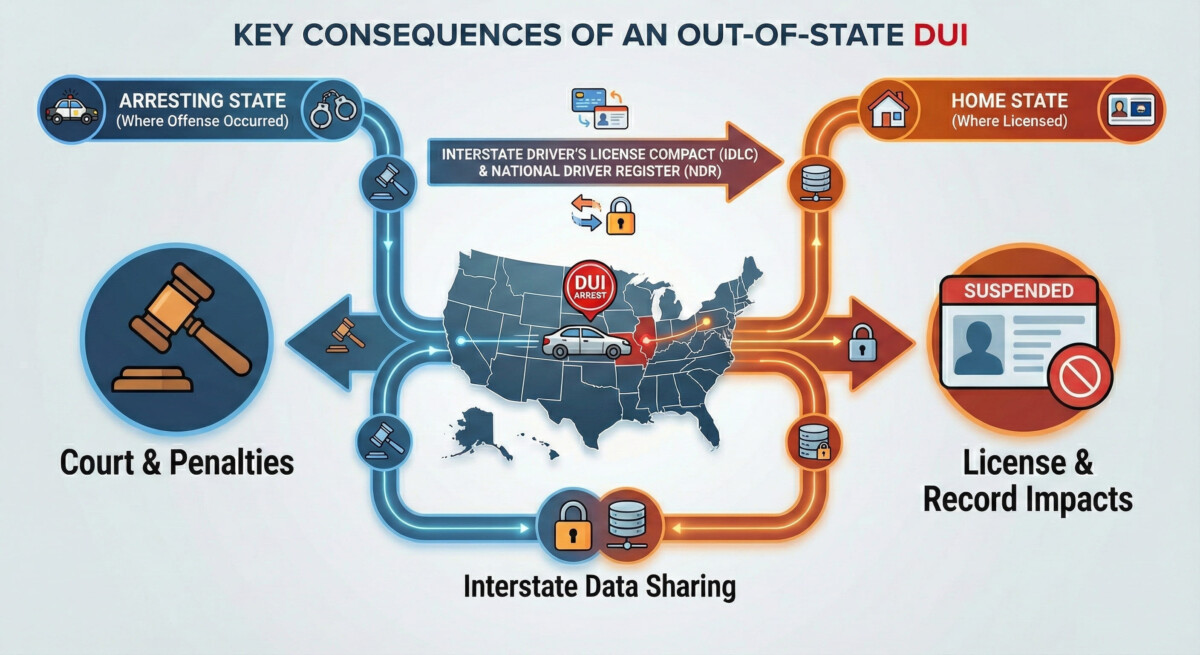
One of the most significant factors in how states handle these charges is the Driver License Compact (DLC). This is an interstate agreement used by 45 states (all except Georgia, Massachusetts, Michigan, Tennessee, and Wisconsin) to share driver information. If you get a DUI in a member state, your home state will be notified and will typically take reciprocal action, such as suspending your license.

Even states not in the DLC have other ways to share information, such as the National Driver Register (NDR), a database that tracks problem drivers. It’s nearly impossible to hide a DUI charge from your home state.

Key Consequences of an Out-of-State DUI

Key Consequences of an Out-of-State DUI

Navigating an out-of-state DUI involves several challenges. You will likely face penalties from both the state where the incident occurred and your home state.

1. Your Home State Will Be Notified

Through the DLC or other information-sharing agreements, your home state’s Department of Motor Vehicles (DMV) or equivalent agency will learn about your DUI charge. This triggers a secondary set of consequences at home, even if the initial charge is hundreds of miles away.

2. You May Face License Suspension in Two States

An out-of-state DUI can lead to two separate license suspensions. The state where you were arrested may suspend your driving privileges within its borders immediately. Once your home state is notified, it will likely suspend your license under its own laws. This “reciprocal suspension” means you could lose your right to drive everywhere, not just in the state where the offense occurred.

3. You Might Have to Appear in Court

You will be required to appear in court in the state where the DUI occurred. This can be a significant logistical and financial burden, requiring travel, time off work, and accommodation expenses. Ignoring a court date is not an option, as it can lead to a bench warrant for your arrest and further legal complications. A local attorney can sometimes appear on your behalf for certain hearings, but your presence may be mandatory for others.

4. You Could Face Fines, Jail Time, and Other Penalties

The penalties for a DUI vary significantly by state but often include steep fines, court costs, and even jail time. You will be subject to the sentencing guidelines of the state where you were charged. Additionally, many states require the completion of substance abuse education programs or counseling as a condition of sentence or license reinstatement.

Steps to Take After an Out-of-State DUI Arrest

Steps to Take After an Out-of-State DUI Arrest

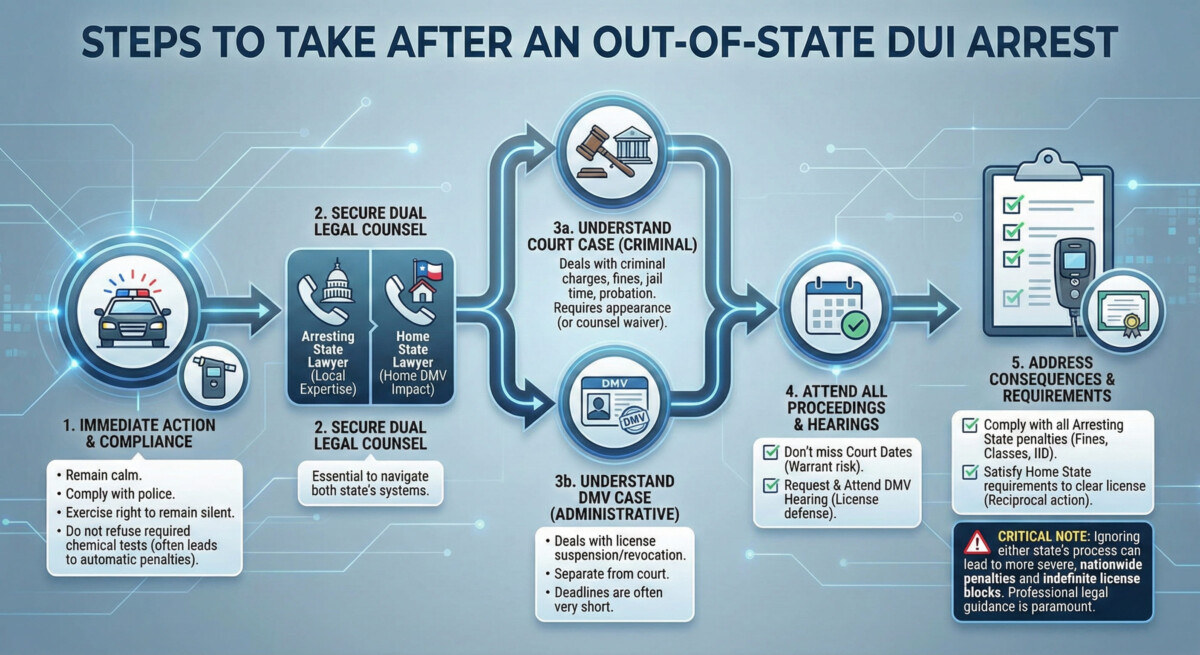
Receiving an out-of-state DUI charge is jarring, but how you respond is critical. Taking thoughtful, deliberate steps can make a significant difference in the outcome.

1. Stay Calm and Cooperate

During the arrest, remain calm and cooperative with law enforcement. Being argumentative or uncooperative can escalate the situation and lead to additional charges.

2. Hire a Local DUI Attorney

This is one of the most important steps you can take. A qualified DUI attorney in the state where you were charged will understand the local laws, court procedures, and key legal figures. They can guide you through the process, represent you in court, and work to negotiate a more favorable outcome.

3. Do Not Ignore Court Dates or Deadlines

Failing to appear in court or missing essential deadlines will only make matters worse. Keep track of all requirements and stay in close communication with your attorney to ensure you meet every obligation.

4. Complete All Required Programs

If the court orders you to complete a DUI education program or substance abuse counseling, it is essential to do so promptly. AACS Counseling offers court-approved programs that can help you fulfill these requirements. Completing these programs is often a necessary step for license reinstatement and shows the court you are taking the situation seriously.

How Professional Counseling Can Help

An out-of-state DUI is more than just a legal problem; it’s a deeply personal one. The stress, shame, and anxiety can take a significant toll on your mental health and well-being. This is where professional counseling becomes invaluable.

A counselor can provide a safe and confidential space to process the emotional impact of the DUI. At AACS Counseling, our experienced professionals can help you:

  • Manage Stress and Anxiety:Develop coping mechanisms to handle the stress of navigating the legal system from afar.
  • Fulfill Court Requirements:We offer DUI evaluations and counseling services that meet court mandates, helping you move your legal case forward.
  • Address Underlying Issues: Explore the root causes of the DUI and develop strategies to prevent future incidents.
  • Prepare for Reinstatement: Our services support your journey to regain your driving privileges and restore normalcy to your life.

Dealing with the consequences of an out-of-state DUI can feel isolating, but you don’t have to go through it alone.

Take the Next Step

If you or a loved one is facing the repercussions of an out-of-state DUI, getting the proper support is crucial. Navigating the legal requirements while managing the personal impact requires professional guidance.

The team at AACS Counseling is here to provide the expert support and confidential counseling you need to satisfy court requirements and get your life back on track. Contact us today to learn more about our DUI counseling services and schedule a consultation.

2026 Return-to-Duty Process: Legal Timelines, SAP Requirements & How to Get Back to Work Faster

When a CDL driver fails or refuses a DOT drug or alcohol test, they immediately become prohibited from operating safety-sensitive duties. The only way back to work is through the DOT Return-to-Duty Process, guided by a DOT-qualified SAP and regulated under 49 CFR Part 40.

In 2026, FMCSA has tightened monitoring of this process through the Clearinghouse, which means drivers and employers must strictly follow every step — and any mistake can delay your return to duty.

This guide breaks down the exact 2026 RTD timeline, legal SAP requirements, treatment expectations, and proven ways to get back behind the wheel faster and legally.

Why the Return-to-Duty Process Matters in 2026

✔ Strongest search volume among all SAP-related queries
✔ Drivers urgently want to know exact timelines & costs
✔ Employers need clarity on legal obligations
✔ FMCSA updates add new compliance layers in 2026

Step 1: SAP Evaluation Timeline (2026 Guide)

The first step drivers must complete is the SAP Initial Evaluation.
This is a clinical assessment done via in-person or telehealth by a DOT-qualified Substance Abuse Professional.

2026 SAP Evaluation Timeline

  • Schedule SAP appointment: 0–48 hours
  • Initial SAP evaluation: 30–60 minutes
  • SAP issues treatment/education plan: Within 2-4 hours
  • Driver begins program: ASAP after evaluation

Important:
A SAP cannot give “same-day clearance” under any circumstances — this is illegal.
In 2026, the Clearinghouse flags suspiciously fast SAP updates.

Step 2: Treatment & Education Requirements in 2026

Based on the SAP’s clinical assessment, drivers must complete:

✔ Education
✔ Treatment
✔ Or a combination of both

Every plan is customized.
There is no standard number of sessions, and no legal shortcut.

Typical 2026 SAP Recommendations:

  • 8–12 hours education (minimum for low-risk cases)
  • 3–6 weeks outpatient treatment (moderate cases)
  • Support meetings & relapse prevention programs
  • Random testing before SAP follow-up evaluation

Drivers must complete exactly what the SAP prescribes — not more, not less.
Skipping steps means you cannot progress to the next stage.

Step 3: Follow-Up SAP Evaluation (Clearance Step)

Once treatment or education is completed:

✔ The driver returns to the SAP
✔ SAP verifies successful completion
✔ SAP authorizes the RTD drug test

This clearance is logged directly into the FMCSA Clearinghouse.
Without this update, employers cannot legally send a driver for the RTD test.

Step 4: RTD Drug Test Rules for 2026 (Mandatory)

In 2026, the RTD test is:

  • Directly observed
  • Required before the driver can return to safety-sensitive work
  • Not optional, not negotiable
  • A one-time test, but must be negative

What Drivers Can Expect

✔ Observed urine test (DOT rule)
✔ Employer receives negative result
✔ Driver becomes “Eligible for Safety-Sensitive Functions”

After this moment, the driver can legally return to duty.

Step 5: Follow-Up Testing Schedule (2026–2028 Requirements)

After returning to duty, the SAP sets a Follow-Up Testing Plan lasting 1 to 5 years, depending on clinical risk level.

2026 Mandatory Requirements:

  • Minimum 6 follow-up tests in the first 12 months
  • Tests must be:
    ✔ Unannounced
    ✔ Observed
    ✔ Spread throughout the year
  • Longer plans (2–5 years) are based on SAP’s clinical judgment

Employers must follow this plan exactly.
Drivers cannot negotiate out of tests, and employers cannot skip them.

How Long Does the 2026 Return-to-Duty Process Take?

This depends on the SAP recommendation, but typical timelines:

Fastest RTD Timeframe (Low-Risk Case):
  • SAP Evaluation = 1–2 days
  • Education program = 1–2 weeks
  • Follow-up SAP review = 2-4 hours
  • RTD test scheduling = 1–3 days
    Total: 2–3 weeks
Moderate Case:

4–6 weeks

High-Risk Treatment Case:

8–12+ weeks

❗ In 2026, FMCSA is watching for unusually fast or fake SAP clearances.
Cheap or fraudulent SAP providers often lead to restarting the entire process.

How to Get Back to Work Faster in 2026 (Legally)

Here are proven ways to speed the Return-to-Duty process without breaking rules:

✔ 1. Schedule SAP evaluation immediately

Top SAPs offer appointments within 2-4 hours.

✔ 2. Choose a DOT-qualified SAP (not cheap scams)

Fake SAPs delay drivers the longest.

✔ 3. Start treatment or education the same week

Do not wait — downtime increases costs.

✔ 4. Complete every recommendation without skipping

Every skipped session adds more days.

✔ 5. Communicate with the SAP frequently

Faster paperwork → faster clearance.

✔ 6. Choose employers who process RTD tests quickly

Some carriers can schedule tests same day.

What Employers Must Know in 2026 (Legal Obligations)

Employers are legally required to:

  • Immediately remove the driver from safety-sensitive duties
  • Provide list of available SAP providers
  • Ensure driver is not working while prohibited
  • Conduct required RTD test only after SAP approval
  • Follow SAP’s Follow-Up Testing Plan exactly
  • Report violations to the Clearinghouse
  • Keep records for audits

Failure to follow these rules can result in FMCSA penalties.

Call Now