Qualified SAP Counselor, Author at AACS Counseling - Page 9 of 33

Child Custody Evaluations: A Complete Guide for Parents

For many parents, the phrase “child custody evaluation” triggers a wave of anxiety. It feels like your entire life, your parenting style, and your relationship with your children are being put under a microscope. If you are currently navigating a custody dispute, you likely have dozens of questions keeping you up at night. Will the evaluator understand my bond with my child? What if I say the wrong thing?

Take a deep breath. While the process is rigorous, it is designed with a single, crucial goal: to determine your child’s psychological best interests, helping you stay focused on what truly matters during preparation.

At AACS Counseling, we are here to support you at every stage of your child custody evaluation. This guide breaks down the evaluation process step-by-step, covers what evaluators look for, the specific questions you might face, and practical strategies to help you navigate this challenging time with confidence and grace.

Understanding Child Custody Evaluations

A child custody evaluation is a comprehensive investigation conducted by a mental health professional typically a psychologist or psychiatrist. It usually occurs when parents cannot agree on a parenting plan or when a judge needs more information to rule on custody and visitation.

Unlike a standard court hearing, where lawyers argue on your behalf, an evaluation is a forensic assessment. This means the evaluator acts as a neutral investigator. Their job is not to take sides but to gather objective data about your family dynamics. They assess the children’s needs and each parent’s ability to meet them.

Knowing that support from counselors and attorneys is available can reassure you, helping you feel less isolated and more confident during this process.

Ultimately, the evaluator provides a detailed report and recommendation to the court. While the judge has the final say, these recommendations carry significant weight because they come from an expert who has observed the family firsthand.

The Child Custody Evaluations Process

The process begins when the court appoints a specific evaluator, or when both parties agree on a private professional. Once the appointment is official, the clock starts ticking. However, patience is essential; a thorough investigation generally takes at least two months, and complex cases can take longer.

Steps in the Investigation

You should expect a multi-faceted approach to data gathering. The evaluator will not rely on a single interview to form an opinion. Instead, they will use several methods:

  • Interviews: You will participate in individual interviews to discuss your background, parenting philosophy, and concerns. The evaluator will also interview the children (depending on their age) and potentially other adults involved in the children’s lives, such as teachers, doctors, or therapists.
  • Home Visits and Observations: The evaluator typically visits each parent’s home. This allows them to see the environment where the child lives and observe interactions between you and your child in a natural setting.
  • Record Reviews: Expect to sign releases for school records, medical files, and police reports. The evaluator reviews these to identify patterns in stability, attendance, and health care management.
  • Psychological Testing: In many complete evaluations, parents undergo psychological testing to screen for personality disorders or mental health issues that could impact parenting capacity.

AACS Counseling can help you prepare for each of these phases, offering expert guidance on what evaluators are looking for and how you can present your parenting strengths authentically.

Special Circumstances

If your case involves allegations of domestic violence, substance abuse, or child neglect, the process adapts to address these safety concerns.

If there is a history of domestic violence, safety is the priority. You can request separate interviews to avoid being in the same room as the other parent. It is also vital to provide the evaluator with copies of any existing restraining orders or police reports immediately. The evaluator’s role in these scenarios shifts to include a risk assessment to determine whether unsupervised visitation is safe for the child.

AACS Counseling offers specialized support in high-conflict and trauma situations, helping you gather the proper documentation and communicate your concerns in a way that prioritizes your child’s well-being.

Key Questions in a Child Custody Evaluation

Evaluators ask targeted questions to assess specific areas of your life. Being prepared for these topics can help you answer honestly and clearly without getting confidence.

Parenting Capacity

These questions assess your daily involvement and ability to care for the child.

  • “Describe your child’s daily routine from the moment they wake up until they go to sleep.”
  • “How do you handle medical decisions? Who takes the child to the doctor?”
  • “What discipline methods do you use when your child breaks a rule?”
  • “How do you support your child’s educational needs?”

Co-Parenting Dynamics

The court favors parents who can facilitate a relationship with the other parent.

  • “How do you communicate with the other parent about childcare or schedule changes?”
  • “Describe your willingness to support the child’s relationship with the other parent.”
  • “What positive attributes does the other parent bring to the child’s life?”

Home Environment

This assesses stability and logistical support.

  • “Who lives in your household, and what is their relationship to the child?”
  • “What childcare support do you have (e.g., grandparents, babysitters)?”
  • “How does your work schedule impact your parenting time?”

Child-Focused Questions

These demonstrate how well you know your child as an individual.

  • “What activities does your child enjoy most?”
  • “How does your child react after returning from visits with the other parent?”
  • “What are your child’s greatest strengths and biggest challenges?”

AACS Counseling can work with you to practice responding to common questions and highlight your dedication to your child’s needs.

Preparing for a Child Custody Evaluation

Preparation involves organizing your caregiving responsibilities by documenting who manages daily tasks like school drop-offs, medical visits, and activities, which can serve as objective proof of your involvement.

Start by documenting your caregiving responsibilities. Create a log or calendar that shows who takes the children to school, who attends medical appointments, and who manages extracurricular activities. If you are the primary parent handling these tasks, documentation serves as objective proof.

Next, focus on child-focused home preparation. Ensure your home is clean, safe, and appropriate for children. This doesn’t mean it needs to look like a model home, but it should be functional. The child should have a dedicated sleeping space and a study area. Verify that safety measures, like smoke detectors and secure storage for medications or firearms, are in place.

Finally, practice neutral communication. During the evaluation, you might feel tempted to vent about your ex-partner’s flaws. Resist this urge. Unless there is a safety issue (like abuse), disparaging the other parent often reflects poorly on you. Focus on your relationship with your child, not your conflict with your ex.

If you need help getting organized or shaping how you communicate, AACS Counseling offers dedicated preparation sessions to help you manage stress, plan documentation, and approach the evaluation with confidence.
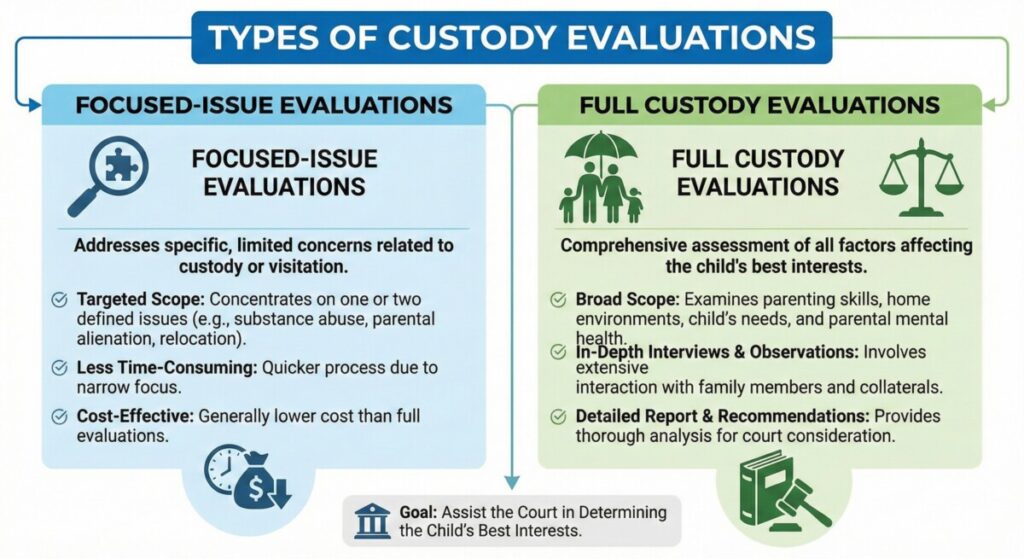
Types of Custody Evaluations

Not all evaluations are the same. Understanding the scope of yours helps set expectations.

Full Custody Evaluations

These are the most common in contentious cases. They cover every aspect of the family dynamic, including psychological testing, home visits, and comprehensive interviews. They result in a recommendation for legal and physical custody.

Focused-Issue Evaluations

Sometimes the court only needs answers on a specific topic. A focused-issue evaluation might look strictly at:

  • A parent’s potential relocation.
  • Allegations of substance abuse.
  • The mental health of one parent.
  • Whether a specific visitation schedule is working.

These are generally shorter and less expensive than complete evaluations but are limited in scope.

If you’re unsure what type of evaluation you’ll be facing, the team at AACS Counseling can walk you through the specifics and prepare you accordingly.

Role of Attorneys in Strengthening Your Position

Your attorney is your strategic partner during this process. They cannot sit in on the evaluation interviews, but they can prepare you for them.

Experienced family law attorneys often use mock evaluations. They will ask you tough, likely questions so you can practice answering without getting defensive or emotional. They can help you gather parenting class certificates or other proof of your dedication to improving your skills.

Attorneys also play a key role in witness preparation. If you have nannies, teachers, or family members who will speak to the evaluator, your attorney can help ensure they understand the process and what information is most relevant to the child’s welfare.

AACS Counseling works hand-in-hand with your legal counsel, offering evidence-based documentation and professional support that can reinforce your case.

After the Evaluation

Once the investigation concludes, the evaluator writes a confidential report. This document summarizes their findings and offers specific recommendations for custody, visitation schedules, and, at times, therapeutic interventions (such as family counseling).

The report is released to the attorneys and the court, but typically not directly to the parents to protect privacy. You will review it with your lawyer.

If the report is favorable, your attorney will likely use it to push for a settlement that mirrors the recommendations. If you strongly disagree with the findings, you have options. You can choose to contest the report in court. This might involve hiring an expert to review the evaluator’s methodology or cross-examining the evaluator during trial to expose biases or errors.

AACS Counseling can help you process the evaluation’s findings and support you in the following steps—whether that’s moving toward settlement, contesting a report, or strengthening your parenting approach.
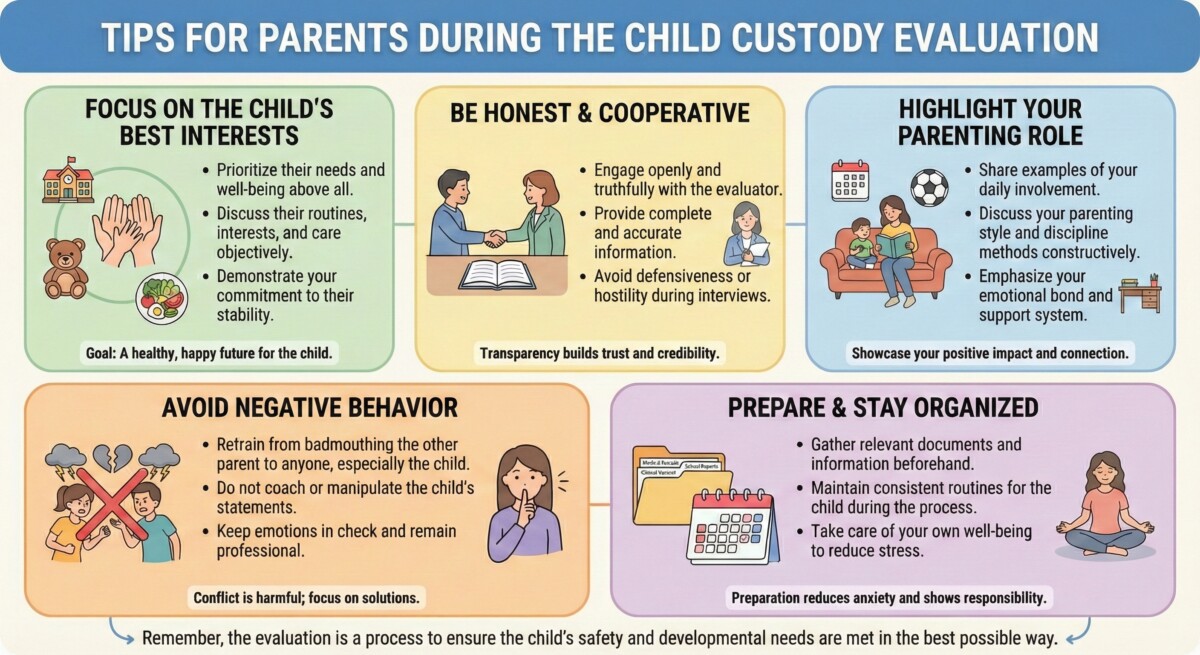
Tips for Parents During the Evaluation

Success in an evaluation often comes down to attitude and organization.

  • Be Honest: Evaluators are trained to spot deception. Admitting you aren’t perfect is far better than being caught in a lie. If you have a past mistake (like a DUI), own it and explain how you have learned from it.
  • Keep the Child Center Stage: Frame every answer around your child. Instead of saying, “I want full custody because I miss him,” say, “I believe he needs the stability of a consistent routine during the school week.”
  • Stay Organized: Keep copies of all documents you provide to the evaluator. If you promise to send a report card or a doctor’s note, do it immediately.
  • Dress and Act Appropriately: Treat appointments like a job interview. Arrive on time, dress neatly, and be polite to everyone in the office.

AACS Counseling helps you manage stress and present your best self in every interaction with an evaluator.

Frequently Asked Questions (FAQs)

What factors most influence outcomes?

The most influential factors are typically the stability of the home environment, the strength of the emotional bond between parent and child, and the parent’s willingness to facilitate a relationship with the other parent.

How do I choose the right evaluator?

Ideally, your attorney will help you select a professional with a reputation for neutrality and thoroughness. Look for someone with specific experience relevant to your case, such as working with special needs children or handling high-conflict divorces. If you need recommendations, AACS Counseling can connect you with trusted evaluators in your area.

What if I disagree with the evaluation report?

You are not bound to accept the report as the final word. Your attorney can file motions to challenge it, depose the evaluator, or introduce contradictory evidence during the trial. AACS Counseling can help you prepare documentation and emotional support for this process.

Conclusion

A child custody evaluation is undoubtedly one of the most stressful hurdles in family law proceedings. However, it is also an opportunity. It is a chance for a neutral expert to see the love, care, and stability you provide for your children.

By preparing thoroughly, focusing on your child’s well-being, and maintaining a professional demeanor, you can navigate this process effectively. Remember, the goal is a healthy, happy future for your children. Stay focused on that horizon, and lean on your legal and mental health support systems—including AACS Counseling—to guide you through.

References

Failed a DOT Drug Test in 2026? Step-by-Step Legal Guide for Drivers in the U.S.

Failing a DOT drug test in 2026 is serious—but it does not automatically end your trucking career. Federal regulation (49 CFR Part 40) gives every driver a legal pathway to return to duty (RTD) through a DOT-qualified SAP Program.

This guide breaks down exactly what you must do legally, how fast you can return to work, how the Clearinghouse records your violation, and what mistakes delay your reinstatement.

What Legally Happens First When You Fail a DOT Drug Test in 2026

The moment you fail a DOT drug or alcohol test, federal regulations require:

1. Immediate Removal From Safety-Sensitive Duties

You cannot drive, operate heavy machinery, or perform any DOT-regulated job.

2. Employer Must Report the Violation to the FMCSA Clearinghouse

Under the 2026 reporting mandate, employers must submit your violation within 3 business days.

3. You Must Be Provided With a List of DOT-Qualified SAPs

This list must include only Qualified SAPs compliant with Part 40.

Failing to follow these steps puts employers at risk of civil penalties, so most fleets are strict.

Do You Need a SAP After Failing a DOT Drug Test? (Yes — Federal Law)

Every driver who failed a DOT drug test in 2026 must complete a SAP Evaluation.
There are no exceptions under Part 40.

During the SAP process, you must complete:

  • Initial clinical SAP evaluation
  • Treatment or education program
  • Follow-up evaluation
  • Return-to-duty (RTD) drug test
  • Follow-up testing schedule (1–5 years)

Without SAP clearance, you legally cannot return to duty for any employer in the U.S.

Step-by-Step: What You Must Do After Failing a DOT Drug Test in 2026

Step 1: Register or Sign Into the FMCSA Clearinghouse

Your violation and all SAP progress will be recorded in the Clearinghouse.

You must:

  • Add your new employer (if applicable)
  • Provide consent for RTD queries
  • Allow the SAP to update your case status

Step 2: Schedule Your DOT SAP Evaluation

Your SAP Evaluation includes:

  • Clinical interview
  • Substance use history
  • Mental health screening
  • Assessment of risk level
  • Recommendation for treatment or education

Step 3: Complete the SAP Treatment or Education Plan

Based on 2026 guidelines, drivers are usually required to complete:

  • Outpatient counseling
  • Education courses
  • Relapse prevention
  • Follow-up sessions

Your SAP determines the duration—but only the SAP can legally approve your progress.

Step 4: Follow-Up Evaluation and RTD Test

Once treatment is done, your SAP conducts a Face-to-Face Follow-Up Evaluation.

If cleared, you can take your Return-to-Duty Test.
A negative result is required before you return to driving.

Step 5: Begin Follow-Up Testing (1–5 Years)

After returning to duty, FMCSA requires “unannounced follow-up testing.”
This is determined solely by your SAP.

How to Avoid FMCSA Clearinghouse Delays in 2026

Clearinghouse delays can add weeks or months to your reinstatement.

Avoid these 2026 common mistakes:

❌ Starting SAP treatment before the SAP Evaluation

This invalidates your process.

❌ Not registering on the Clearinghouse

Your employer cannot query you → RTD delays.

❌ Choosing a non-qualified SAP

Only DOT-Qualified SAPs can update your status.

❌ Not completing the follow-up evaluation

Without this, your RTD test cannot be scheduled.

2026 Employer Reporting Rules You Must Know

In 2026, employers must legally:

✔ Report all violations within 3 days

This includes refusals, positive tests, and tampering.

✔ Complete annual Clearinghouse queries

For current employees.

✔ Conduct pre-employment queries for ALL new drivers

No driver can be hired before this check.

✔ Honor SAP treatment recommendations

Employers cannot override or alter SAP instructions.

Can You Still Work After Failing a DOT Drug Test in 2026?

Yes—but only after:

  1. Completing the SAP process
  2. Passing the RTD test
  3. Clearinghouse reflects “eligible for RTD test” and “negative RTD test result”

You cannot drive commercially until these steps are completed.

FAQ: Quick Legal Answers for Drivers

Is failing a DOT drug test a crime?

No, but it is a federal violation.

How long does a DOT violation stay on my record?

Clearinghouse: 5 years or until all SAP steps are completed (whichever is longer).

Can I change my SAP provider?

Yes, only before treatment begins.

Can a new employer hire me during the SAP process?

Yes, but you cannot drive until you pass the RTD drug test.

DOT SAP Program Explained for 2026: Legal Requirements, Costs & Safety Rules

If you’re a CDL driver, employer, or owner-operator facing a DOT drug or alcohol testing violation in 2026, you must complete the DOT SAP Program before returning to safety-sensitive duties.

This guide breaks down the DOT SAP Program Explained for 2026, including updated legal requirements under 49 CFR Part 40, safety rules, program costs, and employer responsibilities.

FMCSA continues tightening enforcement, and in 2026 the SAP process is more structured, traceable, and compliance-focused than ever.

1. What Is the DOT SAP Program in 2026?

The DOT SAP Program is a federally mandated return-to-duty process for any CDL driver who:

  • Tests positive on a DOT drug test
  • Tests 0.04 or higher on an alcohol test
  • Refuses a drug/alcohol test
  • Violates DOT drug and alcohol rules in any safety-sensitive role

The program ensures drivers receive professional evaluation, education/treatment, and follow-up testing before safely returning to work.

2. 49 CFR Part 40: Updated Interpretations for 2026

49 CFR Part 40 is the federal regulation that governs the entire SAP Evaluation. While the core rules remain unchanged, FMCSA added clarifications and stricter reporting expectations in 2026.

Key 2026 Highlights Under 49 CFR Part 40

✔ Faster reporting

SAPs must submit evaluation reports to the FMCSA Clearinghouse sooner, minimizing delays.

✔ More documentation

SAPs must provide detailed clinical justification for recommended treatment levels.

✔ Telehealth SAP evaluations remain approved

As long as they meet DOT-compliant behavioral health standards.

✔ Stronger verification of SAP credentials

FMCSA is targeting fake, unqualified SAP providers in 2026 audits.

✔ Stricter compliance for employers

Employers must update SAP and RTD status in real-time, not weeks later.

3. Safety-Sensitive Restrictions for Drivers in 2026

Once a violation occurs, DOT requires immediate removal from all safety-sensitive duties, including:

  • Driving a CMV
  • Performing roadside inspections
  • Loading/unloading hazardous materials
  • Equipment operation
  • Sleeper berth operation under dispatch
  • Any CDL-regulated task

Drivers cannot return to duty until they:

  1. Complete the initial SAP evaluation
  2. Complete all SAP-recommended treatment or education
  3. Undergo a follow-up evaluation
  4. Pass the Return-to-Duty test
  5. Begin Follow-Up Testing

Employers are legally prohibited from allowing non-cleared drivers to work.

4. Step-by-Step: How the DOT SAP Program Works in 2026

Here is the DOT SAP Program Explained for 2026 from start to finish:

Step 1 — DOT Violation Occurs

A positive test, alcohol violation, or refusal is entered into the FMCSA Clearinghouse.

Driver is immediately removed from safety-sensitive work.

Step 2 — Select a Qualified DOT SAP

Must be a DOT-qualified Substance Abuse Professional, not a regular counselor or therapist.

Red flag:

If they are not listed as DOT-compliant → the entire program may be rejected.

Step 3 — Initial SAP Evaluation

The SAP determines:

  • Past substance use history
  • Clinical risk level
  • Whether the driver needs education, treatment, or both
  • Program length and intensity

Step 4 — Complete Required Education or Treatment

May include:

  • Early intervention education
  • Individual counseling
  • Group counseling
  • Outpatient treatment
  • Intensive outpatient (IOP)
  • Rarely, residential treatment

Drivers must complete the exact plan provided by the SAP.

Step 5 — Follow-Up SAP Evaluation

SAP confirms whether the driver is ready for:

  • Return-to-Duty drug test
  • Return-to-work clearance

Driver becomes “Eligible for RTD Test” in the Clearinghouse.

Step 6 — Return-to-Duty Test

A DOT RTD test is conducted under direct observation.

Driver must test negative.

Step 7 — Follow-Up Testing Plan (Mandatory 2026 Requirement)

SAP creates a personalized follow-up testing plan lasting 1–5 years.

  • Minimum: 6 tests in the first 12 months
  • Tests must be unannounced
  • Employers must ensure compliance

5. Cost of the DOT SAP Program in 2026

Actual costs vary, but here are the average U.S. ranges for 2026:

SAP Program Costs Breakdown:
SAP Component Cost Range (2026)
Initial Evaluation $300 – $500
Follow-Up Evaluation $150 – $300
Education Programs $150 – $400
Outpatient Treatment $700 – $2,000
Intensive Outpatient (IOP) $1,500 – $4,500
Return-to-Duty Test $55 – $85
Follow-up Testing (Year 1) $330 – $1,080
Total Cost for Most Drivers in 2026:

👉 $800 – $2,500
Moderate cases may reach $4,000–$7,000.

6. Employer Obligations in 2026

FMCSA increased employer responsibilities and penalties.

In 2026, employers must:

✔ Run pre-employment Clearinghouse queries

Before hiring any CDL driver.

✔ Conduct annual queries for all active drivers

No exceptions.

✔ Report all drug & alcohol violations within 24 hours

New stricter timeline.

✔ Report actual knowledge violations

Including observed use, possession, or admission.

✔ Update SAP and RTD statuses

Failure to update SAP completion or RTD eligibility leads to fines.

✔ Enforce follow-up testing plans

Employers are responsible—not SAPs.

✔ Maintain compliant records for DOT audits

FMCSA auditors will check logs for accuracy.

7. Why the DOT SAP Program Is More Important Than Ever in 2026

Because of FMCSA’s enhanced digital tracking:

  • Violations are harder to hide
  • Employers face steeper fines
  • Drivers face CDL downgrade risks
  • SAP documentation must be precise
  • RTD delays mean lost income

The DOT SAP Program is now a central safety, compliance, and legal requirement for all CDL operations in 2026.

8. FAQ’s

1. What is the DOT SAP Program in 2026?

It is a federally required process that helps CDL drivers return to safety-sensitive work after a drug or alcohol violation.

2. Did 49 CFR Part 40 change in 2026?

Core rules remain the same, but enforcement, SAP reporting deadlines, and documentation requirements are stricter.

3. How long does4. Can drivers use telehealth SAP evaluations in 2026?the SAP Program take in 2026?

Anywhere from one week to several months, depending on the SAP’s treatment recommendation.

4. Can drivers use telehealth SAP evaluations in 2026?

Yes—telehealth remains fully DOT-approved and widely used.

5. Do employers have more responsibilities in 2026?

Yes—employers must report violations within 24 hours, run queries, and enforce follow-up testing.

FMCSA Clearinghouse 2026: New Rules Drivers & Employers Can’t Afford to Ignore

The FMCSA Drug & Alcohol Clearinghouse continues to evolve—and 2026 introduces the biggest compliance shift since the system launched in 2020. Whether you’re a CDL driver or a motor carrier, these new rules impact how violations are reported, recorded, and cleared.

If you rely on safety-sensitive DOT work, understanding the FMCSA Clearinghouse 2026 changes is not optional—it’s federal law.

This guide breaks down the new penalties, updated reporting rules, SAP program impacts, and employer obligations for 2026 so you can stay fully compliant.

1. The FMCSA Clearinghouse in 2026: What’s Changing?

The Clearinghouse remains the national database for DOT drug and alcohol violations, but FMCSA has introduced new enforcement triggers, new penalties, automated reporting rules, and stricter timelines.

Here’s what’s new in FMCSA Clearinghouse 2026:

✔ Stronger enforcement for unreported violations

FMCSA now automatically cross-verifies employer records, MVRs, and consortium data.
Failure to report a positive, refusal, or SAP status update can trigger immediate enforcement.

✔ Mandatory automated reminders for employer compliance

Carriers now receive automated Clearinghouse compliance alerts if they:

  • Miss a required query,
  • Fail to upload a violation, or
  • Fail to mark a driver’s RTD status.

These alerts are logged and can be used in audits.

✔ Stricter timelines

As of 2026, FMCSA enforces a 24-hour maximum reporting window for:

  • Positive drug test results
  • Alcohol violations
  • Refusals
  • SAP RTD completions

Late reporting = fines.

✔ Enhanced data sharing

State driver license agencies (SDLAs) now have real-time access to Clearinghouse data, impacting CDL renewals and reinstatements.

2. New FMCSA Penalties in 2026

Penalties are increasing — especially for employers failing to comply with Clearinghouse reporting.

2026 Civil Penalty Ranges

Violation Penalty (2026)
Failure to query a driver annually Up to $2,500 per driver
Failure to report a violation Up to $6,000 per incident
Hiring a driver with an unresolved violation Up to $7,500 per occurrence
Falsifying Clearinghouse data Criminal penalties + $15,000+ fines

Employers are now directly accountable for Clearinghouse compliance—not just their TPA.

3. How Violations Are Recorded in 2026 (Important Update)

The FMCSA Clearinghouse 2026 update makes violation reports:

✔ Faster

All labs and MROs must submit positive results within hours, not days.

✔ More detailed

Reports now include:

  • Test type
  • Substance detected
  • Testing authority
  • SAP referral status
  • SAP completion status
  • RTD test information
  • Follow-up testing plan

✔ Cross-checked

FMCSA validates violation data with:

  • Employers
  • MROs
  • TPAs
  • Consortiums
  • State licensing agencies

This reduces loopholes and false entries.

✔ Longer-lasting

Violations remain in the database for 5 years or until RTD testing + follow-up testing is completed, whichever is longer.

4. SAP Program Changes for 2026

While FMCSA has not altered 49 CFR Part 40’s core SAP regulations, administration and reporting procedures are stricter in 2026.

Key SAP-related changes in 2026:

✔ Faster reporting of SAP evaluations

SAPs must upload:

  • Initial Evaluation Report
  • RTD Eligibility Report
    within tighter FMCSA timeframes.

✔ New Clearinghouse integration requirements

More SAP platforms now integrate directly with FMCSA.
This reduces:

  • Delays
  • Data errors
  • Disputes
  • Duplicate violations

✔ Zero tolerance for non-qualified SAPs

FMCSA has increased audits of unqualified evaluators posing as SAPs.

If your provider is not DOT SAP qualified under Part 40 → your entire SAP Program may be invalid, and you may need to start over.

✔ More telehealth approvals

Telehealth SAP Evaluations remain fully accepted, but documentation standards are stricter.

5. What These 2026 Changes Mean for CDL Drivers

CDL drivers must be more careful than ever, because FMCSA Clearinghouse 2026 rules are more automated and less forgiving.

✔ Violations are uploaded faster and harder to dispute

Drivers will see violations appear in real-time.

✔ Delays in the SAP process = longer unemployment

Because reporting timelines are shorter, missing an appointment or delaying treatment slows RTD clearance.

✔ CDL renewals and reinstatements depend on Clearinghouse status

States now automatically check your Clearinghouse status before:

  • Renewal
  • Upgrade
  • Transfer
  • Reinstatement

If you have an open violation → your CDL may be downgraded or denied renewal.

✔ Employers see more details during pre-employment queries

More data = fewer hiring chances for unresolved violations.

6. What Employers Must Do to Stay Compliant in 2026

Employers have zero room for error under the FMCSA Clearinghouse 2026 update.

To stay compliant, employers must:

✔ Run a pre-employment Clearinghouse query

Every time. No exceptions.

✔ Run annual queries for all CDL drivers

Even for seasonal or occasional ones.

✔ Report all violations within 24 hours

Including:

  • Refusals
  • Alcohol violations
  • Direct observation requirements

✔ Update SAP and RTD completion statuses

Failure to update RTD eligibility is now a finable offense.

✔ Maintain secure Clearinghouse records

DOT audits in 2026 will check digital logs for accuracy.

7. 2026 Compliance Checklist (Drivers + Employers)

Drivers
  • Maintain an active Clearinghouse account
  • Respond to SAP referrals immediately
  • Register with CDL number + email
  • Monitor violation records
  • Complete RTD testing on schedule
  • Use a qualified SAP
Employers
  • Conduct all required queries
  • Report violations within 24 hours
  • Maintain compliance logs
  • Use DOT-qualified TPAs
  • Document follow-up testing per SAP plan

8. FAQ Section

1. What are the new FMCSA Clearinghouse 2026 rules?

The 2026 update includes stricter reporting timelines, higher penalties, improved data sharing with states, and automated compliance alerts for employers.

2. How long do violations stay on the Clearinghouse in 2026?

Violations remain for five years or until all return-to-duty requirements are completed—whichever is longer.

3. Did SAP Program requirements change in 2026?

Core requirements under 49 CFR Part 40 remain the same, but reporting deadlines and documentation rules are stricter.

4. Do CDL drivers need to re-register in the Clearinghouse for 2026?

Drivers do not need to re-register, but they must ensure their account is active and linked to updated CDL info.

5. Are telehealth SAP evaluations accepted in 2026?

Yes—telehealth SAP evaluations remain FMCSA-approved and widely used in 2026.

The Cost Breakdown of the DOT SAP Program: What You Need to Know

Facing a Department of Transportation (DOT) violation is stressful enough on its own. You are likely dealing with the immediate shock of being removed from safety-sensitive duties and the anxiety of lost wages. When you add the financial burden of the mandatory return-to-duty process, the situation can feel overwhelming.

Many employees assume their company or insurance will automatically foot the bill for their recovery process. Unfortunately, this is rarely the case. In 2026, the financial responsibility for the DOT SAP Program often falls squarely on the employee.

Understanding the price tag attached to your return to duty journey is not just about counting pennies; it is about survival. Knowing what to expect allows you to budget effectively, avoid hidden surprises, and make smart decisions that get you back to work without breaking the bank. This guide provides a transparent look at the costs involved in achieving DOT compliance this year.

The Reality: Who Pays for What?

Before diving into specific numbers, we need to address the “who pays” question. While some union contracts or specific employer policies might cover these costs, the vast majority of safety-sensitive employees must pay for the SAP process out of pocket.

Health insurance creates another layer of confusion. While your insurance might cover treatment (like rehab or therapy), it frequently denies coverage for the SAP evaluation itself. Insurance companies often view these evaluations as administrative or legal requirements for employment rather than medically necessary procedures.

Detailed Cost Breakdown of the DOT SAP Program

The total cost of the program varies significantly depending on your specific case, but expenses generally fall into three main buckets.

1. The SAP Evaluation Fee

This is your entry point into the program. You cannot legally return to safety-sensitive work without going through a qualified Substance Abuse Professional (SAP).

Most SAPs charge a flat fee that bundles the two mandatory face-to-face meetings:

  1. The Initial Evaluation: Where your history is assessed and a plan is created.
  2. The Follow-Up Evaluation: Where your compliance is verified before you can take a return-to-duty test.

Estimated Cost in 2026: $400 – $700

Note: Be wary of providers charging significantly less than the market average. If they are not fully qualified or fail to keep up with 2026 DOT regulations, their low-cost report could be rejected, forcing you to pay twice.

2. Education and Treatment Programs

This category represents the biggest variable in your budget. During your initial evaluation, the SAP will prescribe a specific course of action based on the severity of your substance use. You must complete this recommendation to move forward.

  • Education Courses: If your violation was deemed low-risk or an isolated incident, the SAP might recommend an educational course on drug and alcohol safety. These are often shorter and less expensive.
    • Estimated Cost: $150 – $500
  • Treatment Programs: If the SAP identifies a dependency issue, they may require counseling, outpatient treatment, or even inpatient rehabilitation.
    • Estimated Cost: $1,000 – $10,000+

Pro Tip: While the SAP evaluation is often out-of-pocket, this treatment portion is where your health insurance can be a lifesaver. Check your policy benefits for substance abuse coverage.

3. Return-to-Duty and Follow-Up Testing

Once you finish your program, you must pass a directly observed drug or alcohol test to resume work. Following that, you are subject to a minimum of six unannounced tests in the first year.

  • Return-to-Duty Test: Some employers cover this; others require you to pay.
    • Estimated Cost: $50 – $100 per test
  • Follow-Up Testing: This can get expensive if your employer passes the cost to you. Over five years, frequent testing adds up.

Hidden Financial Factors

When calculating the “cost,” you must also consider lost wages.

The DOT SAP Program is not an overnight fix. It takes time to schedule appointments, complete classes, and wait for reports to be filed. During this period, you are legally prohibited from performing safety-sensitive functions.

  • Efficiency is Currency: Every week you delay starting the process is a week of lost income.
  • Job Search Costs: If your previous employer terminated you after the violation (which is common), you will need to fund a job search while completing your SAP requirements.

Tips for Budgeting and Minimizing Costs

You cannot skip steps to save money, but you can navigate the process smartly to avoid wasting it.

Shop Around (But Verify)

SAPs represent private businesses, and their rates vary. It is perfectly acceptable to call three or four local SAPs to compare their fees. However, never sacrifice credentials for price. Ensure they are currently qualified under DOT Part 40 rules.

Be Honest During the Evaluation

This sounds like moral advice, but it is actually financial advice. SAPs are trained to spot deception. If you minimize your usage and the SAP finds inconsistencies (which they often do via the Clearinghouse or test results), they may prescribe a more intensive—and expensive—treatment plan to be “safe.” Honesty ensures you get the appropriate level of care, not an inflated one.

Ask About Payment Plans

Many SAPs understand that their clients are currently out of work. Some offer payment plans or sliding scale fees. It never hurts to ask upfront if they can split the evaluation fee into two payments.

Utilize Community Resources

If your SAP recommends self-help groups (like AA or NA) as part of your plan, these are free. While they rarely replace formal education courses entirely, active participation in free community support groups can sometimes reduce the need for expensive paid therapy sessions.

Conclusion: The Price of Your Career

When you look at the total potential cost—ranging from a few hundred dollars to several thousand—it can be tempting to give up or look for non-DOT work. However, consider the long-term value of your commercial license or certification.

The cost of the DOT SAP Program is an investment in reclaiming your career. In the grand scheme of your working life, a $600 evaluation fee is a small price to pay to get back into the driver’s seat.

Actionable Next Steps:

  1. Review your finances: diverse funds to cover the initial evaluation immediately.
  2. Check your insurance: See what substance abuse treatment is covered under your plan.
  3. Act fast: The sooner you start, the sooner you stop losing wages.

By understanding the costs upfront and planning accordingly, you can navigate the road to DOT compliance with confidence and financial control.

The Real Cost of a SAP Program in 2026: Fees, Treatment & Insurance Impact

The Real Cost of a SAP Program in 2026: Fees, Treatment & Insurance Impact

If you’ve recently tested positive or refused a DOT drug/alcohol test, you must complete a Substance Abuse Professional (SAP) Program before returning to safety-sensitive work. But many U.S. drivers in 2026 ask the same question:

👉 “How much does the SAP Program really cost?”

The Real Cost of a SAP Program in 2026 is not just the evaluation fee. It includes assessments, recommended treatment, education hours, return-to-duty testing, follow-up testing, and potential insurance consequences.

This guide breaks down every dollar you can expect to spend, why costs vary, and how to reduce your total expenses.

1. SAP Evaluation Fees in 2026 (First Mandatory Cost)

The initial SAP evaluation is required by FMCSA 49 CFR Part 40.

Typical 2026 Pricing Range (United States):

SAP Service Average Cost (2026)
Initial SAP Evaluation $300 – $500
Follow-Up Evaluation $150 – $300
Administrative/Clearinghouse Updates $25 – $75
Why prices vary:
  • SAP experience & credentials
  • State/region
  • Telehealth vs. in-person
  • Demand and availability

💡 Tip: Telehealth SAP Evaluations in 2026 remain fully FMCSA-approved and often cost 10–20% less.

2. Treatment & Education Program Costs (Largest Expense)

Your SAP will recommend either education, treatment, or a combination based on your risk level.

Typical Treatment/Education Costs in 2026:

Recommendation Level Description Typical Cost Range
Early Intervention Education 8–12 hours $150 – $400
Outpatient Treatment Level 1 1–3 months $700 – $2,000
Intensive Outpatient (IOP) 3–6 weeks, 9+ hours/week $1,500 – $4,500
Residential Treatment (rare for SAP) 28+ days $8,000 – $20,000+

⚠️ Important:
FMCSA requires completion exactly as the SAP recommends. Cutting corners delays your return-to-duty (RTD) clearance.

3. Return-to-Duty Test (Paid by Driver or Employer)

To officially return to safety-sensitive work, you must pass a DOT Return-to-Duty test.

Typical Cost:

$55 – $85 per test

If your employer pays, great.
If you’re an independent contractor, you pay out of pocket.

4. Follow-Up Testing Costs (1–5 Years)

FMCSA requires the SAP to create a personalized Follow-Up Testing Plan.

Most common plan:
  • 6–12 unannounced tests during Year 1
  • Additional tests during Year 2–5 if required
Typical Cost per Follow-Up Test:

$55 – $90

Estimated Total Over 12 Months:

$330 – $1,080

Employers usually pay—but they are legally allowed to pass the cost to the driver.

5. Hidden & Indirect Costs Most Drivers Forget

Lost Income While Removed from Duty

If a driver earning $1,200/week is off for 4 weeks, that’s:
➡️ $4,800 lost income

Job Loss or Delayed Hiring

Some carriers won’t hire you until you complete your entire DOT SAP Program.

Clearinghouse Record Impact

Your violation stays in the FMCSA Clearinghouse for 5 years, affecting job opportunities and insurance.

6. Insurance Impact for Drivers in 2026

Insurance companies increasingly use FMCSA Clearinghouse data when rating drivers.

What happens:
  • Higher premiums for drivers with violations
  • More frequent random testing
  • Some carriers may deny hiring
Typical Increase:

$400–$900 per year (for owner-operators)

7. Total Expected Cost of the SAP Program in 2026

Component Typical Cost
Initial Evaluation $300–$500
Follow-Up Evaluation $150–$300
Treatment/Education $150–$4,500+
RTD Test $55–$85
Follow-Up Testing $330–$1,080
Insurance Increase $400–$900/year

Total Estimated Cost (Most Common Case in 2026):

👉 $800 – $2,500 (mild cases)
👉 $2,500 – $6,000+ (moderate cases)
👉 $8,000+ (residential treatment cases)

8. How to Reduce Your SAP Program Costs Legally (U.S. 2026)

✔ Choose Telehealth SAP Evaluations

Usually cheaper and faster.

✔ Request a payment plan

Many qualified SAPs offer flexible payments.

✔ Complete assignments on schedule

Delays = more sessions = more cost.

✔ Ask if your employer covers follow-up testing

Some small carriers openly reimburse.

✔ Avoid “cheap, fake SAP providers”

Low-cost, non-DOT-approved SAPs cause:

  • Clearinghouse errors
  • Violations
  • Redoing your entire program (cost doubles)

9. FAQs About the Real Cost of a SAP Program in 2026

1. Can I shop around for cheaper SAP providers?

Yes—but ensure they are DOT-qualified and listed in the FMCSA Clearinghouse.

2. Can I use insurance to pay for the SAP Program?

Insurance rarely covers SAP evaluations but may cover treatment programs.

3. How long will the SAP Program take?

Anywhere from 1 week to several months, depending on your treatment recommendation.

4. Do employers reimburse SAP costs?

Some do, especially for long-term drivers. Always ask.

Step-by-Step: How to Register for the DOT Clearinghouse in 2026

Introduction: Why Clearinghouse Registration Matters in 2026

Registration with the FMCSA Drug & Alcohol Clearinghouse is mandatory for all CDL drivers and employers in the United States. In 2026, the Clearinghouse remains the central database that tracks DOT drug and alcohol violations, return-to-duty (RTD) status, and DOT SAP program completion.

If you’re a CDL driver, employer, or owner-operator, you must register for the DOT Clearinghouse to remain compliant. This guide walks you through every step in a simple, clear process.

Who Must Register for the DOT Clearinghouse in 2026?

The following must register:

  • All CDL drivers (including new drivers in 2026)
  • Employers of CDL drivers
  • Owner-operators (must register as both driver + employer)
  • C/TPAs (for small companies or independent drivers)

If you don’t register for the DOT Clearinghouse, you cannot legally perform or hire for safety-sensitive duties.

Step-by-Step: How to Register for the DOT Clearinghouse in 2026

Below is the official, updated process for 2026.

Step 1: Create or Log Into Your Login.gov Account

As of recent updates, all FMCSA user accounts must be accessed via Login.gov.

Steps:
  1. Go to the Clearinghouse website.
  2. Click “Register” → You’ll be redirected to Login.gov.
  3. Create an account using your email and a secure password.
  4. Save your login details. You’ll need them every time.

Step 2: Verify Your Email and Identity

Login.gov will ask you to:

  • Confirm your email
  • Set up multi-factor authentication (MFA)
  • Verify your identity
    • Can be done with a state ID, driver’s license, or passport

Identity verification is required so FMCSA can match your CDL to your Clearinghouse records.

Step 3: Select Your User Role

Once inside the Clearinghouse portal, select the role that applies to you.

Options include:
  • Driver
  • Employer
  • Owner-Operator
  • C/TPA
  • MRO, SAP, or Consortium roles

Most individuals reading this guide will select Driver or Employer.

Step 4: Enter CDL Information (Drivers Only)

Drivers must enter:

  • State of issuance (e.g., Texas, Georgia, Florida)
  • CDL number exactly as printed on your license
  • Contact information

FMCSA matches this data with state records to maintain compliance and accuracy.

Step 5: Designate a C/TPA (Required for Owner-Operators)

If you are an owner-operator, you must list a Consortium/Third-Party Administrator for:

  • Random testing
  • Reporting violations
  • Managing drug/alcohol testing

This cannot be skipped. FMCSA will not allow you to complete registration without it.

Step 6: Accept the Terms & Complete the Registration

Review:

Click “Agree and Submit.”
Your registration is now complete.

What Drivers Must Do After Registering for the Clearinghouse

Once registered, CDL drivers should:

  • Keep login information updated
  • Regularly check for employer queries
  • Respond to consent requests quickly
  • Update CDL information if they move states
  • Ensure your contact information is current

If you are in the SAP or RTD process, the Clearinghouse will also list:

  • Violations
  • SAP status
  • Follow-up testing requirements
  • RTD eligibility
  • What Employers Must Do After Registration in 2026

Employers must:

  • Run pre-employment Clearinghouse queries
  • Run annual queries for all CDL drivers

Report:

  • Positive tests
  • Refusals
  • Actual knowledge violations

Verify SAP completion before returning a driver to duty

Non-compliance can result in significant FMCSA fines.

Common Clearinghouse Registration Problems (and Fixes)

1. CDL Not Matching Records

Ensure your CDL number and state are entered exactly as shown.

2. Login.gov won’t verify identity

Try another ID method or upload clearer photos.

3. Can’t complete employer registration

Make sure the company’s DOT/MC number is active.

4. Owner-operator cannot finish registration

You must designate a C/TPA.

Why Registering Early Matters in 2026

Waiting until the last minute can cause:

  • Delayed hiring
  • Missed job offers
  • Compliance issues
  • FMCSA violations
  • Employer rejection due to incomplete records

Early registration ensures you stay eligible for safety-sensitive work across the U.S.

Conclusion

Registering for the DOT Clearinghouse in 2026 is essential for CDL drivers, employers, and owner-operators. Following this step-by-step guide ensures you stay compliant, avoid costly delays, and maintain eligibility for safety-sensitive work across the U.S.

What to Do If You Can’t Afford a SAP Evaluation in the U.S.

Introduction: When a SAP Evaluation Feels Out of Reach

A failed or refused DOT drug or alcohol test means you must complete a SAP evaluation before returning to safety-sensitive duties. But for many U.S. drivers, the cost of a SAP evaluation—often $300 to $500+—can feel overwhelming, especially after job loss.

If you can’t afford a SAP evaluation, you still have options. This guide explains legal requirements, financial solutions, and alternatives that help drivers move forward without putting their CDL career at risk.

Why You Still Need a SAP Evaluation (Even If You Can’t Afford One)

Under FMCSA 49 CFR Part 40, every CDL driver who violates DOT drug/alcohol rules must complete:

  • A SAP evaluation
  • Treatment or education
  • A follow-up SAP evaluation
  • A return-to-duty test
  • A follow-up testing schedule

There are no exceptions for financial hardship. If you don’t complete a SAP evaluation:

  • You cannot drive a CMV in any U.S. state
  • You remain blocked in the Clearinghouse
  • No employer can legally hire you for safety-sensitive work

This makes finding a way to afford the SAP evaluation essential.

What to Do If You Can’t Afford a SAP Evaluation in the U.S.

Below are realistic and FMCSA-acceptable options to help drivers move forward.

1. Look for Low-Cost or Sliding-Scale SAP Providers

Some DOT SAP providers offer:

  • Sliding-scale pricing based on income
  • Discounted evaluations
  • Payment flexibility for follow-up sessions
  • Lower-cost telehealth evaluations

Search for SAP providers who openly list affordable DOT SAP evaluations, especially those experienced with out-of-work CDL drivers.

2. Ask Your Employer for Financial Assistance

Many carriers offer support because they want experienced drivers back on the road.

Employers may provide:

  • Partial reimbursement
  • Full payment after successful RTD
  • Payroll deduction plans
  • Agreements requiring continued employment after RTD
  • Safety incentive funding

If the violation occurred while employed, some companies prefer helping with costs rather than losing a trained driver.

3. Use Employer-Sponsored EAP (Employee Assistance Programs)

If you were employed when the violation occurred, the company may offer:

  • Free assessments
  • Covered counseling sessions
  • Reduced SAP fees
  • Partnership with low-cost SAP providers

Ask HR or Safety if your company has an active EAP.

4. Look for State-Funded or Community-Based Programs

Some states and local agencies support drivers who need substance-use evaluations. While these are not always SAP-specific, many programs partner with DOT-qualified SAPs.

You may find assistance through:

  • State substance abuse agencies
  • Local mental health centers
  • Community recovery programs
  • Non-profit counseling organizations

These can significantly reduce education or treatment costs.

5. Compare In-Person vs Telehealth SAP Evaluations

Telehealth SAP evaluations are often less expensive than in-person visits, especially in:

  • Rural areas
  • States with limited SAP availability
  • High-cost regions
  • FMCSA allows telehealth SAP evaluations, and they are considered valid and compliant.

6. Ask About Payment Plans or Split-Payment Options

Most drivers don’t know that many SAP providers offer:

  • 50/50 payment splits
  • Pay-later for follow-up evaluation
  • Treatment costs billed separately
  • Small installment plans

Ask the SAP provider directly:
“Do you offer payment plans for drivers who can’t afford a SAP evaluation upfront?”

7. Avoid “Cheap SAP Providers” That Seem Too Good to Be True

If you can’t afford a SAP evaluation, it can be tempting to choose the cheapest provider you find.

Warning signs of fake SAPs include:

  • No certification
  • Guaranteed “fast approval”
  • No live evaluation
  • Fake office addresses
  • Cash-only options
  • No credentials listed

Using an unqualified SAP can cause:

  • Employer rejection
  • Legal non-compliance
  • Clearinghouse delays
  • Permanent career damage
  • Choose only DOT-qualified professionals.

8. Prioritize the SAP Evaluation to Avoid Bigger Costs Later

Delaying the SAP process can lead to:

  • Longer unemployment
  • Lost job offers
  • Clearinghouse blocks
  • Higher treatment fees later
  • Insurance increases
  • Extended follow-up testing

In most cases, completing the SAP evaluation sooner saves you more money in the long term.

How to Find an Affordable SAP Provider Today

When searching online, look for phrases like:

  • “Affordable SAP evaluation”
  • “Sliding-scale SAP provider”
  • “Low-cost DOT SAP evaluation”
  • “Telehealth SAP evaluation U.S.”
  • “DOT SAP provider near me”
  • DOT SAP Program Near me

Always verify that the provider is DOT-qualified under 49 CFR Part 40.

Conclusion

Not being able to afford a SAP evaluation can feel overwhelming, but you still have options. Low-cost providers, employer assistance, sliding-scale programs, and telehealth evaluations can help drivers complete the SAP process and regain Clearinghouse eligibility without extreme financial strain.

Completing the SAP process is the only pathway back to DOT safety-sensitive work—so exploring your affordable options is the most important step toward getting back on the road.

Common Misconceptions About DOT Drug Tests and SAP Evaluations (U.S. Drivers Guide)

Why These DOT Drug Test Misconceptions Matter

For U.S. CDL drivers, misunderstandings about DOT drug tests and SAP evaluations can lead to costly mistakes, violations, and even suspended driving privileges. With stricter FMCSA Clearinghouse enforcement in 2025, believing misinformation can directly affect your employability.

This guide clears up the most common misconceptions about DOT drug tests and SAP evaluations so drivers and employers can stay compliant and avoid unnecessary problems.

Common Misconception 1: “I’ll Get a Warning Before a Drug Test.”

Reality:
DOT drug tests—especially random tests—do NOT come with any advance warning. Employers must notify drivers immediately before testing is required.

DOT random testing is designed to be unpredictable. If a driver refuses or delays, it is treated as a failed test under 49 CFR Part 40.

Common Misconception 2: “I Can Use Over-the-Counter or CBD Products Without Issues.”

Reality:
Even legal, over-the-counter products can cause a positive drug test.

Key facts:

  • FMCSA warns drivers that CBD products may contain THC above legal limits.
  • A positive THC test still counts as a violation—even if the driver took CBD legally.
  • “I didn’t know” is not accepted as a defense by DOT or FMCSA.

Avoid all CBD/THC products if you hold a CDL and operate under DOT regulations.

Common Misconception 3: “A Refusal Isn’t as Serious as a Positive Test.”

Reality:
A refusal to test is treated exactly the same as a positive drug test.

This includes:

  • Leaving the testing site
  • Not appearing when notified
  • Not providing a specimen
  • Attempting to cheat or substitute a sample
  • Refusing to remove outer clothing when instructed

Any of these count as a DOT violation requiring a SAP evaluation.

Common Misconception 4: “I Can Keep Working While I’m in the SAP Program.”

Reality:
You cannot perform any DOT safety-sensitive functions until:

  1. You complete the SAP evaluation
  2. You complete all assigned treatment/education
  3. You pass the return-to-duty test
  4. Your employer confirms Clearinghouse eligibility

During this time, you cannot drive a CMV or perform regulated safety duties.

Common Misconception 5: “I Can Choose Any Counselor for My SAP Evaluation.”

Reality:
Only a DOT-qualified SAP can conduct a SAP evaluation.

This means:

  • Licensed
  • Qualified in DOT substance abuse work
  • Listed with recognized national organizations
  • Familiar with 49 CFR Part 40 requirements

Using an unqualified or “cheap” SAP provider can result in your evaluation being rejected by employers or FMCSA.

Common Misconception 6: “My Violation Won’t Follow Me if I Switch Companies.”

Reality:
Since the FMCSA Clearinghouse went live, your violation record follows you everywhere in the U.S.

Every employer must:

  • Run a pre-employment Clearinghouse query
  • Check your violation history
  • Verify SAP completion
  • Confirm RTD eligibility before hiring

You cannot hide a violation by changing companies or states.

Common Misconception 7: “The SAP Process Is Just a Quick Meeting.”

Reality:
A SAP evaluation is a federal, multi-step process, not a single meeting.

It includes:

  • Initial clinical assessment
  • Treatment or education (varies per case)
  • Follow-up evaluation
  • Return-to-duty approval
  • Follow-up testing plan (1–5 years)
  • Full Clearinghouse reporting

The SAP process is designed to ensure safety—not provide shortcuts.

Common Misconception 8: “A SAP Evaluation Guarantees My Job Back.”

Reality:
A SAP can only determine whether you are eligible to return to duty.

Your employer still has full discretion to:

  • Rehire you
  • Place you in a different position
  • Decline rehire and close your employment

A completed SAP process makes you eligible, but it does not guarantee job restoration.

Why These Misconceptions Are Dangerous for Drivers

Believing misinformation can lead to:

  • Immediate suspension
  • Termination
  • Prolonged SAP process
  • Higher insurance requirements
  • Difficulty getting rehired
  • Clearinghouse blocks
  • Long-term career setbacks

Understanding the truth behind these common misconceptions about DOT drug tests is essential for protecting your CDL.

Conclusion

Misunderstanding DOT testing rules can put a driver’s entire career at risk. By learning the truth behind these common misconceptions about DOT drug tests and SAP evaluations, U.S. drivers can stay compliant, avoid violations, and maintain their long-term employability.

FMCSA 49 CFR Part 40 Explained: What It Means for Drivers in 2025

What FMCSA 49 CFR Part 40 Means for You in 2025

FMCSA 49 CFR Part 40 is the federal regulation that outlines how drug and alcohol testing must be conducted for CDL drivers. In 2025, this rule continues to guide every employer, lab, MRO, and Substance Abuse Professional (SAP) involved in DOT-regulated safety-sensitive work.

If you’re a driver or employer, understanding FMCSA 49 CFR Part 40 is essential for staying compliant, avoiding violations, and protecting your ability to work.

What Is FMCSA 49 CFR Part 40?

FMCSA 49 CFR Part 40 is the official federal rule that defines:

  • How drug and alcohol tests must be conducted
  • Which substances the DOT tests for
  • Roles and responsibilities of employers, collectors, and MROs
  • When drivers must enter the SAP process
  • Rules for return-to-duty (RTD) testing
  • How results are recorded in the FMCSA Clearinghouse

It applies to all safety-sensitive transportation workers, especially those operating commercial motor vehicles.

Key FMCSA 49 CFR Part 40 Requirements Drivers Must Know (2025 Update)

1. Mandatory Drug & Alcohol Testing Procedures

Under FMCSA 49 CFR Part 40, drivers may be tested:

  • Pre-employment
  • Random testing
  • Post-accident
  • Reasonable suspicion
  • Return-to-duty
  • Follow-up testing

Each test must follow strict federal procedures, and any refusal is treated like a failed test.

2. What Happens After a Failed DOT Test?

If a driver tests positive or refuses a test, FMCSA 49 CFR Part 40 requires:

  • Immediate removal from safety-sensitive duties
  • Mandatory entry into the SAP evaluation process
  • Completion of treatment or education recommended by the SAP
  • Return-to-duty testing
  • Long-term follow-up testing (1–5 years)

These steps are not optional—they are federal requirements.

3. SAP Evaluation Requirements Under Part 40

FMCSA 49 CFR Part 40 outlines strict rules for SAPs, including:

  • Their qualifications
  • How they perform evaluations
  • How they recommend treatment/education
  • How they authorize return-to-duty
  • What they must report to the Clearinghouse

Drivers cannot return to work without an approved SAP.

4. Clearinghouse Reporting Rules for 2025

Part 40 requires all violations and completions (RTD test results) to be added to the FMCSA Drug & Alcohol Clearinghouse.

In 2025, drivers should expect:

  • Faster reporting timelines
  • Increased employer checks
  • Enhanced cross-state visibility of violations

This means you cannot hide a violation by switching states or employers.

How FMCSA 49 CFR Part 40 Protects Drivers and Employers

✔ Standardization

Every test follows the same federal procedure.

✔ Safety

Reduces risk on highways by ensuring drivers are sober and qualified.

✔ Fairness

Protects drivers from unfair or inconsistent testing processes.

✔ Accountability

Ensures all violations are documented and addressed.

FMCSA 49 CFR Part 40 Changes Drivers Should Expect in 2025

While the rule remains largely stable, 2025 brings a focus on:

1. Digital documentation & tracking

More labs and employers are shifting to digital test records.

2. Faster SAP reporting

Clearinghouse timelines continue to tighten.

3. Increased employer audits

FMCSA is putting more responsibility on employers to verify driver eligibility.

4. Crackdown on fake or unqualified SAP providers

FMCSA is increasing oversight to ensure drivers use qualified SAPs only.

How Drivers Can Stay Compliant in 2025

To avoid penalties, CDL drivers should:

  • Understand FMCSA 49 CFR Part 40 rules
  • Never skip or delay required drug/alcohol tests
  • Use only qualified DOT SAP providers
  • Keep Clearinghouse login information updated
  • Follow SAP recommendations exactly
  • Complete all required follow-up tests

Compliance protects your license, job, and safety record.

Conclusion

Understanding FMCSA 49 CFR Part 40 is one of the most important steps toward staying compliant as a CDL driver in 2025. This regulation outlines every detail of DOT drug and alcohol testing—from violations to SAP evaluations to RTD procedures.

Staying informed protects your career and ensures you remain safe, employable, and compliant.

Call Now